First Seen
2024-02-03T03:14:18.899156+00:00
simple-description (qwen3.5_2b-q8_0)
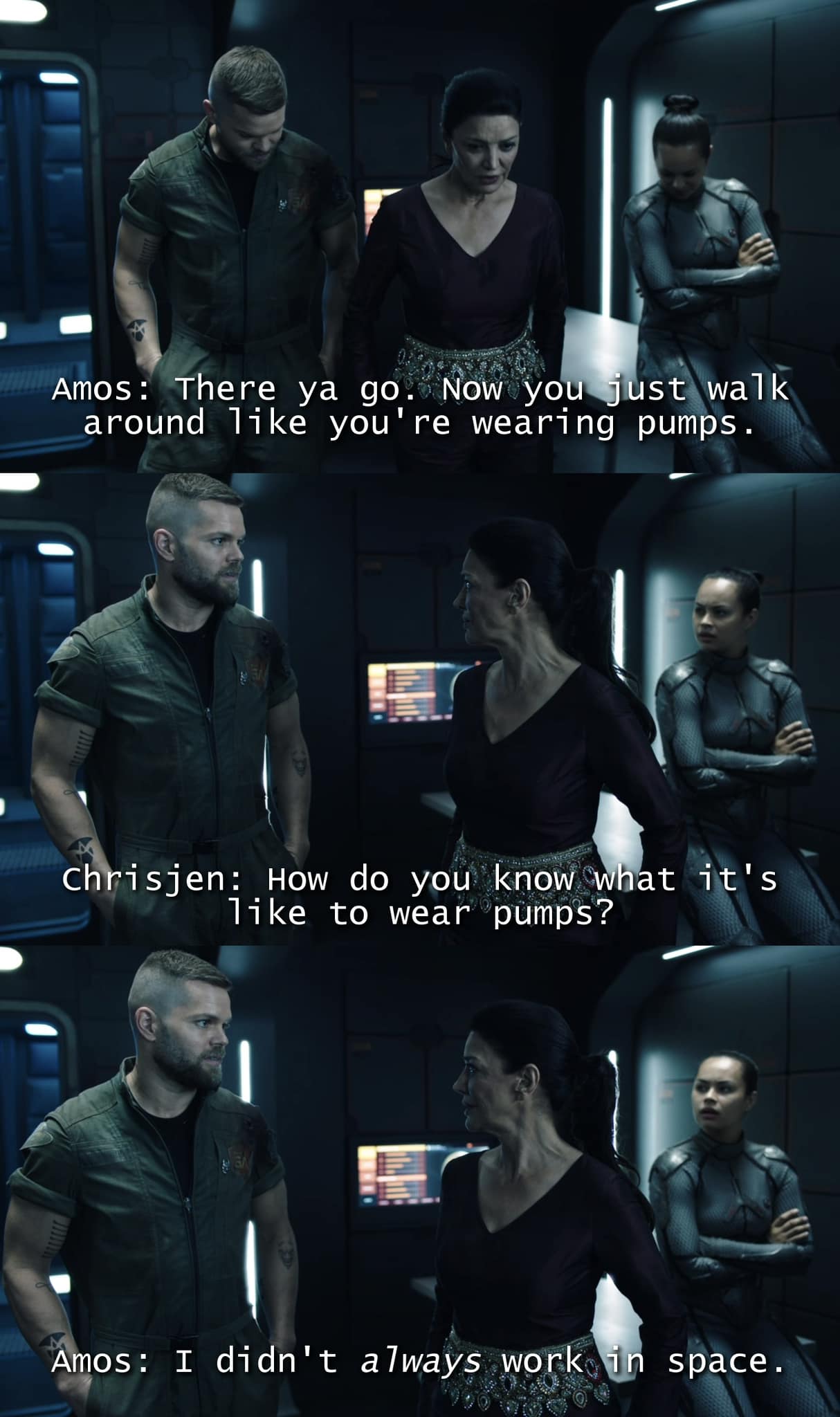
The image shows a character in a green jumpsuit standing in a futuristic space station, while another character (Chrisjen) stands nearby wearing formal shoes like pumps. Amos points out the absurdity of her outfit by telling her to walk like she is wearing pumps, while he himself is wearing the green jumpsuit. When Chrisjen asks what it's like to wear pumps in a space suit, Amos replies, "I didn't always work in space." This final line is a confusing line of dialogue that implies he is no longer an astronaut or is making a play on words about his past career, creating a humorous contradiction between his suit and his words.
This joke plays on the absurdity of a space station character wearing formal pumps while in a space suit, and the ambiguity of the final line suggests the character is either no longer an astronaut or is making a confusing play on words.
simple-description (llama3.2-vision_11b)
The meme is a screenshot from the TV show "The Expanse" where the character Amos Burton (played by Chris Wid ) is having a conversation with a female character named Chrisjen who is a high-ranking officer in the UN government. The conversation takes place in a space station where Amos is working as a mechanic. The text of the meme reads "Amos: I don't know what it means to wear a spacesuit but I know what it means to wear a gun."
detailed-analysis (gemma3-27b-vision)
Okay, let's break down this image from "The Expanse" through a series of analytical lenses, based on the prompts provided. Please note that some lenses will be more applicable than others given the short exchange.
Image Description
The image is a series of three vertical panels, seemingly screenshots from a science fiction television show (The Expanse). The setting appears to be inside a spaceship/station, characterized by metallic, dark, and industrial interiors. The lighting is dim and primarily focuses on the two characters involved in a dialogue.
The characters are Amos (masculine presenting, muscular build, short hair, dark clothing) and Chrisjen (feminine presenting, older, short, dark hair, professional attire). The panels show a progression of their interaction – Amos speaking first, then Chrisjen responding, and finally, Amos delivering the final line. Their body language indicates a casual but focused exchange. The background is indistinct, serving to isolate the characters and their conversation. The image has a serious and slightly ominous tone.
Foucauldian Genealogical Discourse Analysis
This exchange, though brief, offers a fertile ground for Foucauldian analysis. The conversation revolves around how Chrisjen walks ("like she's wearing pumps") and Amos’s past. This seemingly trivial observation taps into the discourse of femininity and societal expectations around movement and presentation. "Pumps" aren’t simply shoes; they are coded with associations of femininity, sophistication, and a specific way of being in the world.
- Power/Knowledge: Amos’s observation isn’t necessarily malicious, but it defines Chrisjen within a framework of gendered expectation. He's demonstrating a knowledge of how women should walk in certain shoes. It's a subtle assertion of power, suggesting he perceives a change in her behavior, a disruption of her usual presentation.
- Genealogy: Amos's revelation ("I didn’t always work in space") is crucial. This hints at a past life before the context of the spaceship, where societal norms, including those around dress and behavior, held different meaning. It is a genealogical uncovering of his before. The contrast between his past and present allows us to see how power structures (like those associated with gendered expectations of movement) have been shifted or disrupted in this new context. The spaceship becomes a space where those norms are less rigid, allowing a recognition of Chrisjen’s “pump-like” walk as something noticeable.
- Discipline/Panopticism: The spaceship’s environment, with its inherent surveillance and limited space, could be seen as a miniature panopticon. This encourages self-regulation. Even without explicit rules, individuals are aware of being observed, influencing their behavior.
Critical Theory
This short exchange offers a chance to apply critical theory, particularly in terms of how norms are constructed and reinforced.
- Ideology: The conversation implies an implicit ideological framework. The expectation that a woman would walk differently in pumps is not inherent; it's a culturally constructed expectation. Amos's observation unwittingly reveals how this expectation permeates even within the context of a spaceship setting.
- Subjectivity: Chrisjen’s reaction to Amos’s comment is essential. She asks how he knows what it’s like to wear pumps. This isn’t simply a literal question; it’s a challenge to his assumed authority. She's questioning the source of his knowledge and subtly asserting her own subjectivity, her own experience of the world. This highlights how knowledge is always situated and contingent.
- Deconstruction: This encounter reveals the constructedness of seemingly natural behaviors. The idea that “wearing pumps” dictates a certain way of walking is a social construct, not an inherent truth. This conversation deconstructs that assumption.
Queer Feminist Intersectional Analysis
This exchange, though not explicitly about queer or feminist issues, can be analyzed through an intersectional lens.
- Gender Performance: The emphasis on Chrisjen's walk and how it relates to "wearing pumps" is about gender performance. It touches on how femininity is constructed and manifested through bodily behavior. Amos is noticing a shift in her performance, even if subconsciously.
- Power Dynamics: The exchange subtly demonstrates power dynamics. Amos's observation can be seen as a way to subtly position himself as an observer and judge of Chrisjen's behavior. Chrisjen's response challenges that power.
- Intersectionality: Amos's comment about his past is crucial. It hints at a background where traditional gender roles were more rigid. This highlights how experiences of gender are shaped by broader social structures and individual histories. He is pointing out the shift in his environment and what that means for those around him.
In summary: This seemingly simple exchange contains layers of social meaning that can be unpacked through critical theoretical lenses. The conversation unveils implicit expectations around gender, power dynamics, and the constructedness of social norms. It’s a subtle illustration of how these issues operate even within the setting of a futuristic science fiction series.
tesseract-ocr
_ ) bd ws es | — a i i 7 ae =| Pc | ( NCCTMEN Ta oMR EE MCTH A Ciao enw around like you're wearing pumps. © ol a ——— b Lady J a IEF acer 2 aa sjen: How do Met eaten ie ro \ like to wear ‘pumps? i » — << a — | | , rd 4 ee a se ' ; ie SS i = | =. | ae Pa ¥ | Amos: I didn't veh lo
simple-description (llama3.2-vision)
This meme is a screenshot from the TV show Star Trek: Discovery, featuring a humorous exchange between characters. The image shows the character Aditya (played by Aditya Aditya) and his friend, who is wearing a ridiculous-looking outfit. The text reads: "In 2-3 sentences, describe this meme for someone who cannot see it. Aditya: 'I don't know what you're wearing.' Chris: 'It's a Star Trek: Discovery meme.' Aditya: 'I don't know what you're wearing.'"