First Seen
2025-06-18T21:37:19.243650+00:00
simple-description (qwen3.5_2b-q8_0)
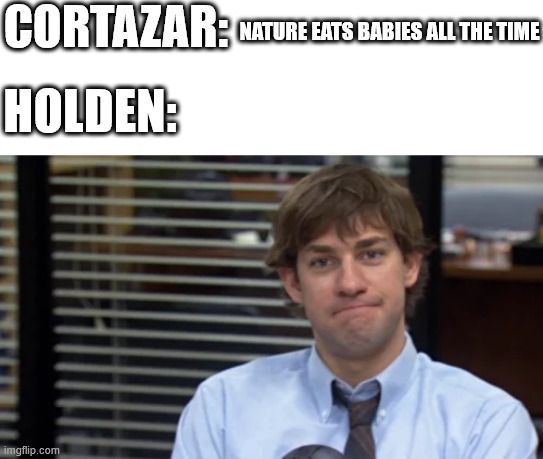
This meme is a humorous example of fandom confusion that plays a classic trope by attributing a line spoken in the movie Sicario to Dr. Holden Caulfield, a main character in the TV show The Expanse. Visually, it shows the actor John Krasinski looking slightly pouty or confused while holding what appears to be a microphone, with text overlaying the scene that reads "CORTAZAR: NATURE EATS BABIES ALL THE TIME" at the top and "HOLDEN:" just below it. The joke implies that Cortazar is making that statement while listening to Holden Caulfield, likely highlighting an absurd or widely known mix-up of movie quotes with characters in The Expanse lore.
detailed-analysis (gemma3_27b-it-q8_0)
Okay, let's break down this Expanse meme, applying the requested analytical lenses. It's a complex meme referencing key plot points in the series, and it gains much of its humor from insider knowledge.
Visual Description
The image features John Krasinski as Jim Halpert from The Office, looking skeptically and slightly awkwardly at the camera. His face conveys a mix of disbelief, amusement, and a subtle "I'm trying not to react" expression. The background is the familiar office setting, with vertical blinds and a muted color palette. The text above the image reads "Cortázar: Nature eats babies all the time" and "Holden:". The juxtaposition of the visual and textual elements is key to understanding the meme.
Critical Theory (Psychoanalytic)
The meme plays on a repressed trauma within The Expanse universe. The Protomolecule, a nanite alien technology, fundamentally alters life. One of its most disturbing manifestations (particularly in season 3) is the creation of the "baby ships" - horrific vessels built from the bodies of humans, including children, integrated into the structure of the Protomolecule's creations. Cortázar, a character from The Expanse, is directly impacted by this, witnessing the formation of these ships and the fate of those consumed within them.
From a psychoanalytic perspective, the line "Nature eats babies all the time" represents a brutal acknowledgement of the indifference of the universe to individual suffering. It's a rejection of any comforting narratives about inherent goodness or order. It’s a deeply unconscious acknowledgement, because the sheer scale and horror of the Protomolecule defies easy processing. Cortázar is confronting the "real" - the drive towards entropy and the relentless, amoral process of evolution. The image of Jim Halpert, stuck in a situation he can't believe is happening, is that repression – the attempt to cope with a reality that violates fundamental assumptions. He is the viewer being confronted with the horror in a way they can’t look away from.
Postmodernism
The meme works because of its fragmented, referential nature. The core of postmodernism is a rejection of grand narratives, and The Expanse is a prime example of a narrative challenging traditional sci-fi tropes. Here's how it manifests:
- Intertextuality: It merges elements from The Expanse (Cortázar, the baby ships) with a completely unrelated cultural product (The Office). This creates a meta-commentary on how we process trauma and horrific events.
- Irony & Satire: The deadpan delivery of the line, juxtaposed with the image of Jim Halpert's awkwardness, is fundamentally ironic. It's satirizing the absurdity of trying to rationalize the horrific.
- Deconstruction: The meme deconstructs the traditional sci-fi trope of "alien invasion." The Protomolecule isn’t motivated by malice, it's operating under different laws. The meme exposes that core disquiet.
- Simulacra: The meme represents a simulacrum of horror, a digital reproduction of the shock and despair experienced by characters like Cortázar. It’s horror distilled into a recognizable comedic format.
Marxist Conflict Theory
While not the central element, the Protomolecule’s impact does tie into class conflict. The Belt, largely composed of exploited laborers, is disproportionately affected by the Protomolecule’s transformations. The "baby ships" are created utilizing individuals from all strata of society, but the marginalized of the Belt are more exposed to its risks, and their suffering is often overlooked by the inner planets. Cortázar's experience, as a Belter, underscores this dynamic. His statement could be seen as a cynical reaction to a system that renders human life expendable in the pursuit of scientific advancement and corporate (or in this case, alien) goals. The meme subtly underscores the power imbalance inherent in the Expanse universe.
Foucauldian Genealogical Discourse Analysis
Foucault's work focuses on power, knowledge, and discourse. In The Expanse, the Protomolecule represents a rupture in existing discourses about life, death, and the boundaries of the human body. It challenges the established episteme (the underlying system of thought) of the 24th century.
- Power/Knowledge: The control of information about the Protomolecule is a crucial source of power. The corporations and governments attempt to contain and understand it, but the knowledge is inherently dangerous.
- Genealogy: The meme traces the “genealogy” of the horror – how the seemingly natural process of evolution, when mediated by alien technology, can lead to utterly unnatural and horrific outcomes. It's a tracing of the historical (or, in this case, fictional historical) conditions that gave rise to this monstrous reality.
- Discipline and Biopower: The Protomolecule’s reshaping of bodies and environments represents an extreme form of biopower – the power to control and manage life itself. The baby ships are the ultimate expression of this, as humans are reduced to mere components in a larger system.
In Conclusion
This meme is a clever and disturbing distillation of the core anxieties of The Expanse. It’s successful because it relies on a deep understanding of the show's lore and utilizes a recognizable comedic trope to confront a profoundly unsettling topic. It’s a testament to the power of the series to generate challenging and thought-provoking interpretations.
simple-description (llama3.2-vision_11b)
The meme is a humorous comparison between the fictional character of Cortazar, a human, and a fictional character from the Expanse series, Holden. The text "Cortazar: Nature eats babies all the time" is a sarcastic comment, implying that Cortazar's actions are not as effective as Holden's.
detailed-analysis (gemma3-27b-vision)
Okay, let's break down this meme using the requested critical lenses. It's... a lot. This meme is particularly rich in potential for layered analysis due to the juxtaposition of literary figures (Julio Cortázar and J.D. Salinger's Holden Caulfield) with a deeply unsettling and bizarre statement.
Visual Description
The image depicts actor Rainn Wilson (most famous for playing Dwight Schrute in The Office) in a relatively neutral office setting. He's wearing a button-down shirt and tie, and his expression is a mix of confusion, skepticism, and mild disdain. His brow is furrowed, and he's giving a side-eye look, conveying a sense of disbelief or judgment. The lighting is standard office lighting, and the background is a blurred office environment. Above him are the words “Cortázar: Nature Eats Babies All The Time” and "Holden".
Postmodernism
This meme is deeply postmodern in its nature. Several key elements contribute to this:
- Juxtaposition of Disparate Elements: The meme forces together a surreal statement ("Nature Eats Babies All The Time," which is inherently shocking) with figures representing distinct literary traditions – Cortázar, known for his experimental, surrealist fiction, and Holden Caulfield, the quintessential cynical adolescent from The Catcher in the Rye. This jarring combination is a hallmark of postmodern collage.
- Disruption of Meaning: The statement itself doesn’t have an obvious, rational meaning. It challenges conventional logic. The meme isn't trying to convey a straightforward message; it’s designed to disrupt our expectations and provoke a response.
- Meta-Commentary: The meme feels like a meta-commentary on literature and its potential for existential horror and absurdity. It's not just about the statement; it's about the act of making a statement, the power of language, and the inherent strangeness of existence.
- Irony/Parody: It's implicitly ironic. It takes the existential angst and alienation often present in the works of Cortázar and Holden and pushes it to a grotesque, shocking extreme. It's a parody of intellectualizing existential dread.
Foucauldian Genealogical Discourse Analysis
A Foucauldian analysis would focus on the power dynamics embedded in the statement and how the "truth" of "Nature Eats Babies All The Time" is constructed through discourse.
- Power/Knowledge: The statement, though shocking, could be seen as an attempt to claim a certain "truth" about the natural world – a ruthless, amoral force indifferent to human values. By presenting this as an absolute truth, the meme subtly asserts a certain power over those who encounter it.
- Genealogy of the Statement: We might trace the genealogy of this statement by examining historical and cultural discourses around nature, predation, mortality, and the vulnerability of infants. This could lead us to explore ideas about "survival of the fittest," the romanticization of nature as both beautiful and terrifying, and the cultural taboos surrounding infanticide.
- Discursive Formation: The meme represents a specific discursive formation – a way of speaking about nature, existence, and alienation. This formation positions the "speaker" (Cortázar) as someone who sees the brutal reality beneath the surface of social conventions. The Rainn Wilson image becomes a visual representation of incredulity to this claim.
- Normalization and Resistance: The meme asks us to consider the ways in which we normalize certain ideas about nature and the natural order. The sheer absurdity of the statement throws that normalization into question, inviting a form of resistance.
Critical Theory
From a general Critical Theory perspective (drawing on thinkers like Adorno and Horkheimer):
- Alienation: The meme taps into the broader theme of alienation in modern society. Both Cortázar and Holden are often associated with characters who feel alienated from societal norms, institutions, and even their own emotions. The shocking statement could be interpreted as a manifestation of that profound sense of disconnection and the realization of humanity's insignificance in the face of uncaring natural forces.
- The Loss of Meaning: The absurdity of the statement can be seen as a symptom of the loss of traditional values and meaning in a postmodern world. The statement seems designed to provoke discomfort, mirroring the feelings of disorientation and nihilism that are often associated with the breakdown of social and cultural structures.
- Critique of Enlightenment Rationality: The statement subverts rational thought. It is a claim that is not substantiated, therefore it invites a questioning of the way we understand things.
Marxist Conflict Theory
While not the most directly applicable lens, a Marxist interpretation could focus on the underlying power dynamics implied in the statement.
- Nature as a Force of Exploitation: One could argue that the statement positions “nature” as a relentless exploiter, mirroring the capitalist system's relentless pursuit of profit and its exploitation of both humans and the environment.
- The Vulnerability of the Proletariat: The "babies" could be interpreted as representing the most vulnerable members of society, those who are most easily exploited and disregarded. The statement, therefore, might be a metaphorical commentary on the conditions of oppression and the systemic disregard for human life.
Queer Feminist Intersectional Analysis
This lens is perhaps the most challenging to apply, but it could be done by focusing on the vulnerability of babies and the body.
- Reproductive Labor and Value: The meme can be interpreted as an unsettling reminder of the biological realities of reproduction and the vulnerability of the pregnant body. The statement emphasizes the precariousness of life, especially at its most nascent stages.
- The Social Construction of Innocence: Babies are often positioned as symbols of innocence and purity. The statement challenges that construction, presenting a brutally realistic view of the natural world that disregards sentimental notions of childhood.
- Power Dynamics and the Body: The statement is deeply unsettling because it violates our deeply held beliefs about the sanctity of life. The meme exposes the ways in which our cultural narratives about the body are often used to mask the inherent vulnerability and precarity of existence.
In Conclusion
This meme is remarkably dense with potential interpretations. It's a chaotic collision of high-brow literary references, shocking imagery, and existential dread. It’s a testament to how a seemingly simple internet image can provoke complex thought and invite diverse critical analyses. The most compelling reading depends on the lens through which you choose to interpret it.
simple-description (llama3.2-vision)
This meme is a humorous comparison between two characters, Cortez (or Cortez the Killer) and Holden Caulfield, from the classic novel "The Catcher in the Rye". The meme juxtaposes a quote from Cortez (who is known for eating humans) with a quote from Holden, implying that Holden's character would eat humans if he had the opportunity. The meme is likely intended to be humorous and ironic, playing on the contrast between the two characters' personalities.