First Seen
2024-01-12T20:30:50+00:00
simple-description (qwen3.5_2b-q8_0)
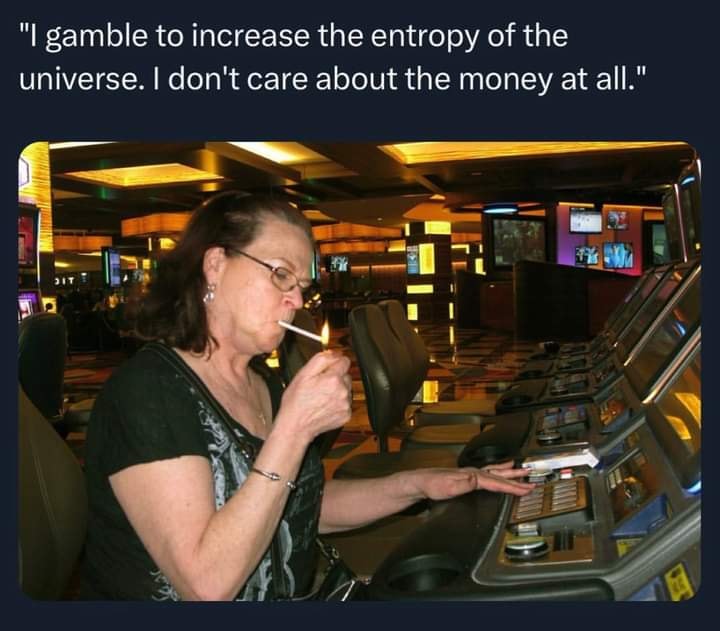
This meme depicts a woman smoking a cigarette at a slot machine, symbolizing the typical gambler. She quotes, "I gamble to increase the entropy of the universe," implying she is trying to create chaos. To the uninitiated, she appears to be playing for cash to earn money. However, in the context of Extropianism, the "gambler" is the one trying to increase the entropy (disorder) of the system, acting like a force trying to pull the system back from a perfectly orderly streak of wins.
simple-description (llama3.2-vision_11b)
This meme is a humorous take on the concept of Extropianism, a philosophy that emphasizes the pursuit of technological advancement and the optimization of human life. The image features a person at a casino, exemplifying the Extropian ideal of maximizing pleasure and minimizing pain, as expressed in the quote "I gamble to optimize my utility function."
detailed-analysis (gemma3-27b-vision)
Here's an analysis of the image, broken down into sections as requested, focusing on areas where the theoretical frameworks apply:
Visual Description
The image depicts a woman in what appears to be a casino, standing in front of a slot machine. She is middle-aged with her hair pulled back. She’s in the process of lighting a cigarette, and her facial expression is one of intense focus or determination. She wears a dark, olive-green top and has a bracelet on her wrist. The background is filled with more slot machines, a wash of flashing lights and a somewhat blurred and hazy atmosphere, typical of a casino environment. The lighting is artificial and contributes to a sense of manufactured excitement. The overall aesthetic is somewhat dated, suggesting the photo isn't recent. The caption accompanying the image is a quote: "I gamble to increase the entropy of the universe. I don't care about the money at all."
Foucauldian Genealogical Discourse Analysis
This image and caption are ripe for a Foucauldian analysis. The discourse around gambling has historically been constructed as a morality play – one of vice, excess, and potential ruin. However, the caption deliberately subverts this discourse. The woman does not acknowledge the conventionally accepted dangers, or motivations, associated with gambling. Instead, she frames her activity as an attempt to increase "entropy," a concept from physics relating to disorder and the tendency towards uniformity in the universe.
A genealogical approach would look at the historical shifts in how gambling has been understood. Originally, it may have been seen as linked to divine chance or demonic influence. Later, it became associated with economic productivity (lotteries funding public works) and, increasingly, with the psychology of addiction. The caption, in its invocation of entropy, represents a break from these earlier discourses. It suggests a nihilistic or absurdist reframing – gambling as an act of existential rebellion against order and meaning.
Furthermore, the power relations embedded in the casino environment become visible. Casinos are designed to be sites of control, using light, sound, and psychological techniques to encourage continuous play. The woman’s statement can be interpreted as an attempt to reclaim agency within this controlled space, to assert a motivation that transcends the casino's intended effects. She’s reframing the activity on her own terms.
Critical Theory
The image embodies aspects of critical theory, especially concerning the nature of rationalization and the "iron cage" described by Max Weber. Modern life, Weber argued, is increasingly dominated by instrumental rationality – a focus on efficiency and calculation that leads to a loss of meaning and freedom. The woman's statement could be seen as a darkly humorous response to this process.
She's rejecting the conventional rational justifications for gambling (winning money, seeking pleasure) and instead embracing an irrational one – increasing entropy. This suggests a rejection of the pursuit of meaning within a rationalized system. The casino itself is an exemplar of rationalization, a precisely engineered environment designed to maximize profit. The woman’s deliberate embrace of disorder can be viewed as a form of resistance, even if a somewhat absurdist one.
The image also points to the construction of “need” and “desire” in consumer culture. The casino functions as a site where artificial needs are created and exploited. By claiming she doesn't care about the money, the woman is potentially attempting to disrupt this cycle of manufactured desire.
Postmodernism
The image and caption are deeply resonant with postmodern sensibilities. The rejection of grand narratives and the embrace of irony and pastiche are evident. The woman’s statement is a rejection of conventional motivations and a deliberate embrace of the absurd.
The concept of entropy itself, taken from the realm of physics and applied to gambling, is a classic example of postmodern borrowing and mixing of disciplines. It’s a playful and deliberately incongruous juxtaposition.
Postmodernism often challenges the notion of a stable "self" or identity. The woman’s defiant statement could be interpreted as an attempt to construct a self-image that is independent of social expectations and economic pressures. She is performing a type of ironic self-presentation.
Critical Theory, Marxist Conflict Theory
While not a primary focus, a Marxist lens can illuminate aspects of this image. The casino represents a system of capital accumulation, where wealth is extracted from participants (the gamblers). The woman, despite her claim of indifference to money, is still participating in this system.
However, her statement can be seen as a form of symbolic resistance. By claiming her motivation is to increase entropy, she is rejecting the idea that her activity is purely driven by economic self-interest. This could be interpreted as a subtle critique of the alienating nature of capitalist exchange, where individuals are reduced to their economic roles.
The casino environment itself is a manifestation of class inequality, where wealth is concentrated in the hands of the owners and operators while gamblers risk their resources. The woman's statement doesn't directly address this inequality, but it does implicitly reject the dominant logic of economic rationalization.
Important Notes:
- These analyses are interpretations, and other readings are possible.
- The effectiveness of these analyses depends on the context in which the image is presented and the audience's prior knowledge.
- It's important to avoid overly rigid application of theoretical frameworks; the goal is to illuminate the image in a nuanced and insightful way.
tesseract-ocr
"| gamble to increase the entropy of the universe. | don't care about the money at all." a _= . P| ye ae | PS a ee BR aes Jen YS =f J »’ yt é £ a vs y \ an } 3 le vy a S/O
simple-description (llama3.2-vision)
This meme is a humorous image of a person sitting at a casino slot machine, taking a drag on a cigarette, and looking unimpressed. The text above the image reads: "I gamble to increase the entropy of the universe. I don't care about the money at all." The meme is likely poking fun at the idea that some people gamble not for financial gain, but for the thrill of it, and to potentially disrupt the order of the universe.