First Seen
2023-05-10T21:03:35+00:00
simple-description (llama3.2-vision_11b)
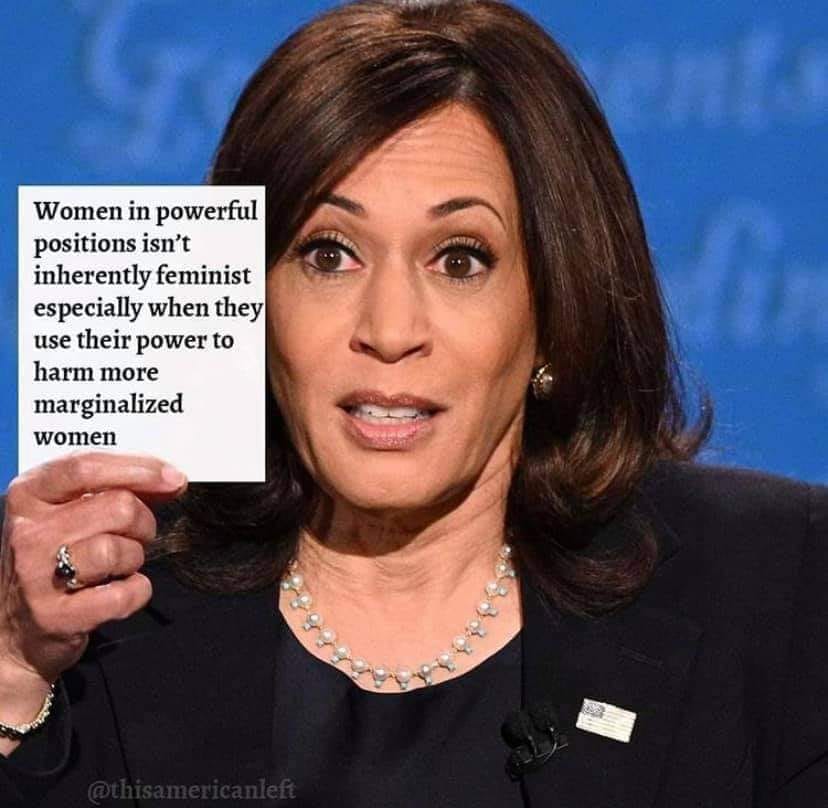
This meme uses a photo of a woman, likely a politician or public figure, holding up a card with a statement that challenges the idea of feminism as a movement that advocates for the empowerment of women. The text on the card reads, "Women in powerful positions aren't inherently feminist, especially when they use their power to harm marginalized women." The meme is likely meant to be humorous and satirical, poking fun at the idea that women in power are always feminist, and that they can use their power to harm others.
detailed-analysis (gemma3-27b-vision)
Okay, here's an analysis of the image, broken down into relevant theoretical frameworks. Note that not all of the headings apply equally strongly, and I'll explain my reasoning for inclusion/exclusion.
Image Description
The image is a cropped headshot of Kamala Harris, the Vice President of the United States, looking slightly upward with a look of mild surprise or concern. She is wearing a black blazer and a pearl necklace, with a ring visible on her left hand. Overlaid on the image, in a white rectangular text box, is the text: “Women in powerful positions isn't inherently feminist especially when they use their power to harm marginalized women.” At the bottom, in small text, is the username "@thisamericanleft" which indicates the source of the image and potential perspective.
Critical Theory
The image directly engages with the critical theoretical concern for power dynamics. The statement challenges a naive assumption that the mere presence of women in positions of power automatically equates to feminist progress. It argues that power, regardless of who wields it, can be used to perpetuate harm, and that this is particularly significant when women in power are implicated in harming other, more marginalized women. This aligns with a critical theory critique of universal claims about emancipation. The statement isn't saying women in power are never feminist, but rather that their power must be critically examined, and their actions assessed in terms of actual impact on all women, not simply symbolic representation.
The image challenges the idea that gender identity (being a woman) inherently guarantees a commitment to dismantling oppressive structures. It asks us to move beyond surface-level representation and delve into the practice of power. It implicitly critiques the idea that the "sisterhood" is inherently unifying, instead suggesting that hierarchies within gender categories can recreate patterns of domination.
Queer Feminist Intersectional Analysis
This theoretical lens is crucial for understanding the image's strongest message. The phrase "marginalized women" is central. The statement acknowledges that women are not a homogenous group, and that some women experience multiple and intersecting oppressions based on factors like race, class, sexuality, disability, immigration status, etc. It suggests that women in powerful positions might be complicit in systems that harm those who are most vulnerable.
This aligns with intersectionality by implying that power dynamics aren't just about gender, but are built on complex layers of social stratification. A queer feminist reading would further emphasize that traditional feminist frameworks may overlook the specific experiences of queer and trans women, and that a truly liberatory politics must center the needs of the most marginalized. The image invites us to ask who is being harmed and how, and to consider the ways in which power operates to reinforce existing inequalities.
Marxist Conflict Theory
While not the primary focus, Marxist Conflict Theory is relevant. The statement implies a struggle for power within society and within the category of "women." The image subtly suggests that women in powerful positions might be acting to protect their own interests or the interests of the dominant class, rather than working towards genuine liberation for all. The statement suggests that women in power, even if identifying as feminist, may function to maintain capitalist structures or other forms of inequality, perpetuating conflict between different groups of women.
Foucauldian Genealogical Discourse Analysis
A Foucauldian approach would examine how the very discourse surrounding women in power constructs certain expectations and silences others. The image itself is an act of disrupting a dominant narrative that might assume women in power are automatically progressive.
A genealogy would trace the historical construction of ideas about "feminism" and "power". It might ask how these terms have been used to legitimize certain forms of domination and to obscure others. The statement challenges the notion of a unified "feminist" project, implying that there are multiple, often conflicting, ways of understanding and enacting feminism. It acknowledges that power operates through discourse, shaping our understanding of who counts as "feminist" and what "feminist" action looks like.
Postmodernism
While elements of postmodernism are present, its application is less direct here. The image subtly undermines the idea of grand narratives or universal truths about feminism. It suggests that the meaning of "feminism" is contingent, context-dependent, and subject to interpretation. However, the image isn’t radically deconstructing concepts so much as it’s applying a critical lens to power dynamics within a specific context. The message isn’t about the impossibility of knowledge, but about the necessity of critical inquiry.
Let me know if you'd like me to expand on any of these analyses!
simple-description (llama3.2-vision)
This meme features a photo of a person looking shocked or surprised. In the caption, a quote is presented in a humorous and ironic way, stating "Women in powerful positions are not inherently feminist" and then quickly corrected to "Women in powerful positions are not inherently feminist, especially when they use their power to harm marginalized women."
tesseract-ocr
Ve" — —. a x Women in powerful rN positions isn’t = 7S \ . nts & inherently feminist “ especially when they use their power to rH if harm more ans marginalized os women _— ( i ae a | ’ 4 e