First Seen
2023-05-10T21:03:35+00:00
simple-description (llama3.2-vision_11b)
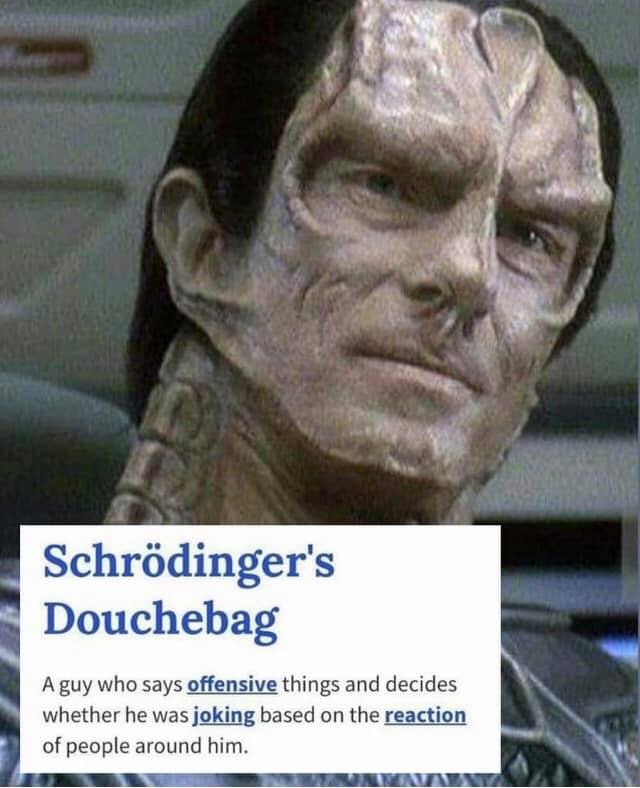
The meme is a photo of a character from the Star Trek: The Next Generation series, with a caption that reads "Schrödinger's Douchebag". This meme is a play on the concept of Schrödinger's cat, where a cat is both alive and dead at the same time, but in this case, the "douchebag" is a person who is both offensive and a "douche" (a derogatory term for someone who is annoying or obnoxious).
detailed-analysis (gemma3-27b-vision)
Okay, let's break down this image and its associated definition ("Schrödinger's Douchebag") through the lenses of various theoretical frameworks.
Please Note: These frameworks are complex, and applying them requires interpretation. This response aims to give a reasoned and informed interpretation within the scope of the image/definition provided.
1. Visual Description
The image presents a close-up, dramatic portrait of a character from Star Trek: Deep Space Nine—Gul Dukat. Dukat is portrayed with heavy, angular makeup that accentuates his stern features. His face is partially in shadow, and his expression is a complex mix of arrogance, calculation, and potentially malice. The lighting is stark, emphasizing the contours of his face. The overall effect is that of a menacing, morally ambiguous character. The image quality is a still from an older television show, lending it a certain visual texture.
2. Foucauldian Genealogical Discourse Analysis
Foucault’s genealogy focuses on the history of power/knowledge relationships, and how discourses (ways of speaking and thinking) construct realities. The very term "Schrödinger's Douchebag" exemplifies this.
- Discourse Construction: The phrase creates a discourse around an individual's behavior. It frames certain actions (saying potentially offensive things) not as inherently malicious, but as contingent upon the reaction of others. This shifts the responsibility away from the speaker and onto the audience. The term itself is a playful paradox, merging high-level physics (Schrödinger’s cat) with a derogatory slang term.
- Power/Knowledge: This discourse subtly reinforces power dynamics. By making the speaker's intent dependent on audience response, it implicitly grants power to the audience to validate or invalidate the speaker's “joke.” The speaker can deflect responsibility if the audience finds it humorous, and claim it was "just a joke".
- Genealogy: A genealogical tracing of this concept could reveal how modern humor often relies on pushing boundaries and gauging reactions. It also points toward the historical construction of what is considered “offensive” and the way humor is used as a mechanism for testing limits.
3. Critical Theory
Critical Theory, particularly associated with the Frankfurt School, aims to critique and change society. This image and definition offer several points for critique.
- Ideology: The concept of "Schrödinger's Douchebag" can be seen as a manifestation of a specific ideology. It exemplifies a trend where individuals can deploy potentially harmful rhetoric, then claim innocence by appealing to the subjectivity of perception ("it depends on how you take it"). This can be a way to normalize harmful language and absolve oneself of responsibility.
- Commodification of Offense: In contemporary culture, offense is often commodified and used for attention. The "Schrödinger's Douchebag" figure thrives in this environment, exploiting the ambiguity of intent and audience reaction for personal gain.
- Erosion of Empathy: The concept, if embraced, may contribute to the erosion of empathy and accountability. If offense is merely subjective, it undermines the significance of harm caused by language and behavior.
4. Marxist Conflict Theory
While less direct, we can consider this through the lens of class and power dynamics.
- Power Structures: The "Schrödinger's Douchebag" figure can be seen as leveraging their social power (whether class, status, or influence) to test boundaries and exert control. They are confident that their position allows them to navigate social consequences, or to deflect responsibility if necessary.
- Ideological Hegemony: The normalization of this behavior could be seen as contributing to ideological hegemony – a dominant worldview that serves the interests of the ruling class. It reinforces a culture where individuals can behave with impunity, as long as they can manipulate social perceptions.
- Class Performance: The figure may perform this ambiguity as a means of displaying their perceived power – testing limits to see what they can “get away with” and projecting a sense of dominance.
5. Postmodernism
Postmodernism emphasizes subjectivity, deconstruction, and the rejection of grand narratives.
- Deconstruction of Intent: The phrase fundamentally deconstructs the notion of authorial intent. The "joke" doesn’t have a fixed meaning; its meaning is contingent on the observer’s reaction.
- Rejection of Objective Truth: It rejects the idea that offense is objectively determined. What is “offensive” is not inherent in the act, but a socially constructed response.
- Hyperreality & Simulation: The act of gauging the audience's response could be seen as a simulation – the speaker is performing a role, testing the limits of acceptability in a hyperreal environment where meaning is fluid and constructed.
- Irony and Meta-commentary: The use of a scientific term (“Schrödinger”) in conjunction with slang creates a layer of irony and self-awareness – a meta-commentary on the absurdity of contemporary social interactions.
6. Queer Feminist Intersectional Analysis
This offers a powerful lens, particularly concerning harm and vulnerability.
- Harm & Vulnerability: The concept disproportionately affects marginalized groups. Individuals with intersecting marginalized identities are often less able to dictate or control the interpretations of their experiences. They may be less able to call out offense without being labeled as "oversensitive" or "difficult."
- Responsibility & Accountability: Shifting responsibility onto the audience undermines the crucial need for perpetrators of harm to be accountable for their actions. It reinforces the dangerous idea that harm is only valid if it’s received as such by the “right” people.
- Silencing & Gaslighting: The "Schrödinger's Douchebag" tactic can be a form of gaslighting – manipulating the audience into questioning their own perceptions of harm. This is particularly dangerous in contexts where marginalized groups are already subjected to systemic silencing.
- Intersectionality: A queer feminist lens highlights how offense intersects with multiple forms of oppression (race, gender, sexuality, class, etc.). The impact of a "joke" can be amplified for individuals with intersecting marginalized identities.
I hope this detailed breakdown, across several theoretical frameworks, is helpful. Let me know if you'd like me to elaborate on any of these points!
simple-description (llama3.2-vision)
The meme is a photo of a character from the TV show Star Trek: The Next Generation, specifically the alien species known as the Klingon, with a sarcastic expression. The text overlayed on the image reads "I'm not arguing, I'm just explaining why I'm right."
tesseract-ocr
r » i oa p . on 4 ‘ dd ] Py _ q A eee ; ¥ oo oo ge ' | Schrodinger's Douchebag y a m guy who says offensive things and decides m= whether he was joking based on the reaction ™ of people around him. ns WW Zz ew - ry ‘