First Seen
2023-06-11T21:01:40+00:00
simple-description (qwen3.5_2b-q8_0)
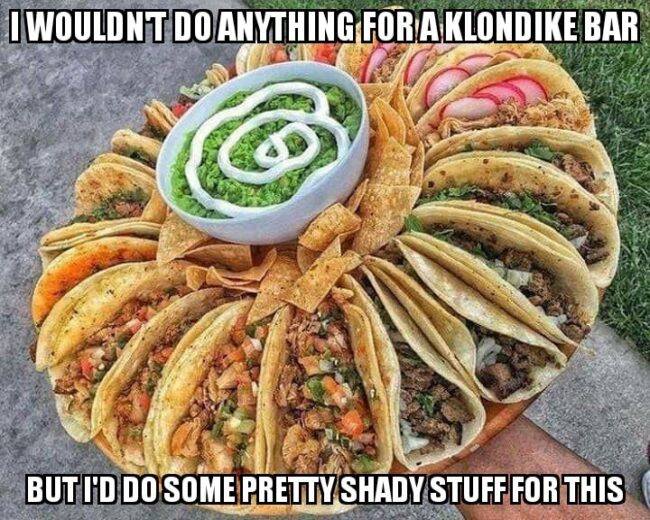
The image displays an enormous plate piled high with soft-shell tacos, featuring various fillings and a central bowl of guacamole. The caption reads, "I WOULDN'T DO ANYTHING FOR A KLONDIKE BAR BUT I'D DO SOME PRETTY SHADY STUFF FOR THIS," indicating that the person is eating the tacos because their friend has the entire bar.
simple-description (llama3.2-vision_11b)
The meme is a humorous image of a plate of tacos with a caption that says "I don't like broccoli, but I'd eat it if it was a taco." The meme is a play on the idea that people will often eat foods they don't like if they're presented in a way that's more appealing, like a taco.
detailed-analysis (gemma3-27b-vision)
Okay, here's an analysis of the image, broken down into the requested sections. Not all sections will apply strongly or at all, and I'll note that where appropriate.
Visual Description
The image is a digitally-created meme featuring a very large pile of tacos, arranged to create a somewhat circular shape. The tacos appear to be filled with some type of meat (likely carnitas or al pastor) and topped with various garnishes. Around the tacos are scattered chips and a small bowl of green sauce, possibly guacamole or a salsa. The overall presentation is abundant and somewhat exaggerated, suggesting an excess of food. A green banner at the top and a red banner at the bottom contain text. The text reads “I WOULDN’T DO ANYTHING FOR A KLONDIKE BAR” on top, and "BUT I'D DO SOME PRETTY SHADY STUFF FOR THIS" at the bottom. The background is grass.
Foucauldian Genealogical Discourse Analysis
This meme can be examined through a Foucauldian lens, looking at the discourses surrounding desire, value, and excess.
- Discursive Formation: The meme engages with the established discourse around “treats” and what people are willing to do for them. The reference to the Klondike Bar ad (“What would you do for a Klondike Bar?”) establishes a pre-existing power dynamic relating to consumer desire.
- Power/Knowledge: The image creates a new power dynamic. It inverts the conventional discourse surrounding value. The tacos are presented as more desirable than the Klondike Bar, implying a shift in cultural preferences and a rejection of the "simple pleasure" promoted by the original ad. The "shady stuff" referenced is a demonstration of how desire can be used to justify bending or breaking norms.
- Genealogy: The "shady stuff" alludes to a history of bartering, coercion, and the social arrangements surrounding obtaining desires. It’s a playful acknowledgement that desires have always involved some degree of compromise or risk. The meme draws on the shared understanding of this history.
Critical Theory
From a Critical Theory perspective, the meme highlights the constructed nature of desire and the manipulation of needs within consumer culture.
- Commodification: The tacos, as a desirable object, become a commodity. The meme implies that one might be willing to engage in unethical or questionable behavior in order to acquire this commodity.
- False Needs: The meme subtly questions the very notion of “need.” Is an overwhelming quantity of tacos a genuine need, or a manufactured desire created by marketing and cultural norms?
- Ideology: The meme challenges the accepted ideology that ethical behavior is paramount. By admitting willingness to do “shady stuff”, the meme questions the stability of moral norms.
Marxist Conflict Theory
A Marxist interpretation would focus on the class-based implications and the commodification of food.
- Commodification of Labor: The tacos represent not just food, but the labor of others – farmers, cooks, servers, etc. The meme's willingness to do "shady stuff" to obtain this commodified product arguably ignores the exploitative structures embedded within the food system.
- Class Desire: The abundant display of tacos could be seen as a symbolic representation of excess and privilege, highlighting the disparity between those who can afford plentiful food and those who struggle with food insecurity.
- Capitalist Exploitation: The “shady stuff” could be interpreted as representing the lengths individuals are willing to go to within a capitalist system to acquire desired goods, even if it means compromising their ethics.
Postmodernism
The meme embraces many characteristics of postmodern thought.
- Hyperreality: The sheer excess and unrealistic pile of tacos create a hyperreal representation of food. It's an exaggeration of reality that becomes its own self-referential spectacle.
- Irony and Parody: The meme is inherently ironic and parodic. It subverts the original Klondike Bar ad, playing with the conventions of advertising and desire.
- Deconstruction: The meme deconstructs the idea that there is a clear moral boundary between “acceptable” and “unacceptable” behavior in the pursuit of desire. It suggests that those boundaries are fluid and context-dependent.
- Playfulness: The meme’s overall tone is playful and irreverent, characteristic of postmodern art.
Queer Feminist Intersectional Analysis
This section is less directly applicable, but it's possible to see some connections.
- Deconstructing Normative Desires: The meme’s willingness to pursue a desire without regard for social norms can be seen as challenging restrictive definitions of desire and pleasure.
- Foodways and Power: Food is often tied to gender roles, cultural identity, and power dynamics. The excessive display of tacos can be seen as a rejection of restrictive food norms (e.g., diets, calorie counting), or as a celebration of indulgence and liberation.
- Intersection of Desire and Ethics: The meme can be read as questioning the intersection of desire, ethics, and social expectations, particularly within marginalized communities. The "shady stuff" could represent the compromises that individuals from marginalized groups are often forced to make to survive or achieve their desires.
I hope this detailed breakdown is helpful. Let me know if you'd like me to expand on any particular section.
simple-description (llama3.2-vision)
This meme features a photo of a plate of tacos with a bowl of guacamole and a note of self-deprecation. The text reads: "I would do anything for a Klondike bar, but I wouldn't do anything for a taco." The image is humorous because it's a tongue-in-cheek admission that the speaker's priorities are skewed, and they'd rather have a simple dessert than a delicious meal.
tesseract-ocr
ICE OOLT AG TON tay sie oe et (ff ome BS Eh Ga oo . OV = ie oe 5244 = hy ‘i AGG) we = re. re = OS hh ey, Pp MNS CaM get ‘ Se Ae Bey! Mo cS Pa , — eee Sx Ls JZ pa / ia 4 YY i e.. oy 2Y St ee Se Fw MOEN bat We Ut Se Ee ae | SEU TTS TT a TAS OUST UT UTES