First Seen
2023-11-16T22:02:53+00:00
simple-description (qwen3.5_2b-q8_0)
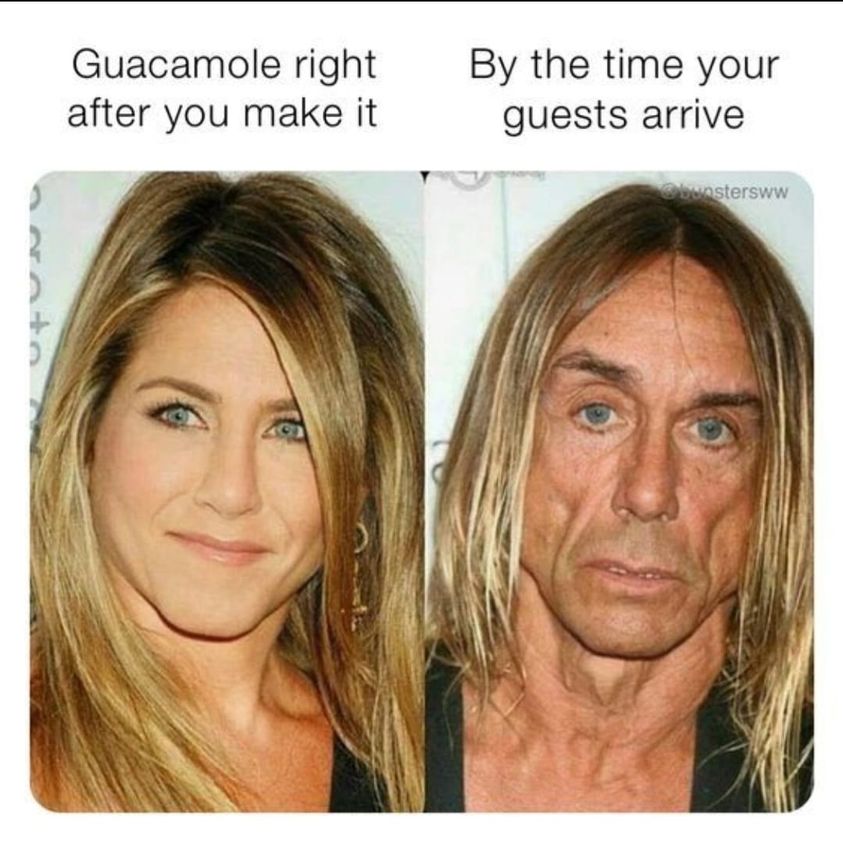
This humor plays on the difference between fresh food and stale food. The first image displays "Guacamole right after you make it," implying it is still hot and delicious. The second image displays "By the time your guests arrive," showing the same dish looking old and rotting. It mocks the idiom "fresh off the grill" in this culinary context.
simple-description (llama3.2-vision_11b)
This meme is a humorous comparison between two images of Jennifer Aniston, one with a natural, effortless look and the other with a more dramatic, exaggerated appearance. The text "Guac to the future" is written above the image, implying that the transformation is like adding guacamole to a dish, making it better and more enjoyable.
detailed-analysis (gemma3-27b-vision)
Okay, here's an analysis of the meme, broken down into sections as you requested, only including sections where the meme genuinely lends itself to the theoretical framework.
Visual Description
The meme is a side-by-side comparison of two portraits. On the left is Jennifer Aniston, looking fresh-faced and well-rested. The text above the image states, "Guacamole right after you make it." On the right is a heavily edited image of Iggy Pop looking aged, haggard, and weary. The text above this image reads, "By the time your guests arrive."
The visual contrast is stark and relies on hyperbole and humor. The meme suggests the act of making guacamole and the subsequent wait for guests to arrive is exhausting and transforming – changing a person from a celebrity-level appearance to something drastically different. The use of the two celebrities is also significant – Aniston represents a cultural ideal of contemporary beauty, while Iggy Pop has a reputation for a rebellious and alternative aesthetic, often associated with a lived-in, worn look.
Foucauldian Genealogical Discourse Analysis
This meme can be analyzed through a Foucauldian lens by examining how it reflects discourses surrounding domestic labor, hospitality, and self-presentation.
- Discourses of Hospitality: The meme taps into the unspoken rules and expectations surrounding hosting. The act of providing (in this case, guacamole) implies a certain level of effort and self-sacrifice on the part of the host. It reveals the 'power/knowledge' relationship at play - the host is expected to put in effort, even to the point of perceived exhaustion.
- The "Good Host" Subject: The meme implicitly defines what it means to be a "good" host – someone who puts in significant effort, to the extent of personal depletion. The contrast between the two images highlights the expectation that the host must perform hospitality, masking their own fatigue.
- Genealogy of Domestic Effort: Historically, women have been largely responsible for domestic labor and hospitality. While the meme doesn’t explicitly state gender, it subtly taps into this historical expectation, suggesting that the exhaustion is tied to the labor of preparing for guests. It's a humorous acknowledgment of this often invisible work.
- Power Dynamics: The meme suggests that hosting guests is a power dynamic—the host performs labor for the enjoyment of others. The exhausted image speaks to the exertion required for this performance.
Postmodernism
The meme embraces postmodern characteristics through its reliance on juxtaposition, irony, and self-awareness.
- Hyperreality and Simulation: The contrast between Aniston and Iggy Pop isn’t real – it’s a digitally manipulated image. This leans into the postmodern idea of hyperreality, where simulations become more real than reality itself. The meme uses exaggerated imagery to communicate a feeling—the exhaustion of hosting—rather than depicting an actual physical transformation.
- Irony and Parody: The meme is deeply ironic. It uses celebrity images to highlight a mundane experience. The exaggeration is a form of parody, poking fun at the pressure to be the perfect host.
- Deconstruction of Social Norms: The meme subtly deconstructs the social norm of appearing effortlessly hospitable. It reveals the work and exhaustion behind the façade of hosting.
- Fragmentation & Juxtaposition: The side-by-side comparison, contrasting two utterly different aesthetic and celebrity images, reflects the fragmentation and lack of unifying narratives characteristic of postmodern thought.
Critical Theory
The meme can be understood through the lens of Critical Theory, specifically concerning alienation and the performance of self.
- Alienation from Labor: The exhausted Iggy Pop image suggests a kind of alienation from the labor of hosting. The host is reduced to a state of depletion, their energy and well-being sacrificed for the benefit of others. It subtly criticizes the expectation that individuals should consistently prioritize the comfort of guests at their own expense.
- Performance of Self: The "fresh" Aniston image and the subsequent transformation suggest the host is performing a role—the ideal, cheerful host. The Iggy Pop image reveals the "true" cost of that performance—exhaustion and a loss of self. It hints at the pressures to maintain a certain image, even in private settings.
- Critique of Social Expectations: The meme implicitly critiques the social expectations around hospitality. It suggests that these expectations are often unreasonable and contribute to individual burnout.
Note: Some frameworks, like Marxist Conflict Theory or Queer Feminist Intersectional Analysis, don’t readily apply to this meme in a meaningful way. While you could stretch interpretations to fit, it would feel forced. The meme primarily speaks to cultural expectations around hosting, self-presentation, and the labor involved.
Let me know if you’d like me to elaborate on any of these sections or explore a different angle!
simple-description (llama3.2-vision)
This meme is a humorous comparison between two images of Jennifer Aniston, one where she's looking fresh and made-up, and another where she's looking tired and worn out. The text above the first image reads "Guacamole right after you make it" and the text above the second image reads "Guacamole right before your guests arrive". The meme is poking fun at the idea that a freshly made guacamole is always a great idea, but the reality is that it's often a mess by the time guests arrive.
tesseract-ocr
Guacamole right By the time your after you make it guests arrive j A Ss ‘4 astersww , yi ot J Ve ft f E> am faa ft" mM de i) 4% \ i i} , 4 ! / | \ . > wd 14 “lh Wa Ht i 4 Saal ny th Fi AK Ys f Va Bae .\ Ni a A ) LS NS ER ‘ - Ze r/| PIM. \ i