First Seen
2023-12-10T22:22:28+00:00
simple-description (qwen3.5_2b-q8_0)
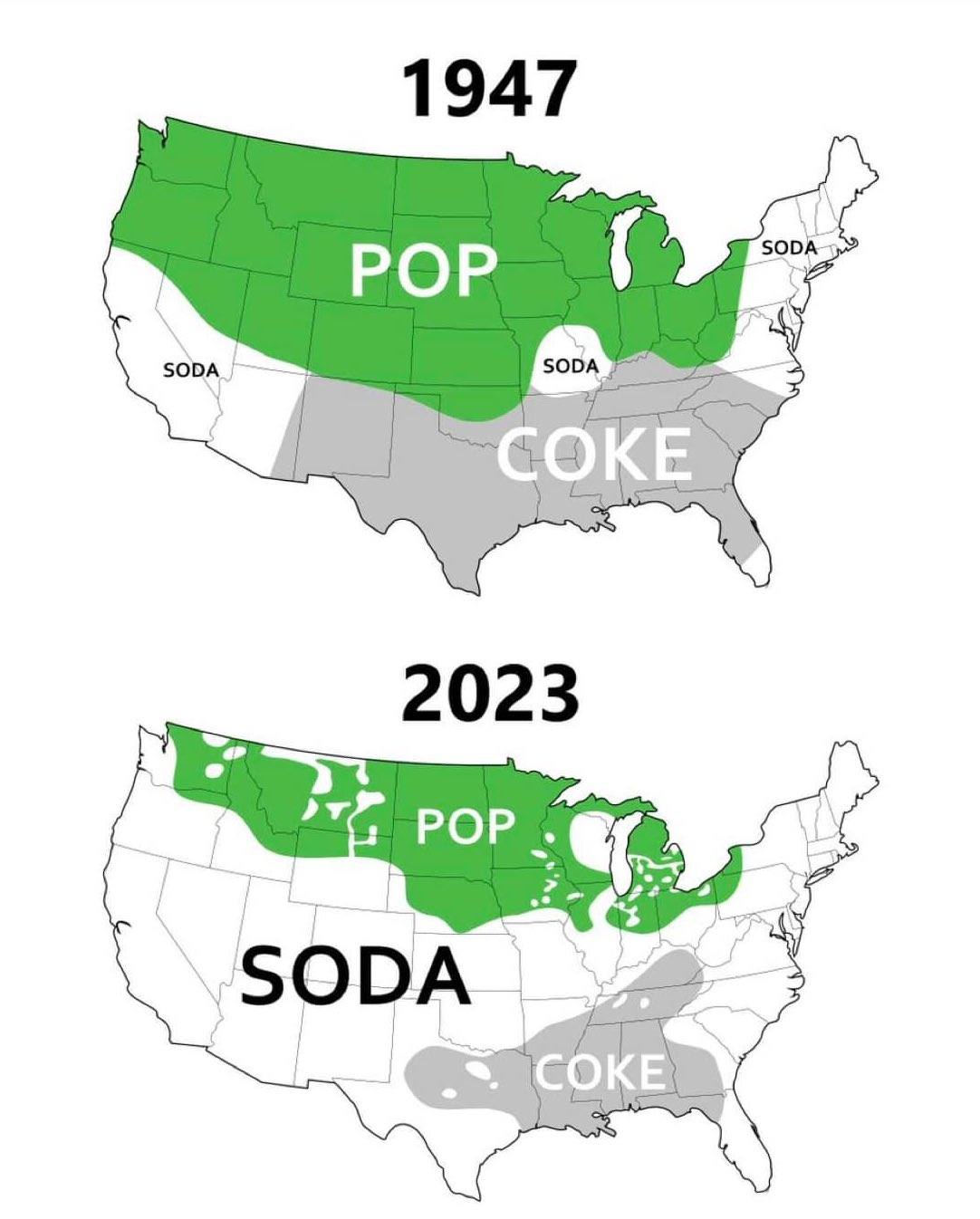
This infographic contrasts 1947 and 2023 to illustrate the evolution of the Coca-Cola brand name in the United States.
In 1947, the map labeled the green area "POP" and the grey area "COKE," representing a time when the brand was widely known simply as "Pop Coke."
By 2023, the map shows "SODA" in large letters in the center, "COKE" in white letters in the south, and "POP" in green letters in the north, humorously suggesting that the brand name has been replaced by the generic term "Soda."
simple-description (llama3.2-vision_11b)
The meme is a side-by-side comparison of a map of the United States in 1947 and 2023, with areas where a specific food is popular. The map in 1947 shows that the East Coast, Midwest, and parts of the West Coast have a high preference for soda, while the South and parts of the West Coast have a high preference for cola. In 2023, the map shows a shift towards a more uniform preference for soda across the country, with the South and parts of the West Coast still preferring cola.
detailed-analysis (gemma3-27b-vision)
Okay, here's an analysis of the provided map comparing regional preferences for "Pop", "Coke", and "Soda" across the United States in 1947 and 2023, broken down into sections as requested. I'll only include sections where the theory truly applies, and will indicate the level of applicability within each.
Visual Description
The image presents two maps of the contiguous United States, labeled "1947" and "2023". Each map is divided into states, with each state colored to represent the dominant regional term used for carbonated soft drinks. The three terms used are:
- Pop: Represented by a green color.
- Soda: Represented by a gray color.
- Coke: Represented by a brown color.
In 1947:
- "Pop" dominates the Midwest and parts of the Pacific Northwest.
- "Soda" is prevalent in the Northeast and parts of California and Florida.
- "Coke" is dominant across the Deep South, notably including Georgia, Alabama, and Mississippi.
In 2023:
- "Pop" has considerably diminished, largely contained to small areas of the Pacific Northwest and a pocket in the upper Midwest.
- “Soda” has expanded significantly, covering most of the country, including the entirety of the Northeast, California, and Florida.
- "Coke" remains dominant in the same regions of the Deep South, but is visibly reduced in area.
The stark contrast between the two maps reveals a substantial shift in linguistic preference over the decades.
Foucauldian Genealogical Discourse Analysis (High Applicability)
This map is very amenable to a Foucauldian analysis. Michel Foucault's work focuses on the ways power operates through discourse – systems of thought, language, and practice that shape our understanding of the world. Here's how it applies:
- Power/Knowledge: The labels ("Pop," "Soda," "Coke") aren't simply neutral terms for a beverage. They constitute and are constituted by a network of power relations. The dominance of "Coke" in the South, for example, represents not just a linguistic preference, but the power of the Coca-Cola company's branding, marketing, and cultural influence in that region. The decline of “Pop” and increase of “Soda” are similarly linked to wider cultural and corporate powers.
- Genealogy: Foucault's method of genealogy traces the historical development of these terms and their associated meanings. The map presents a snapshot of this development. We can ask: What historical forces led to the decline of “Pop”? What facilitated the expansion of "Soda”? This isn’t about a linear progression but a complex web of factors—migration patterns, media influence, corporate strategies, etc.
- Discursive Formations: These terms create particular ways of thinking about the beverage and, by extension, about regional identities. Calling it "Coke" can be a marker of Southern identity, while "Soda" may be associated with more urban, nationalized culture. The map demonstrates how these terms produce these identities through their circulation.
- The Panopticon of Language: We can see how, like Foucault’s idea of the panopticon, language itself exercises a form of discipline. The shift from regional terms to a more standardized “Soda” suggests a homogenization of language and culture, potentially linked to broader forces of globalization and standardization.
Critical Theory (Medium Applicability)
The map lends itself to a Critical Theory analysis, particularly through the lens of the Frankfurt School.
- Culture Industry: The map can be viewed as a reflection of the "culture industry" at work. The decline of regional terms ("Pop") and the rise of a more standardized term ("Soda") mirror the homogenization of culture promoted by mass media and corporate control.
- Commodification: The term "Coke" itself is a prime example of commodification. Coca-Cola successfully branded its product to the point where the name became synonymous with the category of carbonated beverage in certain regions. This illustrates how capitalism turns even everyday language into a vehicle for profit.
- Ideology: The map reveals how ideology functions. The widespread adoption of "Soda" can be seen as a reflection of a consumerist ideology that emphasizes standardization and national brands. The regional persistence of “Coke” is indicative of a strong regional identity.
- False Consciousness: While less direct, one might argue the shift towards “Soda” represents a type of “false consciousness”, where people adopt language (and potentially values) aligned with dominant corporate or cultural forces, potentially at the expense of regional or local identities.
Marxist Conflict Theory (Low Applicability)
While a Marxist analysis isn't central here, it can offer a supplementary perspective.
- Capitalism and Branding: The dominance of "Coke" in the South is directly linked to the success of the Coca-Cola company as a capitalist enterprise. Coca-Cola's marketing strategies were immensely successful in establishing its brand identity and capturing market share.
- Cultural Hegemony: The spread of "Soda" could be interpreted as a manifestation of capitalist cultural hegemony – the dominance of one social group’s ideas and values over others.
- Class and Consumption: The map could be explored (though more research would be needed) in terms of class dynamics. Were regional terms more common in working-class communities, while "Soda" gained traction among the middle and upper classes?
Postmodernism (Medium Applicability)
A postmodern reading emphasizes the fluidity, fragmentation, and loss of grand narratives.
- Death of Metanarratives: The map showcases a break from a unified linguistic landscape. The decline of regional terms and the rise of "Soda" suggest a loss of local narratives and a shift towards a more fragmented, standardized language.
- Simulation and Hyperreality: One could argue that the increasing dominance of "Soda" creates a sense of hyperreality – a simulation of reality that obscures the original meaning and context. The term becomes detached from the actual beverage and becomes a symbol of mass consumption.
- Deconstruction of Language: The map demonstrates how language is not fixed but is constantly changing and being reinterpreted. The shift in regional preferences reveals the instability of linguistic categories and the power of social forces to shape language.
Queer Feminist Intersectional Analysis (Low Applicability)
While a stretch, one could explore this through a very specific lens.
- Language as Identity Marker: Language, like gender, sexuality, and race, is a key aspect of identity. The map showcases how regional linguistic preferences can be tied to specific communities and cultures.
- Marginalization of Regional Languages: The decline of "Pop" could be seen as a form of linguistic marginalization, where local languages or dialects are suppressed by dominant cultural forces.
- Intersectional Identities: Exploring how the linguistic preferences intersected with other social categories (race, gender, class) within each region could reveal complex patterns of power and inequality. (This would require further data and research).
Important Notes:
- This is an interpretive analysis. Different theoretical frameworks will yield different insights.
- The map only presents a limited snapshot of a complex phenomenon. There is a need for further research and context to fully understand the underlying dynamics.
- Some of the analyses (particularly Queer Feminist Intersectional) are more speculative and require additional data to confirm.
Let me know if you'd like me to elaborate on any of these points or explore a different theoretical perspective!
tesseract-ocr
1947 p Jol ted = Ba <I COKE 7 S es 2023 oe & ine AD .\ aS vs este eal
simple-description (llama3.2-vision)
This meme is a comparison of a 1947 map of the United States showing the areas where people preferred different types of soft drinks, such as Coca-Cola and Pepsi, to a 2023 map showing the same areas with the same preferences. The 1947 map shows that Coca-Cola was popular in the South, while Pepsi was popular in the North. The 2023 map shows a similar pattern, but with a few changes, such as Pepsi being more popular in the Midwest.