First Seen
2025-05-29T20:36:27.445118+00:00
simple-description (qwen3.5_2b-q8_0)
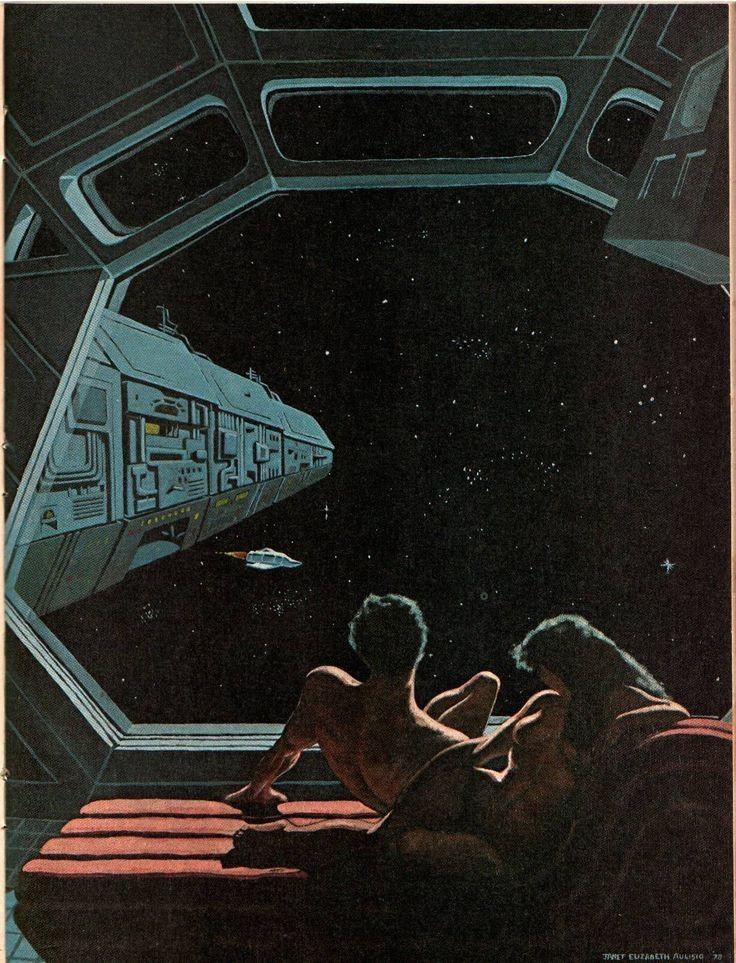
This quintessential image captures the spirit of Futurism, a genre deeply fascinated by space exploration and the technological future. A couple lounges on their sofa bed, gazing out at a massive sci-fi ship and a sleek jet cruising through the starry black void, capturing the romantic yet technological atmosphere of the era. The artwork is signed "Joret Elizabeth Aulisda 73" in the bottom right corner, anchoring the scene as a vintage example of this bold art movement.
detailed-analysis (gemma3_27b-it-q8_0)
Okay, let's analyze this striking image by Janet Elizabeth Allen (1978) through the lens of Futurism and its associated theoretical frameworks. Given the image’s intense focus on technology, space, and a certain detached human element, several of the requested analytical lenses will be highly relevant.
Image Information: This artwork, created in 1978, depicts two nude figures lounging within a sleek, futuristic space station or vehicle. The background showcases a view of outer space with a distant spaceship, and possibly other celestial bodies. The interior is characterized by sharp, geometric lines, a muted color palette with pops of warm red, and a strong emphasis on technological infrastructure. The lighting creates dramatic shadows and a sense of depth. The figures, while human, appear almost secondary to the environment, their bodies echoing the curves and lines of the architecture. This piece embodies a vision of the future dominated by technology and space travel.
Visual Description (within a Futurist Context)
The image screams Futurism, even though created much later than the movement’s peak. The hallmarks are all present: speed, technology, movement, and a rejection of the past. The stark geometry, the gleaming surfaces, the emphasis on engineered lines and angles – all reflect a belief in the power and beauty of the machine.
However, this isn’t simply an optimistic depiction of technological progress. The choice of perspective – looking out into the vastness of space, combined with the languid, almost vulnerable poses of the figures – injects a sense of melancholy. It’s a Futurism tinged with awareness of human insignificance in the face of the cosmic, or perhaps a critique of a future where humans become detached from the physicality of existence.
The use of color is also key. The red lighting, though striking, doesn't evoke warmth but rather a sense of artificiality and controlled environment. The sharp contrast between light and shadow adds to the dramatic, and somewhat alienating, effect. It is a visual articulation of a technologically advanced future, but one that doesn’t necessarily promise utopia.
Foucauldian Genealogical Discourse Analysis
From a Foucaultian perspective, this image reveals how the "discourse" of the future has been constructed. Specifically, it highlights a power dynamic embedded in the very idea of technological advancement.
- Power/Knowledge: The image embodies a regime of power/knowledge where "the future" is defined by and for technological systems. The architecture dictates the experience of space; the machine determines the human subject’s relationship to the cosmos. The "knowledge" of how to build such structures, and the power to do so, inherently shapes our understanding of what the future is.
- Genealogy: A genealogical tracing would examine how ideas about space travel, architecture, and even the human body have evolved (historically) to arrive at this specific vision. It would investigate the preceding discourses – early science fiction, industrial design, architectural movements – that contribute to this "truth" of the future.
- Discipline & Biopower: The enclosed, controlled environment could be interpreted as a space of discipline. It's a space that manages life (biopower) by controlling environmental factors, potentially regulating bodily functions (through technology not immediately visible in the image, but implied). The figures' apparent lack of agency within this space speaks to the potential for normalization and control.
- Panopticism: The image subtly alludes to panoptic surveillance. The figures are positioned as though they could be observed, even though no observer is explicitly present. The very structure of the space allows for the possibility of constant monitoring and self-regulation.
Critical Theory
This image lends itself well to analysis through critical theory, particularly the Frankfurt School’s critiques of instrumental reason and the “culture industry.”
- Instrumental Reason: The image embodies a world dominated by instrumental reason – reason used solely as a means to an end (technological progress). The beauty of the space isn’t organic or natural; it's the beauty of efficiency, precision, and function. This suggests a society where all aspects of life are potentially reduced to calculable and controllable variables.
- Reification: The figures, in their relaxed poses, appear somewhat reified – treated as objects within a larger technological system rather than as autonomous subjects. They’re integrated into the environment, almost as aesthetic elements. This speaks to the alienation of the individual in a highly industrialized, technologically advanced society.
- Commodification of Experience: The spectacle of space travel itself could be viewed as a commodified experience. The ability to see the cosmos becomes a consumer product, packaged and presented within a controlled environment. The emotional response to the vastness of space (wonder, awe, terror) is mediated by the technology, rather than experienced directly.
Marxist Conflict Theory
From a Marxist lens, the image exposes the potential for class conflict and exploitation even in a future ostensibly liberated by technology.
- Alienation: The figures' detachment from their surroundings and from meaningful labor reflects the Marxist concept of alienation. Their freedom to lounge in space is predicated on the labor of countless others who built and maintain the technological infrastructure.
- Control of the Means of Production: Who owns this space station/vehicle? Who controls the technology that allows for space travel? The image doesn’t show the laborers, the engineers, or the capitalist class who benefit from this advancement. This omission highlights the underlying power imbalances.
- Ideology: The image itself might function as a form of ideology – a representation of the future that serves to legitimize the existing social order. It presents a compelling vision of progress, obscuring the potential for exploitation and inequality.
- False Consciousness: The figures' relaxed state could also be seen as a symptom of false consciousness. They may be unaware of the underlying social and economic forces that enable their privileged existence.
Postmodernism
While initially seeming antithetical to the clean lines of Futurism, a Postmodern reading reveals inherent contradictions.
- Simulacra and Simulation: The space itself could be considered a simulacrum - a copy without an original. The view of space is mediated through the vehicle, becoming a hyperreality. The figures are experiencing a simulation of space travel rather than the raw, unmediated experience.
- Deconstruction of Grand Narratives: The image subtly challenges the "grand narrative" of technological progress. The melancholy tone and the ambiguous relationship between humans and technology suggest that the future is not a simple upward trajectory of improvement.
- Fragmentation: The fractured perspective and the sharp contrasts contribute to a sense of fragmentation – a characteristic of Postmodern aesthetics. The image doesn't present a unified, coherent vision of the future.
- Irony & Pastiche: While less obvious, the image can be read as a pastiche of futuristic tropes. It borrows from various science fiction sources, creating a composite vision that lacks originality.
Queer Feminist Intersectional Analysis (less central, but present)
While not the primary focus of the image, a Queer Feminist lens can illuminate aspects of power and representation.
- Body & Space: The nude figures invite exploration of the ways in which bodies are represented and controlled in a technologically advanced environment. The smooth, androgynous quality of their bodies challenges traditional gender norms, but also leaves them vulnerable to objectification within the futuristic setting.
- Power Dynamics: The power dynamic between the figures and the technology, as well as the implicit power structures surrounding space travel, can be analyzed through a feminist lens. Who gets to explore space? Who designs the spaces in which bodies are contained?
- Intersectional Marginalization: If we assume the figures represent a privileged group (those with access to space travel), we can also consider who is excluded from this future. The image doesn’t address issues of race, class, or other forms of social marginalization, leaving those considerations unaddressed.
In conclusion, this image by Janet Elizabeth Allen is a complex work that resonates deeply with the themes and concerns of Futurism and its critical interpretations. It’s not merely a celebration of technological progress but a nuanced exploration of the potential consequences—alienation, control, commodification, and the loss of authentic experience—in a future shaped by machines.
simple-description (llama3.2-vision_11b)
The meme features a futuristic illustration of a spaceship with a woman in a futuristic dress, but the image is actually a cover of a 1970s science fiction novel by Philip K. Dick, "The Man in the High Castle". The meme is a reference to the novel's depiction of a futuristic society, where the woman is a symbol of the future's ability to be both beautiful and terrifying.
detailed-analysis (gemma3-27b-vision)
Okay, let's break down this image with the requested analytical lenses.
Visual Description
The image is a science fiction illustration, likely a book cover or interior artwork from the 1970s, judging by the style. It depicts a highly structured, futuristic interior. We see a corridor or the observation lounge of a spaceship, framed by a severe, geometric architecture of white and grey. The walls, floor, and ceiling are defined by hard lines, sharp angles and repeating patterns. Large, rectangular windows reveal a vast, star-filled expanse of black space.
The focal point is a pair of figures, a man and a woman, seemingly embracing or supporting each other. They are silhouetted against the view of space, lending them a sense of vulnerability and intimacy. The man is muscular, while the woman is more slender. They are draped in what appears to be futuristic or theatrical garments, with flowing folds and a warm, reddish-gold hue.
The light sources are primarily internal, casting dramatic shadows and highlighting the architecture. A small spaceship or satellite can be seen in the distant background. The overall impression is one of starkness, isolation, and a sense of being on the edge of something immense and unknowable.
Foucauldian Genealogical Discourse Analysis
This image provides a rich surface for Foucauldian analysis, focusing on power, knowledge, and the construction of the 'subject' within a specific discourse—in this case, the discourse of science fiction and space exploration.
- Space as Discipline: The rigid, geometric architecture of the spaceship is a spatial manifestation of discipline. Foucault argued that institutions (like prisons, hospitals, schools) create spaces that regulate behavior. This spaceship interior functions similarly. The hard lines, predictable structures, and lack of organic forms enforce a specific order and control. The design suggests a system of surveillance—though not explicitly shown, the lines imply an ability to visually monitor activity.
- The Subject & Gaze: The figures’ position – looking out at space – is crucial. They are defined by the spectacle of space, but also by their relationship to the interior architecture. The gaze isn't solely outward toward exploration. The architecture frames their gaze, shaping their experience of space. The internal positioning suggests the spaceship as the primary site of meaning-making, not the cosmos itself.
- Genealogy of ‘Exploration’: Tracing the genealogy of “exploration” through this image reveals how the concept is constructed. It's not merely about venturing into the unknown. It’s linked to notions of technological mastery, colonization (even if of abstract “space”), and the assertion of human control over the natural world. The image subtly connects the historical discourse of colonial exploration with the future of space travel.
- Power/Knowledge: The technology is knowledge, and knowledge is power. The spaceship is the visible manifestation of this power. The architecture doesn’t simply contain the exploration; it enables it, while simultaneously restricting it.
Critical Theory
Looking at this image through a critical lens, we can see elements relating to alienation and the potential for dehumanization within technological systems.
- Alienation & the Technological Sublime: The vastness of space, while potentially awe-inspiring, is also isolating. The characters are physically and emotionally distanced from the natural world. The spaceship represents the pinnacle of human technological achievement, but it also symbolizes a growing separation from our origins. This creates a sense of alienation – a common theme in critical theory, particularly in the works of Marx and the Frankfurt School.
- Commodification of Experience: The spaceship itself can be seen as a commodity - a product of industrial production designed to deliver a specific experience (space travel). This commodification of experience extends to the view of space – it’s mediated through the windows of the spaceship, transforming a natural phenomenon into a spectacle consumed by the passengers.
- The Spectacle & Loss of Authenticity: The dramatic lighting and composition of the image contribute to a sense of “the spectacle” (Debord). The experience of space is not authentic; it’s staged and presented for consumption. The characters are, in a way, spectators of their own lives.
Marxist Conflict Theory
Applying a Marxist lens, we can analyze the image in terms of class, control, and the potential for exploitation.
- Ownership & Access to Space: The spaceship immediately raises questions about who owns this technology. In a capitalist system, access to space would likely be limited to the elite—those with the economic power to fund and control such ventures. The image implicitly suggests a power dynamic – the passengers are privileged, able to view the cosmos from the comfort of their technologically advanced vessel, while the vast majority of humanity remains grounded.
- Labor & the Means of Production: While not explicitly depicted, the spaceship represents a massive amount of labor – the work of engineers, scientists, factory workers, and countless others who contributed to its creation. This labor is largely invisible in the image, obscured by the sleek, futuristic design. The image subtly reinforces the capitalist dynamic of surplus value—the wealth generated by labor is appropriated by those who own the means of production.
- Alienation of the Body: The confined space and lack of natural elements contribute to a sense of bodily alienation. The characters are detached from their physical environment, their bodies reduced to passengers within a machine. This can be seen as a manifestation of the Marxist concept of alienation – the separation of individuals from their labor, their products, and their fellow human beings.
Postmodernism
From a postmodern perspective, the image challenges notions of grand narratives and absolute truth.
- Simulation & Hyperreality: The spaceship interior could be seen as a "simulacrum" (Baudrillard)—a copy without an original. It’s a constructed environment that mimics reality, blurring the boundaries between the authentic and the artificial. The view of space itself becomes a simulation, mediated through the windows of the spaceship. This creates a sense of “hyperreality”—a state in which simulations become more real than reality itself.
- Fragmentation & Loss of Meaning: The geometric architecture and starkness of the image contribute to a sense of fragmentation and loss of meaning. There’s a lack of organic form, a rejection of traditional aesthetic principles. This can be seen as a reflection of the postmodern condition—a state of uncertainty, instability, and cultural relativism.
- Intertextuality & Genre Conventions: The image draws heavily on science fiction genre conventions—the sleek spaceship, the distant stars, the heroic figures. However, it also subverts these conventions by presenting a more ambiguous and ambiguous vision of the future. The image acknowledges its own constructedness, inviting viewers to question the narratives and ideologies embedded within the science fiction genre.
Queer Feminist Intersectional Analysis
This lens is the most challenging to apply directly, as the image doesn’t explicitly depict issues of gender or sexuality. However, we can approach it by considering the representation of bodies and power dynamics:
- Gendered Performance of Roles: The man is the larger figure and could be interpreted as the protector, while the woman is potentially vulnerable. These roles perpetuate traditional gender norms. But, it is also possible to interpret their postures as supportive, and equal. The limited representation of bodies in the image also suggests the erasure of queer and trans bodies.
- Space as a Site of Control: The architecture of the spaceship controls and defines the bodies within it. Feminist analysis of space has demonstrated how it's often used as a tool of oppression and control, particularly for women. This spaceship functions similarly – it’s a heavily structured environment that limits freedom of movement and expression.
- Intersectional Marginalization: Considering the intersection of gender, class, and race (which are not directly visible in the image but implied), we can ask who doesn't have access to this spaceship? Who is excluded from the benefits of space travel? This question highlights the systemic inequalities that shape our world.
- Queering the Narrative of Exploration: The traditional narrative of space exploration is often framed as a masculine, heroic endeavor. A queer feminist analysis can challenge this narrative by questioning the assumptions and power dynamics that underpin it. By deconstructing the traditional tropes of science fiction, we can create more inclusive and empowering visions of the future.
Hopefully, this comprehensive analysis provides a multifaceted understanding of the image from various theoretical perspectives. Let me know if you'd like me to elaborate on any specific point or explore other analytical frameworks.
simple-description (llama3.2-vision)
The meme is a humorous image of a person sitting on a couch, surrounded by empty pizza boxes and trash, with a caption "I've been on the couch for 3 days". The image is likely a relatable and humorous take on the common experience of binge-watching TV shows or playing video games for extended periods.