First Seen
2024-04-03T23:02:48.069673+00:00
simple-description (qwen3.5_2b-q8_0)
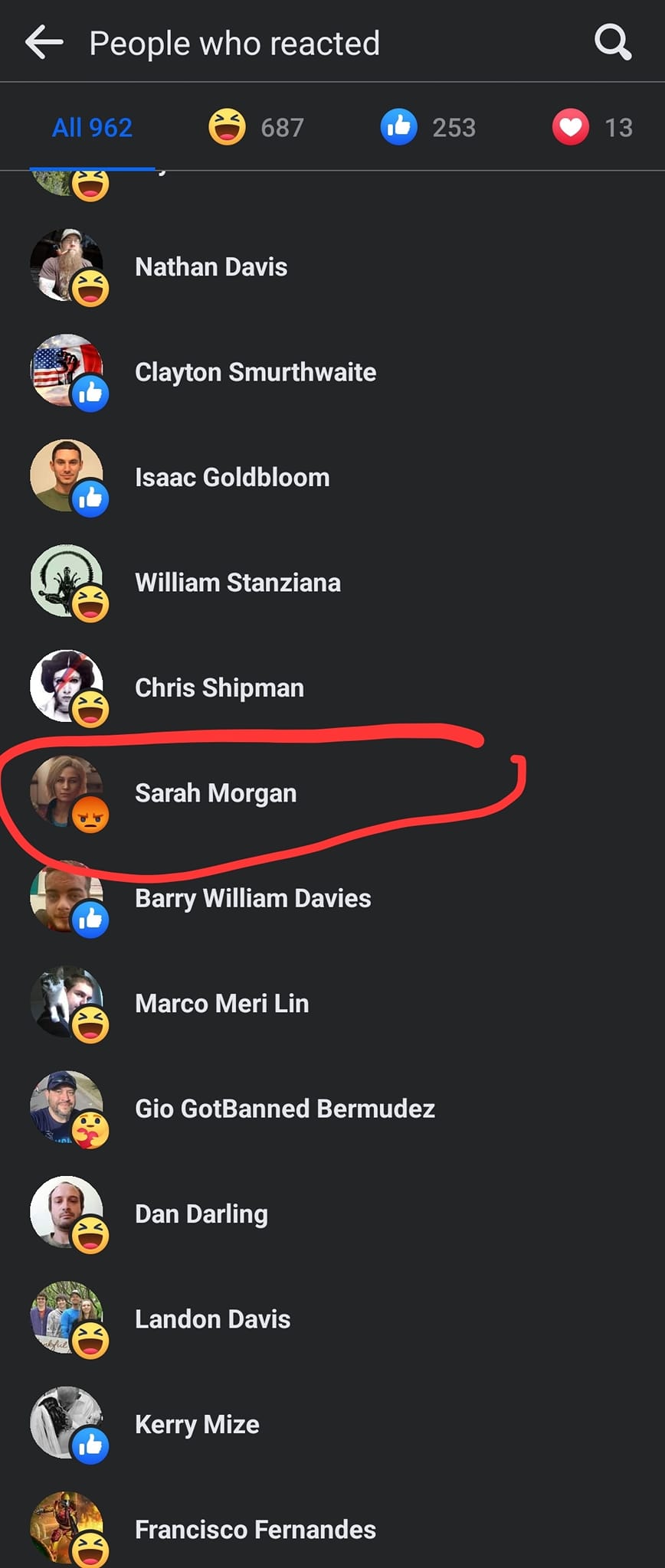
This meme represents a "skip" reaction from the Starfield fandom, where users select an angry or crossed-out emoji to indicate they are bored, annoyed, or unimpressed by the content. The screenshot highlights a user named Sarah Morgan who chose this reaction instead of liking the post, signaling a clear negative or dismissive sentiment toward the content shared.
simple-description (llama3.2-vision_11b)
The meme is a screenshot of a Facebook comment section where a user is reacting to a post about the upcoming game Starfield. The user is expressing excitement and enthusiasm for the game, but their comment is being mocked by others as being overly enthusiastic or "cringey". The meme is likely being shared to poke fun at the user's over-the-top reaction to the game, with the text "I'M SO EXCITED FOR STARFIELD" being highlighted in a sarcastic tone.
detailed-analysis (gemma3-27b-vision)
Okay, here's an analysis of the image, broken down into the requested theoretical sections. I'll indicate when a section doesn't apply strongly to the image's content, and why. The core focus will be on interpreting the implications of a list of people and their reactions to an unseen post.
Visual Description
The image is a screenshot from a social media platform (likely Facebook). It displays a list of people who have reacted to a post. Each line features a small profile picture followed by the reaction they selected (primarily laughing face, thumbs up, crying laughing face). The list is incomplete, but shows a scrolling set of users. A red circle is drawn around the name "Sarah Morgan" and her laughing face emoji. The screen includes counters at the top indicating the total number of reactions: "All 962," "😂 687," "👍 253," and "❤️ 13." The color scheme is predominantly white, with user profile images in varying colors and the blue reaction icons.
Foucauldian Genealogical Discourse Analysis
This image offers a fertile ground for Foucauldian analysis. The list itself is a discourse shaping how reactions are categorized and understood. Here’s how it applies:
- Power/Knowledge: The platform defines what a “reaction” is – limiting options to a pre-defined set of emojis. This controls the way users express themselves, effectively exercising power over emotional expression. It positions certain reactions (like “laughing”) as dominant and others (“sad,” “angry”) as less frequent or acceptable.
- Genealogy of “Reaction”: We could trace the historical development of the “like” and its evolution into a wider array of reaction options. What did it mean to express approval online before these options existed? How did the demand for more nuanced emotional expression lead to the current system?
- Discipline & Normalization: The consistent structure of the list, and the categorization of reactions, normalizes a certain pattern of engagement. Users are encouraged to react in pre-defined ways, fitting within the platform's established framework.
- The Circle around Sarah Morgan: The act of circling Sarah Morgan’s name signals a specific focus or interest. Someone is singling her out, potentially highlighting her reaction as significant or noteworthy. This could be an exercise of power – drawing attention to her for a specific reason, or a form of surveillance. The observer is drawing a line between Sarah Morgan’s reaction and something else.
Critical Theory
Critical Theory, particularly stemming from the Frankfurt School, can illuminate the ideological implications of this image.
- Commodification of Emotion: The list of reactions represents the commodification of emotional responses. Feelings are reduced to quantifiable data – a count of laughing faces versus thumbs up. This data is then used for marketing, content optimization, and user profiling.
- Culture Industry: The platform, as part of the broader “culture industry,” manufactures consent and reinforces dominant ideologies. By presenting only limited reaction options, it subtly shapes how users perceive and respond to content.
- False Consciousness: Users may believe they are freely expressing their emotions, but their choices are constrained by the platform's design. This creates a form of false consciousness, where they are unaware of the ideological forces shaping their behavior.
- The focus on Sarah Morgan: Again, the circling of her name implies that her reaction is being scrutinized or deemed important. It is a demonstration of surveillance and the categorization of the individual.
Marxist Conflict Theory
While less direct than the previous analyses, a Marxist lens can still be applied.
- Class & Digital Access: Access to social media platforms is unevenly distributed, creating a digital divide that reinforces existing class inequalities. Those with limited access are excluded from the discourse and its benefits.
- Ideological Control: The platform, as a privately owned entity, has its own interests and biases. It can use its control over the platform to promote certain ideologies and suppress others.
- The “Attention Economy” as Exploitation: The competition for likes and reactions can be seen as a form of symbolic capital. Users are incentivized to create content that generates engagement, effectively exploiting their own creativity and emotional labor.
- The circled name of Sarah Morgan: Again, the act of circling indicates some kind of social ranking and value judgement.
Postmodernism
A postmodern perspective emphasizes the fluidity of meaning, the breakdown of grand narratives, and the importance of individual interpretation.
- Simulacra and Simulation: The reactions themselves can be seen as simulacra – copies of emotions that have become detached from their original referents. The laughing face is not the experience of laughter, but a symbolic representation of it.
- Deconstruction of Meaning: The list challenges the idea of a singular, objective meaning. Each user's reaction is subjective and open to interpretation.
- Fragmentation and Hyperreality: The list is a fragmented collection of individual responses, contributing to a sense of hyperreality – a world dominated by simulations and representations.
Queer Feminist Intersectional Analysis
This analysis is the hardest to apply directly, but still possible.
- Digital Harassment & Surveillance: The list raises concerns about digital surveillance and potential harassment. Who is collecting this data, and how is it being used? Are certain groups disproportionately targeted? The circled name of Sarah Morgan could signal an intent for harassment or monitoring.
- Algorithmic Bias & Representation: The platform’s algorithms may perpetuate gender and racial biases, leading to unequal visibility and representation.
- Performance of Emotion & Gender: The way users express emotions online can be shaped by gender norms and expectations. The list could reflect these norms, or challenge them. The focus on Sarah Morgan could be a reflection of a patriarchal tendency to scrutinize and judge women’s actions.
- Intersectionality: The way that the platform's algorithm may affect Sarah Morgan may depend on her other identities, like her race, class, sexuality, etc.
I hope this detailed breakdown of the image through multiple theoretical lenses is helpful. Let me know if you'd like me to elaborate on any specific point or approach!
tesseract-ocr
€ People who reacted oy All9ez2 ss & 687 Pex Cae) i. 5 ~ aS Nathan Davis a Clayton Smurthwaite oy Isaac Goldbloom op} William Stanziana er Cee eStal url 25 Sarah Morgan we ry Barry William Davies “i ae Wy Marco Meri Lin 7) Gio GotBanned Bermudez @ Dan Darling ey Landon Davis ¥4 Cia airs) c. a Francisco Fernandes (as)
simple-description (llama3.2-vision)
The meme is a screenshot of a Facebook comment section, where a user is reacting with a laughing face emoji to a post. The user's name is "Sarah Morgan" and they have a comment that says "I'm not even mad, I'm just disappointed".