First Seen
2024-05-05T09:46:02.401483+00:00
simple-description (qwen3.5_2b-q8_0)
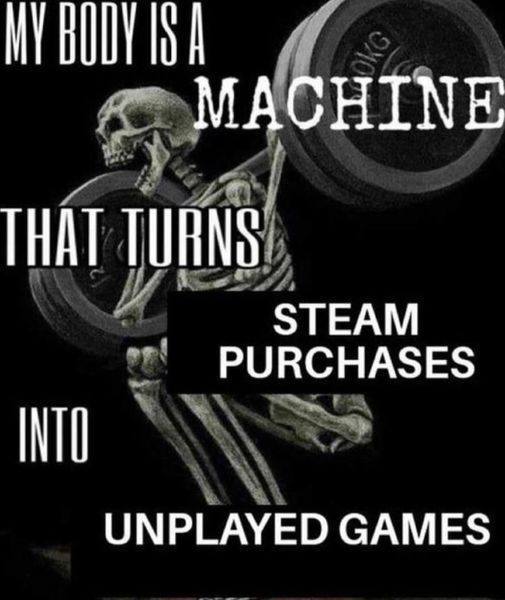
This meme, often referred to as "The Gamer's Curse," satirizes the frustrating situation where players buy games (usually on sale) but finish nothing. In the image, a skeleton lifting weights represents a gamer, and the text reads: "MY BODY IS A MACHINE THAT TURNS STEAM PURCHASES INTO UNPLAYED GAMES." The humor comes from the irony that the investment (the Steam purchase) results in zero enjoyment or progress, leaving the player with unfinished content and a sense of financial loss.
simple-description (llama3.2-vision_11b)
This meme is a play on the phrase "my body is a temple" and is referencing the popular video game "PlayerUnknown's Battlegrounds" (PUBG). The meme is saying that the player's body is being used as a temple, but in a humorous way, implying that the player's body is being used as a gaming platform, with the phrase "my body is a temple" being replaced with "my body is a game" and the phrase "that turns" being replaced with "that plays".
detailed-analysis (gemma3-27b-vision)
Okay, here's an analysis of the image, broken down into the requested sections where applicable. It's a layered image, so the analysis can be quite involved.
Visual Description
The image is stark and high-contrast, dominated by black and white tones with some grey shading. It features a skeletal figure struggling under the weight of a barbell. The skeleton’s pose suggests extreme strain and a sense of being overwhelmed. Overlaid across the image are white text phrases forming a statement: "MY BODY IS A MACHINE THAT TURNS INTO STEAM PURCHASES INTO UNPLAYED GAMES". The barbell is prominent, and seems to represent the 'weight' of accumulated digital purchases. The overall aesthetic is somewhat morbid and darkly humorous.
Foucauldian Genealogical Discourse Analysis
This image powerfully lends itself to Foucauldian analysis.
- Discipline & Power: The skeletal figure under the barbell represents the disciplined body, subject to (self-)imposed regimes. The 'weight' is not literal physical weight, but the burden of digital consumerism. The skeleton itself, stripped of flesh, symbolizes the reduction of the body to its functional capacity – a machine working to fulfill a particular goal (making purchases).
- Genealogy of Consumerism: We can trace a genealogy of how "fun" became connected to acquiring things. Historically, leisure was often tied to communal activities, skill-building, or contemplation. Now, it’s often equated with purchasing access to entertainment (games). The image implies a historical shift where the body functions to keep that cycle of purchase going.
- Subjectivation: The phrase "MY BODY IS A MACHINE" is key. It's not an external force making the body a machine; the subject identifies as such. This internalisation of a productive function is central to Foucault's work. The body is not simply acted upon, but actively participates in its own disciplining. The image highlights a kind of self-commodification.
- Power/Knowledge: The image reflects a power/knowledge dynamic around gaming culture. There is an implicit 'knowledge' that collecting games is desirable (often signalled through Steam’s sale/collection mechanics). This knowledge contributes to the power to make purchasing decisions and reinforces the cycle.
Critical Theory
This image resonates with several tenets of Critical Theory, particularly those focused on alienation and consumer culture.
- Commodification of the Self: The image suggests a disturbing trend of self-commodification. The body is not valued for its inherent worth or experience, but for its ability to generate purchases. It has been reduced to a means of production, turning 'wants' into a constant need to acquire.
- Alienation: The image speaks to a sense of alienation. The accumulation of unplayed games suggests that the joy of gaming isn't found in playing the games, but in the act of acquisition itself. There’s a disconnect between desire and fulfillment. The body is alienated from the actual experience it craves.
- Ideology: The image implicitly critiques the ideology of consumerism, which equates happiness with material possessions. It exposes the underlying mechanisms that drive our desire to buy and collect.
- False Consciousness: The individual may believe they are making free, rational choices, but the image suggests they are subject to forces beyond their conscious control. It raises the question of whether the acquisition of these games truly serves their needs or if they are simply caught in a cycle of consumption.
Marxist Conflict Theory
While not a direct representation of class conflict, the image can be interpreted through a Marxist lens.
- Commodification of Leisure: In a capitalist society, even leisure activities become commodified. Gaming, once a potentially liberating pastime, is now subject to market forces. The image suggests that the joy of gaming is being replaced by the accumulation of digital 'capital' – a collection of games that may never be played.
- Labor & Exchange Value: The skeletal body can be seen as 'laboring' to generate income for game developers and platforms (Steam). It highlights the exchange value (the monetary price) overriding any intrinsic or use value (the enjoyment of the game).
- Alienation from Product: The large backlog of unplayed games signifies a disconnection from the fruits of ‘labor’. The individual doesn’t experience the benefit of the purchased product, thus becoming alienated.
- Fetishism of Commodities: The image gestures toward commodity fetishism – the idea that we attach value to objects themselves rather than to the labor and social relations that produced them. The ‘weight’ is symbolic of the value we assign to the games, rather than the experience of playing them.
Postmodernism
The image exhibits elements of postmodern thought.
- Hyperreality & Simulation: The image suggests a loss of distinction between reality and simulation. The accumulation of unplayed games is a virtual accumulation; a collection of data rather than actual experiences. The weight of "unplayed games" symbolizes the weight of virtual possessions over tangible experiences.
- Fragmentation & Loss of Meaning: The fragmented image (skeleton, barbell, text) and the concept of unplayed games suggest a loss of coherence and meaning. The individual is adrift in a sea of choices, unable to find genuine satisfaction.
- Irony & Self-Referentiality: The image is ironic – it’s a critique of consumerism expressed through a medium (digital imagery) that is itself a product of that same consumer culture. It's self-referential, commenting on the absurdity of its own existence.
- Deconstruction of Narrative: The image deconstructs the traditional narrative of leisure as a source of enjoyment and fulfillment. It exposes the underlying power dynamics and ideological forces that shape our desires.
Queer Feminist Intersectional Analysis
This is where the analysis becomes more nuanced and requires some assumptions about context. It's not immediately apparent in the image, but it's possible to make a reading.
- Performance of Masculinity & Hyper-Consumption: If we assume the skeletal figure represents a masculine identity, we could analyze the image as a critique of how hyper-consumption is linked to performances of masculinity. The desire to ‘collect’ and ‘have it all’ can be a way of asserting dominance and power. (This reading relies on gendered assumptions.)
- Labor & Emotional Load: The skeletal body could also represent the burden of emotional labor often placed upon marginalized identities. The weight of unplayed games could be a metaphor for the unseen labor and responsibility that falls on individuals.
- Consumer Culture & Exclusion: Consumer culture can be exclusionary. The image implies a certain level of disposable income required to build a backlog of unplayed games. This can be seen as a form of privilege, and it raises questions about access to leisure and entertainment.
- Intersection of Identity & Consumption: An individual's identity (race, class, gender, sexuality) can intersect with their consumption patterns. This image could be interpreted as a critique of how consumer culture reinforces existing power dynamics and inequalities.
Important Note: The Queer Feminist Intersectional analysis is the most speculative, as the image doesn't explicitly address these issues. However, these perspectives can be applied to expand the critical reading.
Hopefully, this detailed breakdown is helpful! Let me know if you’d like me to elaborate on any particular section.
tesseract-ocr
Taney! e Pe “él THAT Ly ee 1) cs a EURICHASES ni \ we UNPLAYED GAMES
simple-description (llama3.2-vision)
This meme features a picture of a skeleton holding a weight, with a caption that reads "My body is a weight that turns into steam that powers my video games". The image is a humorous take on the common experience of feeling tired and sluggish, but also a clever reference to the concept of "steam power" from the old Steam video game platform.