First Seen
2024-06-16T22:59:29.657379+00:00
simple-description (qwen3.5_2b-q8_0)
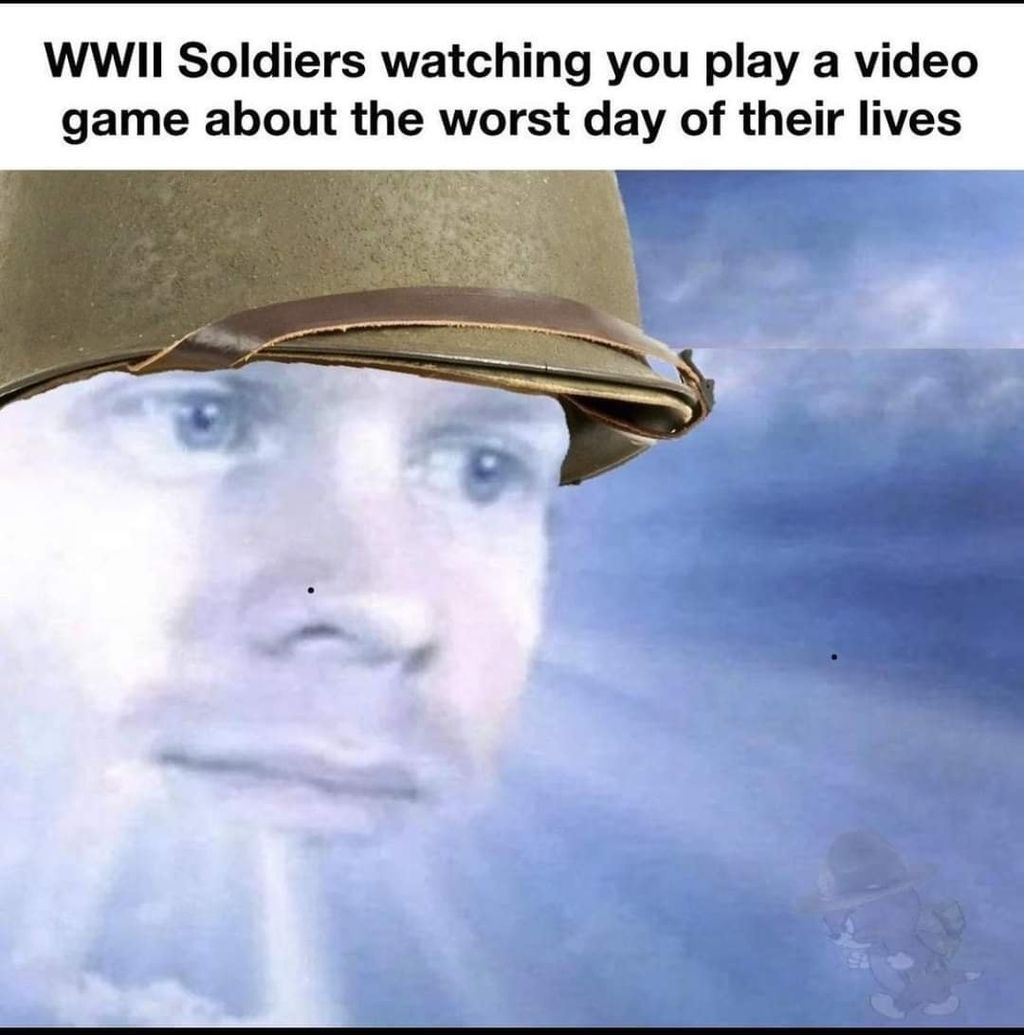
The image features a character resembling General Mordechai, the iconic WWII commander, looking up at a viewer with a expression of confusion and resignation. The text reads, "WWII Soldiers watching you play a video game about the worst day of their lives." In gaming culture, when a character looks up at a player, it often signifies that they are communicating with them or sharing their perspective. This meme humorously applies that trope, implying that as a gamer, you are playing a story about a terrible day while General Mordechai is simply looking up at you with a mix of sympathy and confusion about your experience.
simple-description (llama3.2-vision_11b)
The meme is a humorous image of a soldier from the video game "Call of Duty" with a shocked expression. The text above the image reads "WWII Soldiers watching you play a video game about the worst day of their lives." The meme is a play on the idea that soldiers who experienced the horrors of World War II would be shocked and disturbed by a video game that recreates their traumatic experiences.
detailed-analysis (gemma3-27b-vision)
Okay, let's break down this meme image through the lenses of various theoretical frameworks. It's a potent image so there's a surprising amount to unpack.
Visual Description
The image shows a digitally manipulated, deeply distressed face (seemingly a screen capture of a person looking distraught) overlaid onto the body of a WWII soldier. The soldier is wearing a US Army helmet and camouflage uniform and set against a cloudy blue sky background. The facial expression is one of intense sadness, bordering on anguish. The overall effect is surreal and jarring, juxtaposing a modern emotional expression onto a historical figure. The lighting is relatively flat, emphasizing the emotional state. The image evokes a sense of anachronism and displacement. The meme’s title adds to the emotional complexity, suggesting a specific trigger for this distress: viewing a game that recreates the soldier’s worst day.
Foucauldian Genealogical Discourse Analysis
This image provides fertile ground for a Foucauldian reading. The image can be examined by focusing on the power dynamics inherent in representation and the construction of "truth" through historical narratives.
- Discourse & Power: The act of playing a video game about WWII establishes a discourse about history. This isn’t neutral; the game's designers, developers, and players all contribute to the construction of what WWII means. The soldier’s reaction (as depicted) implies a rejection of this constructed reality. The game attempts to define that soldier’s experience, and their expression is a resistance to that definition.
- Genealogy of Knowledge: The depiction of WWII in games isn't a natural or inevitable representation. It’s a product of evolving cultural norms, technological capabilities, and economic interests. Early war games likely had very different focuses than modern, hyper-realistic titles. The choice to represent this soldier’s worst day specifically reveals a current fascination with the traumatic aspects of war, and perhaps a degree of voyeurism. Tracing the evolution of how WWII is represented in games reveals shifting power dynamics around memory and history.
- Panoptic Effect: There is an element of the soldier being 'observed’ as they watch the game. This replicates the constant surveillance of soldiers, but it’s extended to a present-day audience watching the soldier watching the game. This creates a layer of metanarrative about observation and control.
Critical Theory
This image works powerfully within a Critical Theory framework, specifically as it relates to the commodification of trauma and the implications of war as entertainment.
- Commodification of Suffering: The meme's setup – a game recreating the soldier’s worst day – immediately points to the commodification of trauma. The soldier’s suffering is turned into a consumer product for entertainment. The soldier’s visible anguish becomes a form of ironic commentary on this process.
- Culture Industry: This is a clear example of the "culture industry" (Adorno & Horkheimer). The game is a mass-produced product designed to offer a simulated experience of a horrific event. This risks desensitization and normalization of violence.
- Alienation: The soldier’s expression suggests a profound sense of alienation – a disconnect between their lived experience and its representation in the game. Their personal trauma has been abstracted and repackaged for public consumption.
Marxist Conflict Theory
A Marxist lens emphasizes the underlying economic and power structures that drive conflict and representation.
- Ideology and Hegemony: The video game as a form of media can be seen as reinforcing dominant ideologies about war. It may glorify certain narratives while obscuring the economic and political forces that led to the conflict.
- Class and Conflict: Although the image focuses on the individual soldier, it’s important to remember that war is fundamentally a conflict driven by economic and class interests. The game, in its simplification of this complex reality, may contribute to the obscuring of these underlying dynamics.
- Exploitation: The emotional labor of the soldier is exploited, as their trauma is turned into entertainment for others.
Postmodernism
The image resonates deeply with postmodern themes:
- Simulacra & Simulation: The video game itself is a simulacrum – a copy without an original. It’s a representation of an event, removed from the lived experience. The image highlights the growing difficulty of distinguishing between reality and representation.
- Irony & Parody: The setup is inherently ironic. The soldier is watching a recreation of their own suffering. This challenges the sincerity and authority of historical narratives.
- Deconstruction of Grand Narratives: The image subtly deconstructs the grand narrative of WWII heroism and sacrifice. It focuses on the individual suffering, undermining any attempt to glorify or romanticize the war.
- Anachronism: The combining of modern digital expression and the WWII soldier creates a jarring and intentional anachronism, highlighting the constructed and mediated nature of historical memory.
In conclusion: This meme is surprisingly rich in theoretical potential. It is a commentary on the ways in which we represent, consume, and commodify trauma, particularly the trauma of war. It questions the authority of historical narratives and highlights the growing disconnect between lived experience and its mediated representations.
tesseract-ocr
WWII Soldiers watching you play a video game about the worst day of their lives c ne a — . as - i . “wi
simple-description (llama3.2-vision)
This meme is a humorous image of a soldier from a popular video game, "Call of Duty: WWII", with a shocked expression. The text above the image reads: "WWII Soldiers watching you play a video game about the worst day of their lives." The meme is poking fun at the idea that soldiers who lived through the harsh realities of WWII would be shocked and disturbed by the depiction of their experiences in a video game.