First Seen
2024-07-31T06:55:56.889721+00:00
simple-description (qwen3.5_2b-q8_0)
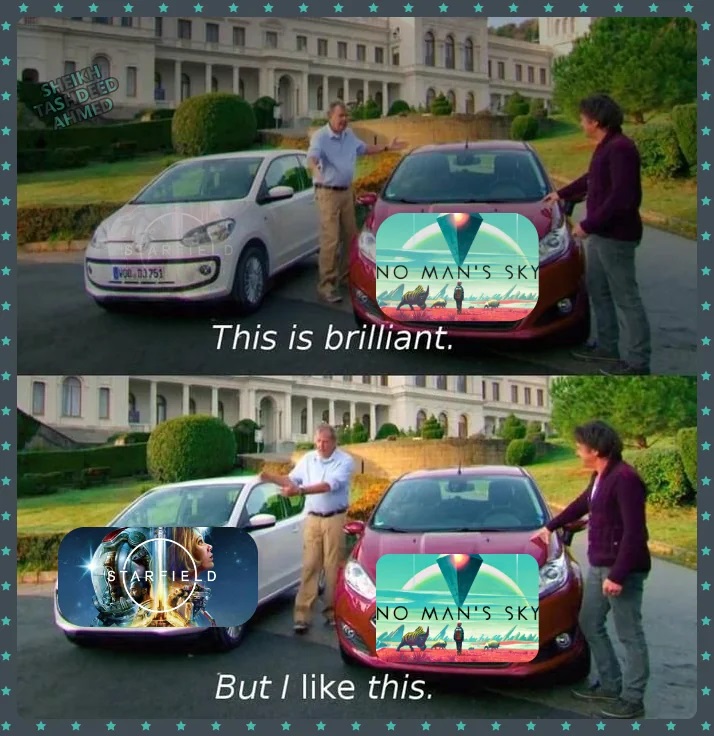
This is a humorous video game meme comparing two popular cars used by professional teams, such as those in the Starfield and No Man's Sky franchises. The top image features a white Peugeot next to a red Renault Scenic, overlaid with game logos and the caption "This is brilliant." The bottom image swaps the white car for a different one, captioned "But I like this," implying a joke about a change that wasn't enthusiastic enough.
simple-description (llama3.2-vision_11b)
This meme is a screenshot from a gaming review show where two hosts are discussing a game, but their conversation is interrupted by a car commercial. The hosts are shown in a split-screen, with one host saying "This is brilliant" and the other host responding "I don't know what to say, but I like it." The meme is captioned "When a game is so good, you just can't say anything but 'I like it'".
detailed-analysis (gemma3-27b-vision)
Okay, let's break down this image series with the requested theoretical lenses. It’s a rather odd set of images, so some lenses will be more applicable than others.
Visual Description
The image is a collage of four screenshots taken from what appears to be a video. The setting is outdoors, in front of a somewhat ornate, potentially institutional building (possibly a hospital or government structure, given the architectural style). A light-colored Toyota minivan is the central object. The focus of each frame shifts as a man is seen applying different stickers to the rear window of the van.
- Frame 1: The van is clean, with the license plate visible. The man is standing beside it.
- Frame 2: A sticker with the text “NO MAN’S SKY” is applied to the rear window. The man is adjusting it.
- Frame 3: The “NO MAN’S SKY” sticker is present. A second sticker reading “STARFIELD” is placed beside it, partially overlapping.
- Frame 4: The “STARFIELD” sticker is present. The man looks toward the camera.
Text appears below the image with "This is brilliant" under the first two frames and "But I like this" under the last two. The entire image is framed with a border of white stars.
Foucauldian Genealogical Discourse Analysis
This image can be analyzed through a Foucauldian lens by examining the power dynamics at play in defining "brilliance" and preference. The man’s act of applying stickers to the van is not merely a personal aesthetic choice, but a practice that participates in broader discourses around gaming, fandom, and perhaps even identity.
- Discursive Formation: The stickers (“No Man’s Sky,” “Starfield”) represent specific video game universes, which are themselves discursive formations. They create communities, shared language, and norms. The man's preference for one over another (indicated by “But I like this”) is not simply a subjective matter of taste, but a position within those discourses.
- Power/Knowledge: The idea of something being “brilliant” is a power/knowledge operation. Who defines what is brilliant? Is it the game developers, the fan communities, or the man himself? The act of sticking the sticker asserts a claim to knowledge (e.g., “I know this is a good game”) and wields power by promoting that knowledge.
- Genealogy: Tracing the “genealogy” of these games, we see how they've evolved, how marketing has shaped perceptions of them, and how fan communities have co-created their meaning. The man’s preference is not a natural expression, but a product of historical forces.
Critical Theory
A Critical Theory lens would focus on the image's potential to reveal broader social structures and the illusion of individual choice.
- Commodification: The stickers themselves are commodities, products of a capitalist system. Their presence on the van turns the vehicle into a form of mobile advertising. The man is, even unconsciously, participating in the expansion of capital by promoting these brands.
- Culture Industry: The games represented by the stickers are part of the “culture industry” (Adorno & Horkheimer). They produce standardized, mass-produced entertainment that numbs individuals and reinforces dominant ideologies. The man’s enjoyment is potentially a form of false consciousness.
- Ideology: The image could be seen as reinforcing the ideology that individual identity is constructed through consumption. The stickers become signifiers of the man’s identity, marking him as a gamer, a fan, or a consumer of particular brands.
Marxist Conflict Theory
Applying a Marxist framework, we could interpret the image through the lens of class and consumption.
- Alienation: The man’s act of applying stickers can be seen as a form of alienation from meaningful labor. Instead of engaging in productive work, he’s consuming and displaying symbols of entertainment.
- False Needs: The culture industry (again) creates false needs – desires that are manufactured by capitalism and that distract individuals from their real material conditions. The man’s desire for these stickers and the games they represent is a product of capitalist manipulation.
- Commodity Fetishism: The stickers become fetishized objects, valued for their symbolic meaning rather than their material worth. This obscures the exploitative labor relations that went into creating the games.
Postmodernism
The image readily lends itself to a postmodern interpretation.
- Simulacra and Simulation: The stickers are simulacra – copies without originals. They don't represent the actual games themselves, but rather a mediated, hyperreal version of them.
- Pastiche and Intertextuality: The image is a pastiche – a collage of disparate elements (van, stickers, text) that lack a unifying aesthetic. The intertextuality of the game references suggests a fragmented, decentered cultural landscape.
- Death of the Author: The meaning of the image is not fixed or determined by the man’s intent. It’s open to multiple interpretations and depends on the viewer’s own cultural background and experiences.
- Playfulness and Irony: The overall tone of the image is somewhat playful, and perhaps ironic. The juxtaposition of the mundane (a van) with the fantastical (video game universes) creates a sense of absurdity.
Queer Feminist Intersectional Analysis
This lens is the least directly applicable, as the image lacks explicit representations of gender or sexuality. However, some connections can be made:
- Performance of Identity: The man’s choice to display these stickers can be seen as a performance of identity. He is actively constructing and presenting a particular image of himself to the world, potentially challenging or reinforcing dominant gender norms associated with gaming (which have historically been male-dominated).
- Consumption and Gender: Consumer culture often targets specific genders, and the marketing of video games is no exception. Analyzing the marketing strategies used for "No Man's Sky" and "Starfield" could reveal how gendered expectations and stereotypes are reinforced.
- Critique of Normative Spaces: The act of decorating the van with these items can be seen as a subtle reclaiming of a mundane, everyday space (the vehicle) and transforming it into a space of personal expression, potentially challenging traditional notions of masculinity or domesticity.
Let me know if you’d like me to elaborate on any of these interpretations, or explore other theoretical frameworks!
simple-description (llama3.2-vision)
This meme is a screenshot from a TV show where a character is enthusiastically reviewing a car, but the reviewer is actually discussing a video game. The image shows a split-screen comparison of the car reviewer's face with a screenshot of the game "No Man's Sky" and the game "Starfield" (which was not yet released at the time of the original review). The text "This is brilliant" and "I like this" are overlaid on the images, with the first line referencing the game "No Man's Sky" and the second line referencing the game "Starfield".