First Seen
2023-05-10T20:59:59+00:00
simple-description (llama3.2-vision_11b)
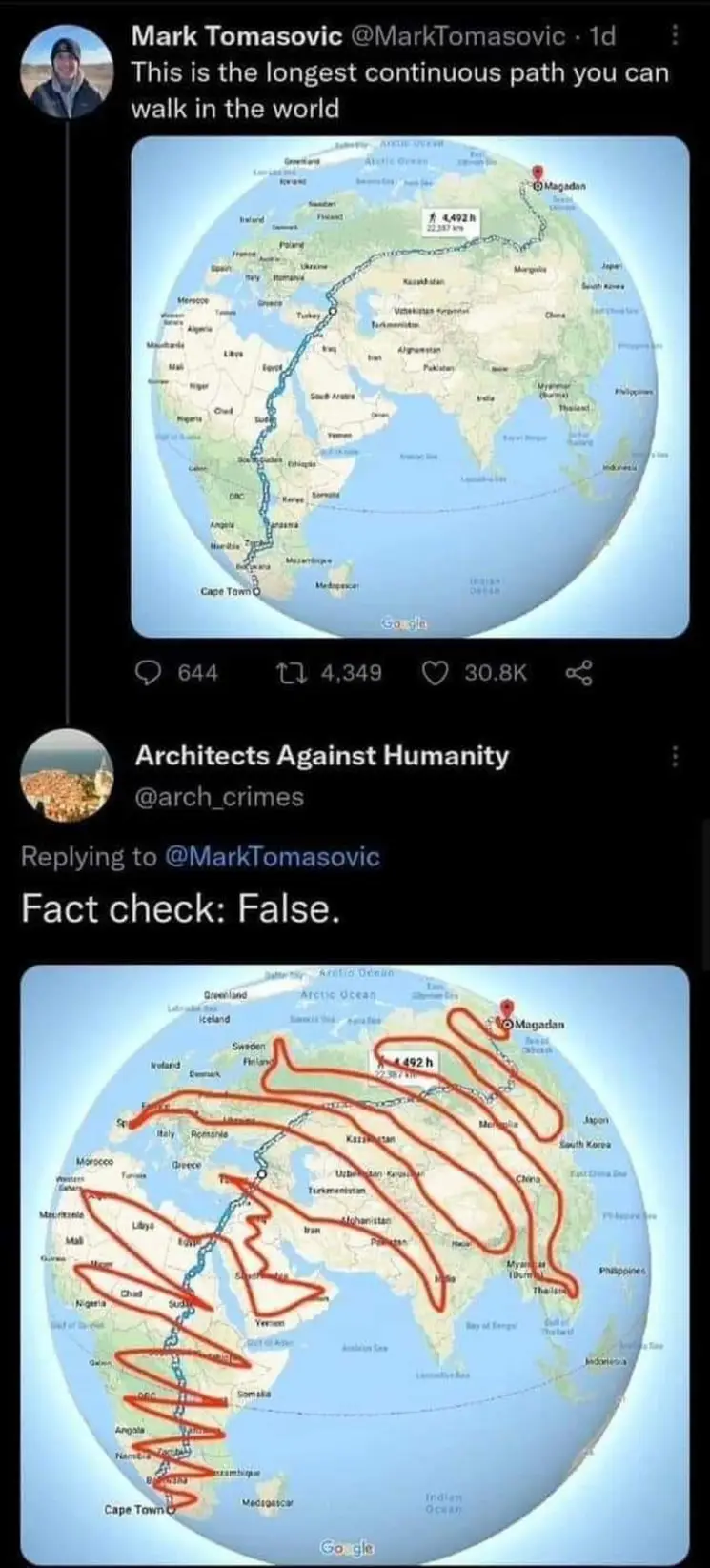
The meme is a screenshot of a Twitter conversation where a user, @MarkT, claims that the longest path he can walk in the world is around the globe, but the response from @ArchitectsAgainstHumanity (AAH) is a sarcastic remark that the path is actually a series of straight lines connecting all the cities in a country, not a continuous path around the globe. The text above the image reads: "This is the longest continuous path you can walk in the world".
detailed-analysis (gemma3-27b-vision)
Okay, here's an analysis of the social media post, broken down into the requested theoretical frameworks, with headings indicating where each framework applies. I'll indicate if a section is not applicable.
Visual Description
The post consists of two images:
- Image 1 (Original Post): Shows a world map with a red line overlaid, ostensibly representing the “longest continuous path you can walk.” The line starts in South Africa, snakes through much of Africa, then across the Middle East, through Russia, and extends into the far east. A time estimate of “4,402h” (approximately 183 days) is included.
- Image 2 (Reply/Fact-Check): A different world map with a red line that is significantly more meandering and fragmented than the first. This line represents what the reply claims is the actual longest walkable path. The time estimate appears to be around “492h.” The line appears to prioritize routes along the coastline.
Both maps have a typical Google Maps aesthetic, with geographic features visible. The difference in the lines is visually striking, suggesting a significant disagreement about the definition of “continuous path” and the methodology for finding it.
Foucauldian Genealogical Discourse Analysis
This post offers a rich site for Foucauldian analysis. The "longest walkable path" isn't simply a geographic fact; it's a discourse constructed through practices of mapping, data collection, and algorithmic calculation.
- Power/Knowledge: The initial post by @MarkTomasovic claims knowledge (the longest path). This claim isn't based on objective truth but is presented as such, wielding a type of power—the power to define and present a world, to create a narrative around human movement and exploration. The replying account challenges this power, attempting to deconstruct the initial claim.
- Genealogy: We could trace the history of this "longest path" claim. What mapping tools and datasets were used? What assumptions were made about "walkability" (e.g., traversable terrain, political boundaries)? How did the algorithm prioritize certain routes over others? A genealogical investigation would show how the initial claim isn't a natural discovery but a product of specific historical conditions and practices.
- Disciplinary Power: The initial claim (and potentially the very idea of optimizing for the longest possible walk) can be seen as an exercise of disciplinary power. It encourages a certain way of understanding and engaging with the world—one that emphasizes conquest, measurement, and the maximization of physical endurance.
Critical Theory
The post allows for a Critical Theory lens through its exploration of representation and ideology.
- The Illusion of Objectivity: Both the initial claim and the fact-check present their "longest path" as a factual discovery. However, the visual difference in the lines reveals the constructed nature of this "fact." The claim to objective measurement masks the underlying choices and biases inherent in the mapping process.
- Ideology and Exploration: The very desire to find the "longest walkable path" can be seen as ideologically loaded. It subtly reinforces a Western, colonial mindset of exploration and "conquest" of the world. It frames the world as something to be overcome and mastered, rather than understood and respected.
- Commodification of Experience: The focus on a quantifiable "longest path" potentially commodifies the experience of walking and travel. It reduces it to a data point, a challenge to be "solved," rather than an inherently meaningful activity.
Marxist Conflict Theory
While the post doesn't directly address economic systems, a Marxist reading can be applied through its subtle implications about access, privilege, and the control of space.
- Uneven Geographical Development: The chosen routes in both maps, particularly in Africa and the Middle East, pass through regions marked by political instability, conflict, and economic disparities. This subtly highlights the uneven distribution of resources and power in the world.
- Control of Movement: The "longest walkable path" is, in effect, a route through national borders and potentially dangerous territories. This reminds us that human movement is not free but is regulated by political boundaries, visa requirements, and the exercise of state power.
- Privilege of Exploration: The person proposing and calculating this path likely has the financial and logistical resources to even contemplate such a journey. This highlights the privilege associated with exploration and travel, which is not available to everyone.
Postmodernism
The post embodies several key elements of Postmodern thought.
- Rejection of Grand Narratives: The fact-check directly challenges the "grand narrative" presented by the initial post. There is no single, objective truth about the "longest walkable path." The post acknowledges the subjective and constructed nature of knowledge.
- Deconstruction: The reply’s map deconstructs the initial claim by presenting an alternative route and undermining the idea of a singular "correct" answer. It highlights the instability of meaning and the limitations of representation.
- Simulacra and Simulation: The maps themselves can be seen as simulacra—representations that have become detached from any underlying reality. They are models of the world, not the world itself.
Queer Feminist Intersectional Analysis
This framework has the least direct applicability, but can be teased out.
- Challenging Linear Progress: The very concept of a "longest path" can be seen as a metaphor for linear progress and achievement, which Queer and Feminist theories often critique. A Queer/Feminist perspective might emphasize the value of non-linear paths, detours, and embracing ambiguity.
- Spatial Politics: The paths traverse diverse cultural and political contexts. A feminist perspective could examine how these spaces are gendered, and how the path might affect women and gender-non-conforming people differently.
- Intersectional Vulnerability: The chosen routes traverse contexts where certain groups (based on race, gender, class, etc.) might be particularly vulnerable to violence or discrimination. This highlights the interconnectedness of oppression and the need for an intersectional understanding of risk and safety.
I hope this detailed analysis, divided into the requested theoretical frameworks, is helpful! Let me know if you'd like me to expand on any particular section.
simple-description (llama3.2-vision)
The meme is a screenshot of a Twitter conversation between two users, @markovian and @arch_crimes. The first user, @markovian, posts a tweet saying "This is the longest continuous path you can walk in the world" with a map of the world showing a path from Norway to New Zealand that covers over 40,000km. The second user, @arch_crimes, responds with a joke saying "Fact check: false" and a map of the world showing a different path that covers over 40,000km, but is actually a drawing of a cat.
tesseract-ocr
Mark Tomasovic @MarkTomasovic - id This is the longest continuous path you can 5 walk in the world bo Ao ae © 644 (an Ti cy: a P10 -) Go Nelle ce Vlei a @arch_crimes Replying to @MarkTomasovic Fact check: False. — y