First Seen
2023-05-10T21:03:35+00:00
simple-description (llama3.2-vision_11b)
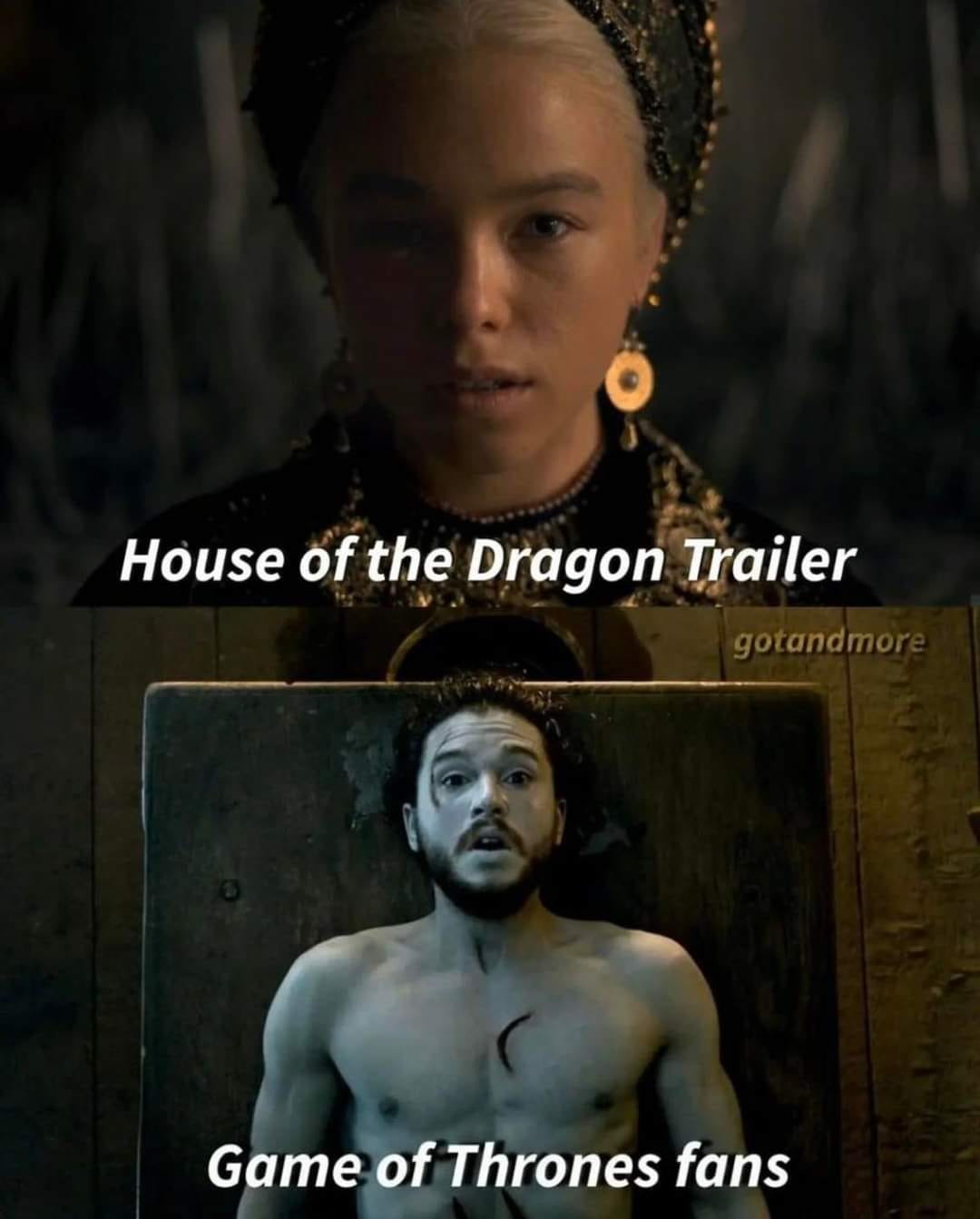
This meme compares the trailers for "House of the Dragon" (HOTD) to the Game of Thrones (GoT) fans' reactions. The top image shows a still from the HOTD trailer, while the bottom image is a humorous representation of a GoT fan's shocked expression, with the text "HOTD Trailer" above it and "Game of Thrones fans" below it. The meme is meant to be humorous and relatable, poking fun at the intense reactions of GoT fans when they see the new trailer.
detailed-analysis (gemma3-27b-vision)
Here's an analysis of the image, broken down into sections as requested. Given the nature of the image (a meme connecting a House of the Dragon trailer with the reaction of Game of Thrones fans), some of these theoretical frameworks are more applicable than others.
Visual Description
The image is a composite, likely a meme. It features two distinct sections. The top section displays a frame from the House of the Dragon trailer, featuring a character (likely Rhaenyra Targaryen) in period dress, gazing with a serious expression. The background is dark and heavily textured, evoking medieval settings. A text overlay reads “House of the Dragon Trailer”.
The bottom section shows a cropped image of Kit Harington (Jon Snow) shirtless, with a confused or slightly distressed expression. The image is framed as if it’s displayed on a screen within an ornate, dark-wood frame. The text overlay reads “Game of Thrones fans”. The watermark in the upper right reads “gotandmore”.
The meme format implies a juxtaposition between the new prequel series and the perceived reaction/disappointment of fans regarding the ending of the original Game of Thrones.
Foucauldian Genealogical Discourse Analysis
We can apply a Foucauldian lens to the "discourse" surrounding Game of Thrones and its prequel.
- Power/Knowledge: The original series held significant cultural power, defining fantasy television for a period. The ending of Game of Thrones disrupted this power structure, as fan dissatisfaction created a counter-discourse. This meme encapsulates that disruption. The knowledge surrounding the series (and its perceived failings) now influences the reception of House of the Dragon.
- Genealogy: Examining the "genealogy" of this meme—its origins and transformations—reveals how fan expectations and online discourse have evolved. The disappointment with the ending established a precedent, shaping how audiences approach the new series. The image itself is a "trace" of this earlier discourse, a visual shorthand for fan discontent.
- Discursive Formation: The meme contributes to the discursive formation around House of the Dragon. It sets a particular tone, suggesting skepticism and potentially even preemptive disappointment. It’s a way of "speaking" about the series before it's even fully aired, influenced by the historical context of Game of Thrones.
Critical Theory
From a broad critical theory perspective, the image is an example of audience reception and the power dynamics between producers and consumers of media.
- Hegemony: The original Game of Thrones established a certain “hegemony” over the fantasy genre and television landscape. The meme suggests a challenge to that hegemony, born from audience dissatisfaction. The fact that this meme exists indicates that the producers lost some degree of control over the narrative.
- Ideology: The image implicitly critiques the ideologies presented in Game of Thrones and the ways those ideologies were perceived as unsatisfactorily resolved in the final season. The meme functions as a form of audience resistance to perceived failures of storytelling.
- Commodification of Discontent: The image itself, as a meme, participates in the commodification of discontent. It's shared, liked, and reposted, effectively turning fan frustration into content.
Marxist Conflict Theory
While subtle, a Marxist reading can be applied, focusing on the tension between audience expectations (the "proletariat" of viewership) and the producers/creators (the "bourgeoisie").
- Alienation: The meme suggests a sense of alienation between the audience and the producers. Fans felt that the creators did not fulfill their expectations, leading to the perceived betrayal and frustration expressed in the image.
- Class Struggle (Symbolic): There’s a symbolic “struggle” between the producers (who control the narrative) and the audience (who consume it). The meme represents a moment where the audience attempts to reclaim some power by voicing their dissatisfaction.
- Commodification of Narrative: The series itself is a commodity, and the audience (as consumers) have a vested interest in its quality. The meme can be interpreted as a protest against the perceived devaluation of the narrative.
Postmodernism
The meme embodies several postmodern characteristics:
- Intertextuality: The image relies on intertextuality, referencing both the original Game of Thrones and the new House of the Dragon. It’s meaning is derived from the relationship between these texts.
- Pastiche/Irony: The juxtaposition of the serious House of the Dragon trailer with the bewildered Kit Harington image can be seen as a form of ironic pastiche.
- Loss of Grand Narratives: The meme implicitly questions the “grand narrative” of Game of Thrones and the expectations that were built around it. It suggests a skepticism towards any overarching, unifying story.
- Simulation/Hyperreality: The meme itself is a “simulation” of fan reaction, a hyperreal representation of their disappointment.
Queer Feminist Intersectional Analysis
This lens is the least directly applicable, but can be considered given the problematic representations of women and sexuality in Game of Thrones.
- Disrupting Narrative Power: The meme could be read as a challenge to the patriarchal structures inherent in Game of Thrones. The perceived dissatisfaction with the ending may stem from the ways female characters were treated or marginalized.
- Intersection of Expectations: The meme implicitly highlights the intersection of audience expectations regarding storytelling, character development, and potentially, the representation of gender and sexuality.
In conclusion, the image is a complex cultural artifact that reflects the dynamics between media producers, consumers, and the broader cultural context. The theoretical frameworks above offer different lenses through which to analyze its meaning and significance.
simple-description (llama3.2-vision)
This meme is a humorous comparison between the trailer for the HBO series "House of the Dragon" and the Game of Thrones fanbase. The top image is a still from the trailer, while the bottom image is a mock-up of a Game of Thrones fan's reaction, with a caption "HBO: 'We're making a 10 hour movie'" and "Game of Thrones fans: 'We're going to make 10 hour movies for the next 10 years'".
tesseract-ocr
Ve =. House of ee vA . eeu | | | mm, A) ' _ | = | 2 Bu aS