First Seen
2023-05-10T21:03:35+00:00
simple-description (llama3.2-vision_11b)
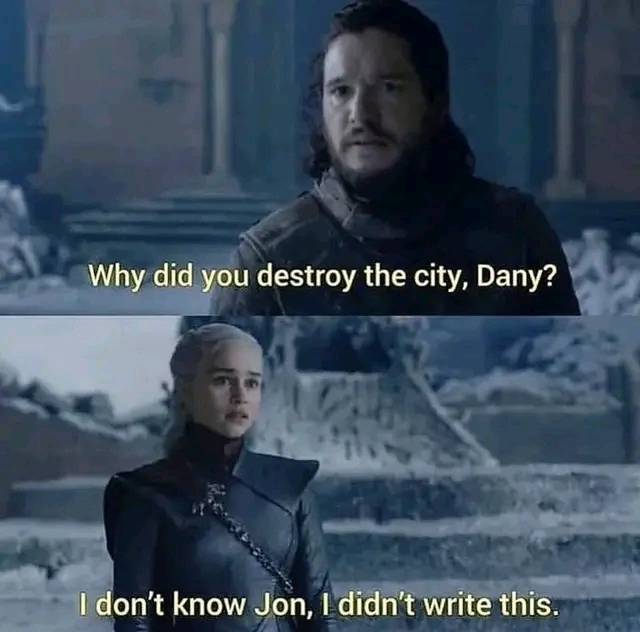
The meme is a humorous exchange between two characters from the Game of Thrones series. The top image shows a character asking why he destroyed a city, to which the other character responds with a sarcastic and unexpected answer. The bottom image is not visible to me, but I can describe the text: "I don't know Jon, I didn't write this." This response is a play on the idea that the character is not responsible for the destruction of the city, and is instead blaming someone else (Jon) for the action.
detailed-analysis (gemma3-27b-vision)
Okay, let's break down this meme, which is derived from a Game of Thrones scene, through the lenses you've requested. It's a meme that has taken on life beyond the show, becoming a shorthand for denying responsibility or authorship – a denial that’s particularly resonant in the digital age.
1. Visual Description
The meme is a two-panel image from the TV series Game of Thrones.
- Panel 1: Jon Snow (Kit Harington) stands in what appears to be the ruins of King's Landing. He’s dressed in dark, worn clothing. His expression is solemn and questioning, looking directly at someone off-screen. Text overlay: "Why did you destroy the city, Dany?"
- Panel 2: Daenerys Targaryen (Emilia Clarke) stands in the same ruined setting. She’s dressed in a dark, imposing outfit. Her expression is distant and seemingly detached. Text overlay: "I don't know Jon, I didn’t write this."
The background consistently shows a landscape of destruction – collapsed buildings, ash, and devastation. The overall color palette is muted blues and greys, emphasizing the grim setting.
2. Foucauldian Genealogical Discourse Analysis
This meme is saturated with Foucauldian relevance. It's a potent commentary on power, knowledge, and the construction of authorship in our modern age.
- Discourse & Power/Knowledge: The initial question ("Why did you destroy the city?") operates as a demand for accountability, seeking a justification within established discourses of leadership and morality. Daenerys's response, "I didn't write this," is a radical rejection of that accountability. It implies that the act of destruction wasn't a deliberate choice authored by her, but rather a product of something external.
- Genealogy & Externalization of Responsibility: Foucault's genealogical method traces the historical emergence of concepts and power relations. Here, Daenerys’s claim resonates with how modern institutions and individuals externalize responsibility. In the age of social media, algorithms, and "AI-generated content," this is particularly relevant. It’s a claim that something “happened,” but it wasn't a conscious choice, but the product of a system. The meme taps into the anxieties around losing authorship over our actions and creations. Who is responsible when the system, not the individual, "writes" the outcome?
- The "Author" is Constructed: Foucault argued that the concept of the "author" is not natural but historically constructed. This meme deconstructs the authorial role, particularly the role of a ruler or leader. It’s a declaration that the actions are not a reflection of her will, but are a product of external forces.
3. Critical Theory
The meme speaks directly to themes of instrumental rationality as explored by the Frankfurt School. Daenerys’s response can be read as a rejection of personal responsibility, framing the destruction as something that "just happened," rather than a consequence of her choices and the logic of her quest for power. This resonates with Adorno and Horkheimer's critique of the Enlightenment, where reason, when detached from ethics, can lead to domination and destruction.
The meme further questions the very foundations of moral accountability. It suggests that assigning blame is inadequate when the forces driving events are complex and systemic. It hints at a critique of the entire system that enabled Daenerys’s actions, not just her individual agency.
4. Marxist Conflict Theory
While not overtly central, a Marxist reading is possible. The destruction of the city can be seen as a manifestation of the inherent contradictions within the power structures of Westeros. Daenerys, in her quest to overthrow the existing order, ultimately replicates the violence and oppression she sought to dismantle.
Her denial of authorship can be interpreted as a rejection of her role within this system. She claims to be a victim of circumstance, rather than an agent of change. However, from a Marxist perspective, this denial obscures the fact that she benefits from the existing power dynamics, even as she claims to be above them. The destruction of the city, from this perspective, is not an anomaly but a predictable outcome of the class struggle and the pursuit of power.
5. Postmodernism
This meme is deeply postmodern.
- Deconstruction of Meaning: The meme actively deconstructs the notion of authorship and accountability. Daenerys's refusal to claim responsibility undermines the traditional link between action and intention.
- Simulacra and Simulation: The meme operates as a simulacrum of responsibility – a representation of the act of taking blame that is ultimately empty. Daenerys doesn't offer explanation, justification, or remorse. She simply denies authorship. This is a common trope in postmodern art and media, where authenticity and meaning are increasingly elusive.
- Loss of the "Grand Narrative": The meme rejects the idea of a coherent, overarching narrative of good versus evil. Daenerys’s actions aren't driven by a clear moral purpose, but by forces beyond her control. This is a hallmark of postmodern thought, which challenges the idea that history and culture have a fixed meaning or direction.
6. Queer Feminist Intersectional Analysis
This is the most tenuous connection, but present nonetheless.
Daenerys, as a powerful female leader, is often held to different standards than her male counterparts. The scrutiny of her actions, and the expectation that she embody a certain kind of "benevolent ruler," are shaped by patriarchal expectations. Her denial of authorship can be read as a rejection of those expectations, a refusal to be defined by the roles traditionally assigned to women.
Furthermore, the destruction of the city can be seen as a consequence of the systemic violence and oppression that disproportionately affect marginalized groups. Daenerys's actions, while horrific, are rooted in a history of colonialism, exploitation, and gender inequality. Her denial of authorship can be interpreted as a rejection of her complicity in those systems, even as she benefits from them.
In conclusion, this meme is far more complex than it appears. It's a powerful commentary on power, responsibility, and the anxieties of the digital age. It resonates because it taps into deep-seated cultural anxieties about the loss of control, the erosion of meaning, and the increasing difficulty of assigning blame in a complex and interconnected world.
simple-description (llama3.2-vision)
This meme is a humorous exchange between two characters from the Game of Thrones series. The top image shows Jon Snow (played by Kit Harington) asking Daenerys Targaryen (played by Emilia Clarke) why she destroyed a city, to which she responds, "I don't know, I didn't write it." The bottom image shows Jon Snow responding, "I don't know, I didn't write it" in a sarcastic tone, implying that Daenerys is trying to shift blame for her actions.
tesseract-ocr
= a 7 ae | ‘J = >. — A; Why di u destroy the city, Dany? £ _ 4 — 3 ain p> — 4 : = ~ Sid y Ten ad Cee arly Say ena cana