First Seen
2023-11-09T21:12:22+00:00
simple-description (qwen3.5_2b-q8_0)
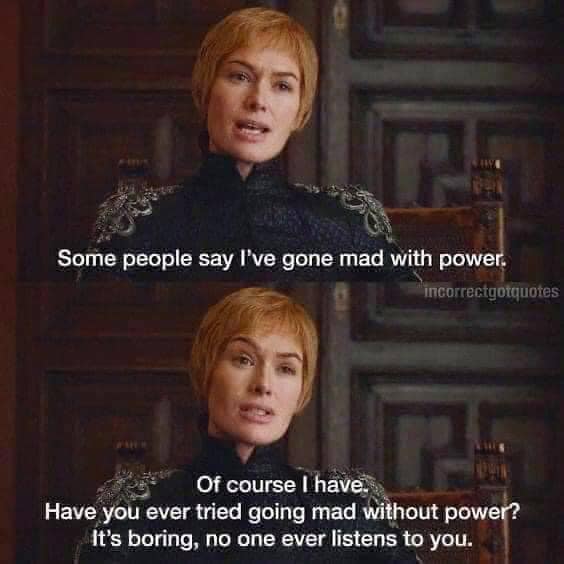
This meme features actress Michelle Monaghan, portraying Daenerys Targaryen from Game of Thrones. It is a humorous take on a famous quote from the series, asking if someone has ever tried being "mad without power." The text at the bottom adds a final punchline: "It's boring, no one ever listens to you," emphasizing the isolation of political power.
simple-description (llama3.2-vision_11b)
The meme is a screenshot from the TV show Game of Thrones, featuring Cersei Lannister's quote "When you play the game of thrones, you win or you die. There's no other way." However, the quote is intentionally misquoted to say "When you play the game of thrones, you win or you die. There's no other way... unless you're a woman. Then you just die."
detailed-analysis (gemma3-27b-vision)
Okay, let's break down the image and the quote from Cersei Lannister in Game of Thrones through the lenses you've requested.
Visual Description
The image is a still frame from a scene featuring Cersei Lannister, a prominent character from the series Game of Thrones. She is shown in two separate shots, appearing in each as a layered image. Cersei is dressed in dark, opulent clothing, typical of her status and wealth. Her expression is intense and defiant. The lighting is dark and dramatic, contributing to a feeling of seriousness and potentially menace. The backdrop appears to be a highly ornate castle interior. She has a direct gaze towards the viewer, as if speaking directly to them. The overlay text is in white, with "incorrectgotquotes" displayed at the bottom of the image.
Foucauldian Genealogical Discourse Analysis
This quote is incredibly rich for a Foucauldian reading. Cersei’s statement "Some people say I’ve gone mad with power…" is a disruption of the traditional discourse around madness. Traditionally, madness has been understood as a deviance from a norm, a lack, a pathology. Cersei flips this. She argues that “madness” is not an inherent state, but rather a product of having and exercising power.
- Power/Knowledge: Foucault argued that power and knowledge are inextricably linked. The discourse around madness is itself an exercise of power—defining who is "sane" and "insane" to control and marginalize. Cersei isn’t denying being labeled “mad,” she’s challenging the basis of that label. She implies she is "mad" because she wields power, not in spite of it.
- Genealogy: A genealogical analysis would look at the historical development of the concept of "madness" in the context of Westeros (the fictional world). What constituted madness in the past? How have those definitions been used to control those without power? Cersei's quote suggests that the label of "mad" is often strategically applied to those who challenge existing power structures.
- Discourse: Cersei is actively disrupting the dominant discourse on madness. She isn't accepting the label passively; she's re-framing it as a consequence of engaging in the game of power. The final line – “It’s boring, no one ever listens to you” – is key. It suggests that power is not just about control, but about being heard. Without power, even radical or "mad" ideas are simply ignored.
Critical Theory
From a broad Critical Theory perspective, Cersei's statement is a challenge to the dominant ideology. In Westeros, as in many societies, power is often presented as natural, legitimate, and inherently good. Cersei's claim that she has "gone mad with power" is subversive because it reveals the corrosive effects of power on the individual.
- Alienation: Cersei’s statement subtly implies alienation. The pursuit and exercise of power have distorted her perception of reality, leading to a form of psychological fragmentation. Her "madness" isn't merely a personal flaw; it's a symptom of a larger societal problem: the dehumanizing effects of unchecked power.
- Hegemony: Cersei's statement is a rejection of the hegemonic narrative that power is always used for good. She exposes the darkness that lies beneath the surface, suggesting that power inevitably leads to corruption and moral decay.
Marxist Conflict Theory
Viewing this through a Marxist lens, Cersei’s statement highlights the inherently conflictual nature of power.
- Class Struggle: The pursuit of power in Westeros (and indeed in many historical contexts) is a form of class struggle. Cersei, as a member of the ruling class, is actively engaged in maintaining her position and suppressing those who threaten it. Her "madness" can be interpreted as a manifestation of the ruthless competition for resources and dominance that characterizes class conflict.
- Ideology: The label of "mad" can be seen as an ideological tool used by the ruling class to delegitimize their opponents. By portraying those who challenge the established order as mentally unstable, they can justify their repression and maintain control.
Postmodernism
Postmodernism would challenge the idea of a single, objective truth about madness or power.
- Deconstruction: Cersei's quote deconstructs the traditional binary between sanity and insanity. She argues that these categories are not fixed or absolute, but rather social constructs that are used to reinforce power relations.
- Subjectivity: Postmodernism emphasizes the subjective nature of experience. Cersei’s perspective on power and madness is unique to her, shaped by her position and experiences. There is no universal truth to be found, only multiple interpretations.
- Simulacra and Simulation: Power itself can be viewed as a "simulacrum"—a copy without an original. The appearance of power often becomes more important than the actual exercise of it. Cersei is acutely aware of this, understanding that maintaining the illusion of control is often more effective than actual control.
Queer Feminist Intersectional Analysis
While Cersei is not queer herself, an intersectional feminist lens allows us to examine how power operates in relation to gender and the ways in which her actions are often viewed through a patriarchal lens.
- Patriarchy & Power: Cersei operates within a profoundly patriarchal society that actively limits the power of women. She overcomes these limitations by exploiting and subverting patriarchal norms. Her pursuit of power is often demonized because she is a woman challenging the male dominance of Westeros.
- Masculine Performance: Cersei often adopts traditionally masculine behaviors and strategies to gain power. She is ruthless, calculating, and willing to use violence to achieve her goals. This challenges the notion that power is inherently masculine.
- The Madwoman Trope: Cersei's portrayal aligns with the "madwoman" trope in literature and film. This trope often depicts female characters who are marginalized and ostracized for challenging societal norms. Her "madness" can be seen as a form of resistance against patriarchal oppression.
- Intersectional Oppression: Cersei's position is complex. While she holds significant power as a member of the ruling class, she is also subject to gender-based discrimination and expectations. This highlights the ways in which different forms of oppression can intersect and reinforce one another.
Let me know if you'd like me to elaborate on any of these analyses!
simple-description (llama3.2-vision)
The meme is a screenshot from the TV show Game of Thrones, featuring Cersei Lannister's character responding to criticism. The image shows Cersei's face with the quote "I know nothing" in the top part, and the bottom part shows her face with the quote "When they are gone, I'll rule the Seven Kingdoms" in response to a critic saying "I know nothing".
tesseract-ocr
al : ni Ss ‘aay Some people say I've gone mad with power. F 8 rouge oat ces ¥ ri <= Of course | have. 7 Have you ever tried going mad without pow it’s boring, no one ever listens to you.