First Seen
2024-06-05T03:56:32.057729+00:00
simple-description (qwen3.5_2b-q8_0)
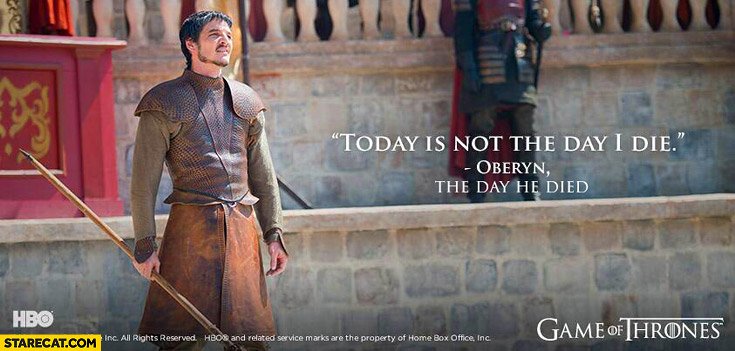
This image is a fan-made meme featuring the character Jon Snow from Game of Thrones, who is depicted looking upward with a hopeful smile. It plays on the iconic line "Today is the day I die," which is typically associated with the series character who dies in a final battle. The text in the image quotes the character Oberon saying, "TODAY IS NOT THE DAY I DIE." - OBERYN, THE DAY HE DIED. The joke is a playful rephrasing that implies that while death is a possibility, this specific day is not the final end.
simple-description (llama3.2-vision_11b)
The meme is an image of a character from the Game of Thrones series, holding a sword and standing in a castle-like setting. The text overlayed on the image reads: "I know I'm going to die, so I don't have anything to lose." This quote is a famous line from the show, spoken by the character Stannis Baratheon, and is often referenced in memes to express a sense of resignation or acceptance in the face of impending doom.
detailed-analysis (gemma3-27b-vision)
Okay, here's an analysis of the provided image of Oberyn Martell from Game of Thrones, broken down into sections as requested. Note that some sections will be more substantial than others, as the image doesn't necessarily lend itself to every theoretical framework equally.
1. Visual Description
The image is a promotional still from the HBO series Game of Thrones featuring Oberyn Martell (played by Pedro Pascal). He is positioned in what appears to be a courtyard or hallway within a castle, likely in King's Landing. The background shows patterned tilework and decorative elements typical of Westerosi architecture.
Oberyn is dressed in a distinct Dornish style: a crimson doublet, a loose, ochre-colored skirt/trousers combination, and brown leather boots. He's armed with a lance, held at a somewhat relaxed, yet alert angle. His body language suggests confidence and readiness for action, but also a degree of defiance. His gaze is directed forward, and his facial expression is a blend of determination and perhaps a hint of arrogance.
The image is dominated by warm, earthy tones, contrasted by the vibrant crimson of his clothing. Text is overlaid on the image: a quote, "Today is not the day I die," attributed to Oberyn, and ironically followed by the parenthetical, "The day he died." The HBO and Game of Thrones logos are also present.
2. Foucauldian Genealogical Discourse Analysis
A Foucauldian analysis focuses on the power structures embedded in the discourse surrounding Oberyn's character and ultimately, his death.
- Discourse and Power: The quote itself ("Today is not the day I die") is a declaration of power, a rejection of the established order that expects obedience and acceptance of fate. It attempts to reshape the discourse around his life and death. The ironic parenthetical statement, "The day he died," immediately reasserts the power of the dominant narrative – the inevitability of death within the brutal world of Westeros.
- Genealogy of 'Martyrdom' or 'Defiance': We can trace the genealogy of the idea of defiance as expressed by Oberyn. In Westeros, challenging power structures rarely ends well. Oberyn's desire for vengeance for his sister, Elia, puts him at odds with the Lannisters and the established power of the crown. His death isn't simply a physical end; it's a suppression of a different way of being – one that values personal justice and challenges the status quo.
- Disciplinary Power: The arena where Oberyn fights in 'Trial by Combat' is itself a manifestation of disciplinary power. The rules and expectations are set by those in control, and Oberyn is attempting to operate within them, while also subverting them with his skill and unconventional fighting style. His ultimate failure underlines the power of the system to ultimately contain and suppress.
3. Critical Theory
This image lends itself to a discussion of the nature of spectacle and the function of violence in Game of Thrones.
- The Spectacle of Violence: Oberyn's fight is designed as a spectacle, a public demonstration of power and brutality. The arena setting, the anticipation, and the gruesome outcome all contribute to this. Critical theory, particularly drawing from thinkers like Guy Debord, would analyze how this spectacle serves to distract from the underlying power dynamics and legitimize the existing order.
- The Heroic Ideal and Its Undermining: Oberyn initially appears to embody a certain heroic ideal – a skilled warrior, a defender of justice, and a passionate advocate for his family. However, the series frequently subverts traditional heroic tropes. Oberyn’s death, while tragic, highlights the futility of individual heroism in a world governed by ruthless power politics.
- Subversion of the Classical Hero: Oberyn is more nuanced than typical fantasy heroes. His sexuality, his motivations, and his methods are far more complex. His death is arguably not a failure of character but a consequence of challenging a system designed to crush anyone who deviates from its norms.
4. Marxist Conflict Theory
From a Marxist perspective, the image exemplifies the inherent class conflict and struggle for power that are central to the series.
- Lannister vs. Martell: The conflict between the Lannisters and the Martells is, at its core, a power struggle. The Lannisters, representing the established nobility and the dominant economic force, seek to maintain their control. Oberyn, representing a different house and a different set of values, challenges that control. His death is a victory for the ruling class.
- Resource Control & Vengeance: Oberyn’s motivation is rooted in a desire for revenge for the rape and murder of his sister, Elia. While personal, this revenge is also tied to the larger struggle for power and control. The crimes committed against Elia were acts of dominance and control, aimed at suppressing any challenge to the Lannister’s authority.
- The Suppression of Dissent: Oberyn’s defiance, embodied in the quote, represents a threat to the existing power structure. His death is a clear demonstration of what happens to those who dare to challenge the ruling class.
5. Queer Feminist Intersectional Analysis
This analysis acknowledges the intersection of gender, sexuality, and power in Oberyn’s character and fate.
- Subversion of Masculine Norms: Oberyn actively subverts traditional notions of masculinity. He is openly bisexual, and his character exudes a confidence and sensuality that are often absent in other male characters. This challenges the heteronormative framework that underpins much of Westerosian society.
- Violence Against Women: The driving force behind Oberyn's quest for revenge is the brutal treatment of his sister, Elia Martell. This highlights the systemic violence against women that permeates the series. The fact that this violence is often minimized or ignored by those in power underscores the patriarchal structures that reinforce it.
- Intersection of Sexuality and Vulnerability: Oberyn's sexuality, while presented as a source of confidence and power, also contributes to his vulnerability. His unconventionality marks him as an "outsider" in a society that is often hostile to anything that deviates from the norm. This makes him a target for those who seek to maintain the status quo. The show's depiction of his death – graphically violent and somewhat sensationalized – can be seen as a way of punishing him for his transgression of societal norms.
6. Postmodernism
Postmodern analysis might focus on the deconstruction of traditional heroic narratives and the fragmentation of meaning.
- Deconstruction of the Hero: Oberyn is not a simple, straightforward hero. His motivations are complex, his methods are sometimes questionable, and his ultimate fate is tragic. This deconstruction of the traditional heroic archetype is a hallmark of postmodern storytelling.
- Irony and Meta-commentary: The ironic parenthetical statement ("The day he died") is a clear example of meta-commentary. It acknowledges the narrative conventions of storytelling while simultaneously subverting them.
- The Loss of Grand Narratives: Game of Thrones as a whole rejects the idea of clear moral absolutes or grand narratives. Oberyn's story, with its tragic ending, reinforces this rejection. It suggests that there are no easy answers or simple solutions in a complex and brutal world.
I hope this detailed analysis provides a thorough response to your request. Let me know if you’d like me to elaborate on any particular aspect.
tesseract-ocr
> a hm; hOB. So Te, 1 i b eee Ch a 7 ve ; , ie He 4 wt a ie i, au 4 ' = al a -* Pie JAY 1S NOT THE DAYI DIE.” (Re: ean en 4 fe THE DAYSHEDIEDEE : ” yy ge Fas al >a) ), V3 we an — sae Wy | it 4 a e i aint une u Mi So ee. ll re) it ERO ee ee eee
simple-description (llama3.2-vision)
This meme is a still image from the HBO series Game of Thrones, featuring the character Tyrion Lannister (played by Peter Dinklage) standing on a balcony, looking out at the audience. The text overlay reads: "Today is a good day to die." However, the meme is actually a quote from the show's creator, George R. R. Martin, that is often misquoted as "Today is a good day to die." The image is likely being used to poke fun at the idea that this quote is actually a good day to die, implying that the character's death is imminent.