First Seen
2024-07-31T06:57:04.174954+00:00
simple-description (qwen3.5_2b-q8_0)
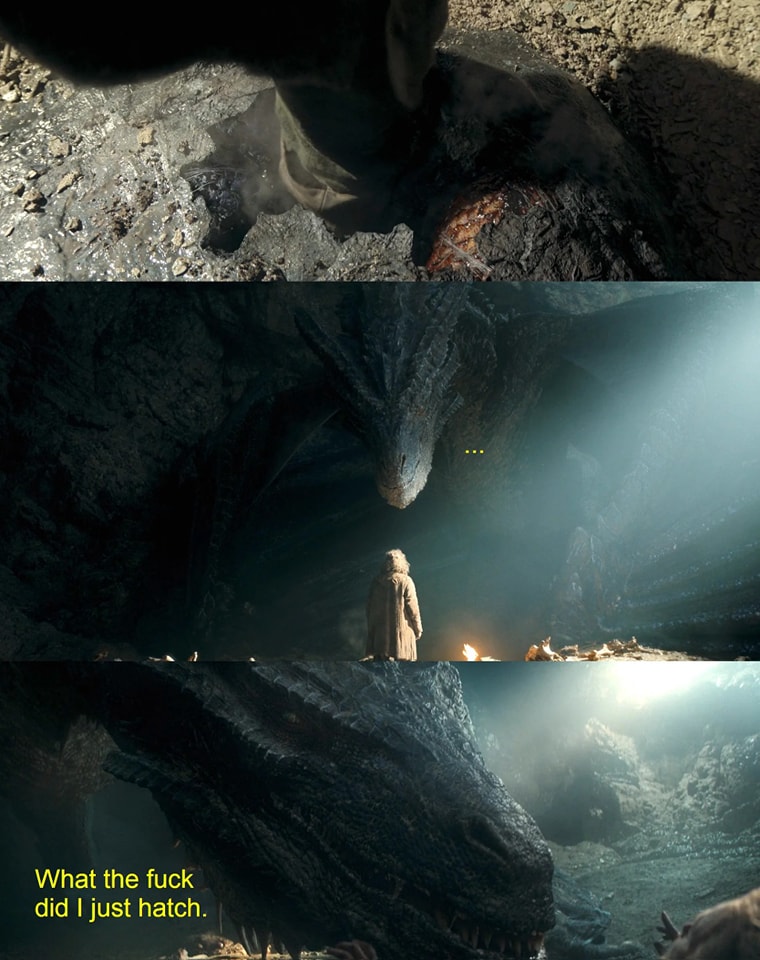
This meme is a humorous edit of a scene from the TV show Game of Thrones where the giant dragon Viserion is seen hatching from the ground. The middle panel shows the man, Jon Snow, standing in front of the massive reptile, while the bottom panel includes the text, "What the fuck did I just hatch." The joke is that this implies the dragon hatched the egg, resulting in the man being the father of the creature.
simple-description (llama3.2-vision_11b)
This meme is from the Game of Thrones series, specifically from the episode "The Dragon and the Wolf" (Season 7, Episode 7). In the scene, a young Maester (a scholar) is talking to a dragon, and he says "What do you know of the world that you have not learned from books?" to which the dragon responds "Nothing. No one knows that who has learned anything from the books of the Maester. The Maester has a lot of knowledge. He has read a lot of books." The dragon then says "What is a book?" to which the Maester responds "A book is a book. It is a book. It is a book."
detailed-analysis (gemma3-27b-vision)
Okay, here's an analysis of the image, broken down into sections based on the requested theoretical frameworks, focusing on the visual elements and how they resonate with those ideas. I’ll indicate when a section isn’t relevant based on the image's content.
Please note: Some interpretations are subjective and rely on understanding the source material (likely House of the Dragon or similar fantasy context) to fill in narrative gaps.
Visual Description
The image depicts a dramatic scene within a cavernous, rocky setting. The most prominent element is a massive dragon, recently hatched or emerging from an egg. It is positioned high above, appearing as a dark, imposing silhouette against the diffused glow of the cave.
- Composition: The image is vertically oriented and emphasizes scale. The dragon dominates the frame, creating a sense of awe and perhaps even dread. The lone human figure below appears dwarfed and vulnerable. The lighting is key; much of the scene is in shadow, with a focused glow illuminating the dragon and a smaller area around the human.
- Color Palette: Dominated by dark browns, grays, and blacks, with hints of light coming from an unseen source. This contributes to the mood of mystery and potential danger. The light is yellowish/golden, possibly from fire or magical sources, and draws the eye to the central subjects.
- Texture: The rocky surfaces are heavily textured, conveying age and a rugged environment. The dragon's form suggests leathery wings, scales, and a powerful physique.
- Symbolism: The dragon is a classic symbol of power, ancient wisdom, and chaos. The hatching is a moment of birth and potential, but also of unpredictable force. The human figure’s posture suggests a mix of wonder and apprehension.
Foucauldian Genealogical Discourse Analysis
This framework examines how power operates through discourse (language, ideas, institutions) and how these discourses shape our understanding of the world.
- Power/Knowledge: The dragon, in this context, embodies a significant form of power. In fantasy settings, dragons often represent not only physical force but also ancient knowledge, magical ability, and a challenge to established power structures. The human figure's posture suggests acknowledgement of this power, an implicit agreement to be part of a larger network of relationships centered around the dragon.
- Genealogy of Power: The hatching itself is a point of rupture and formation. It represents the emergence of power, a re-shaping of the existing order. Tracing the "genealogy" of the dragon's power might involve considering its lineage, its symbolic role in the society depicted, and the rituals/beliefs surrounding it.
- Discursive Formations: The scene implies a whole discourse around dragons. What stories are told about them? What roles do they play in the society? The hatching could be a ceremony, a prophecy fulfilled, or a source of fear/contention. The human figure is a node within this discourse, a participant (or observer) of these power relations.
Critical Theory
This broadly encompasses ideas about challenging dominant ideologies and power structures.
- The Sublime: The scale of the dragon and the cavern evokes the concept of the sublime – an experience of awe and terror in the face of something vast and overwhelming. The image prompts the viewer to contemplate the limits of human understanding and control.
- Myth and Symbolism: The dragon itself is a powerful mythic figure. Critical theory would examine how the dragon serves to reinforce or challenge existing social norms and power dynamics. Is it a benevolent protector, a destructive force, or a symbol of untamed nature?
- The Other: Dragons are often positioned as "the Other" – a force outside of human control, representing what is foreign, dangerous, or different. The scene explores the relationship between humans and this "Other", a relationship that is potentially one of conflict, subjugation, or fragile alliance.
Marxist Conflict Theory
This framework analyzes society in terms of class struggle and economic power.
- Resource Control: Dragons, as powerful creatures, could be seen as representing control over vital resources (territory, wealth, magical ability). The hatching implies a potential shift in this control.
- Power Dynamics: The scene is ripe for interpreting power dynamics between the human and the dragon. Is the human seeking to control the dragon, or vice versa? Is there a struggle for dominance? The image hints at a potential for exploitation or collaboration.
- Symbolic Representation of Class: The dragon could be interpreted as a symbol of the ruling class, possessing immense power and control. The human figure represents a lower class, potentially facing oppression or striving for liberation.
Postmodernism
This often involves deconstructing grand narratives and challenging established truths.
- Fragmented Narrative: The image offers a single, isolated moment. We lack context about the broader story, prompting the viewer to fill in the gaps and create their own interpretation.
- Simulation and Hyperreality: The fantasy setting itself can be seen as a "simulation" of reality, a constructed world that operates according to its own rules. This challenges the notion of objective truth.
- The Death of the Author: The image’s meaning is not solely determined by the creator; the viewer's own experiences and biases shape their interpretation.
Queer Feminist Intersectional Analysis
This examines power structures through the lens of gender, sexuality, race, and other forms of identity.
- Challenging Patriarchal Structures: In some fantasy narratives, dragons have been interpreted as representing a challenge to patriarchal authority, embodying a more fluid and powerful force. The hatching could be seen as disrupting traditional power dynamics.
- Female Power & Monstrosity: The connection between female figures and monstrous creatures (such as dragons) is common in mythology. This framework examines how these connections are used to both empower and demonize women.
- Intersectional Power Dynamics: Exploring how the human figure’s gender, social status, and other identities intersect with their relationship to the dragon and the broader power structure.
Let me know if you’d like me to delve deeper into any of these frameworks or explore additional layers of interpretation!
simple-description (llama3.2-vision)
The meme is a humorous take on a scene from the 2013 film "Game of Thrones" (specifically, the TV series "Game of Thrones" adaptation of the book "A Game of Thrones" by George R. R. Martin). The scene depicts a dragon, named "Drogon", hatching from an egg. The meme includes the text "What the... did I just hatch?"