First Seen
2024-08-15T21:36:04.394536+00:00
simple-description (qwen3.5_2b-q8_0)
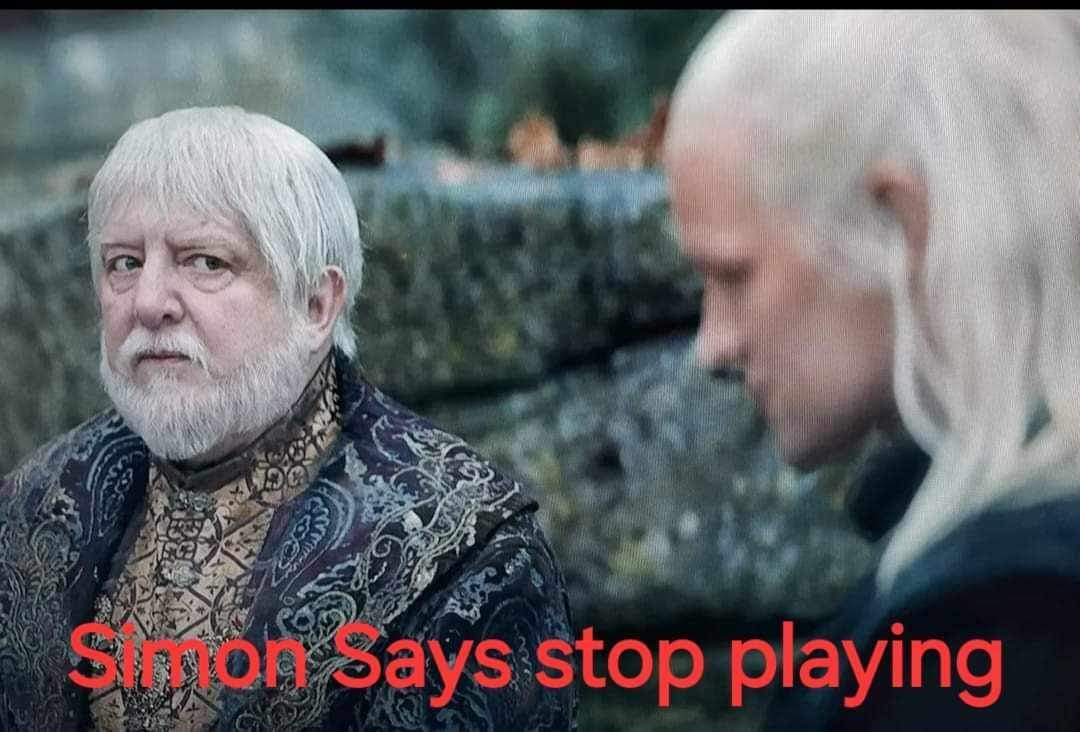
This image is from the final scene of the television series Game of Thrones, depicting the confrontation between the two Lannister families: Jaime Lannister (on the left) and Simon Tully (on the right).
The meme is a parody of the classic "Simon Says" format. In this specific context, the character on the right (Simon Tully) is "playing Simon" to the character on the left (Jaime). The joke is that Simon Tully is the Mayor of Cullion who is attempting to command the Lord Commander to stop his "holy war" and retreat back to the castle to die. The text at the bottom, "Simon Says stop playing," highlights the instruction given by the mayor to the dying commander.
simple-description (llama3.2-vision_11b)
The meme is a screenshot from the Game of Thrones (GoT) series, featuring a character named Petyr "Littlefinger" Baelish, played by actor Peter Dinklage, with a look of shock and a caption "I drink and I...". The caption is a reference to the famous song "I Drink and I...", a humorous take on the character's quote from the show.
detailed-analysis (gemma3-27b-vision)
Okay, here's an analysis of the image, broken down into sections as requested, focusing on applicable theoretical frameworks. Note that certain sections (like Queer Feminist Intersectional Analysis) are less directly applicable given the image's content and context, but I'll attempt reasoned connections where possible.
Please note: Without knowing the exact context of this image (e.g., from what source/episode it comes, and how it's being used as a meme), some interpretations are necessarily speculative. This analysis assumes the image is a still from Game of Thrones, showing Tywin Lannister and Cersei.
Visual Description
The image shows two figures, most prominently an older man with a full white beard and a stern expression. He is positioned on the left side of the frame. He's wearing a richly decorated, dark, patterned garment, suggesting wealth and status. His gaze is directed to the right.
To his right, the image shows the back of a woman’s head and shoulder. She has long, blonde hair, and her posture suggests either sadness or withdrawal. The background is blurred and appears to be foliage, creating a sense of a formal outdoor setting.
Superimposed on the image in bold red font is the text "Simon Says Stop Playing." This text implies a power dynamic and a command being given.
Foucauldian Genealogical Discourse Analysis
This image lends itself well to a Foucauldian analysis. Tywin Lannister's posture and expression embody power/knowledge – his authority isn't simply a result of birthright but is constructed through discourse and displayed through his embodiment. The lavish garment is a material manifestation of this constructed power. He performs the role of a powerful lord.
The phrase "Simon Says Stop Playing" is significant. "Simon Says" is a game of obedience. This frames the interaction as an exercise of disciplinary power. Tywin isn’t just requesting something; he’s invoking a system of rules and expectations that the other person is expected to follow. The very act of commanding establishes a hierarchical relationship and reinforces norms.
A genealogical approach would examine how the idea of the stern, authoritative father/lord has been historically constructed in Westeros (and in our world). It would trace the discourses surrounding lineage, duty, and control that have legitimized this type of power dynamic. The "game" aspect of "Simon Says" points to the constructed nature of social norms and the power to enforce them. The power isn’t inherent; it's produced through repeated performances and accepted conventions.
Critical Theory
From a Critical Theory perspective, the image critiques the structure of power. The command "Simon Says Stop Playing" isn’t a request for reasonable behaviour; it’s a demand for submission. It reinforces a system where one individual exerts control over another.
The image could be seen as embodying a Frankfurt School critique of instrumental reason. Tywin's focus is on maintaining power and control, not on ethical considerations. His "rationality" is geared towards achieving his goals, regardless of the emotional or psychological cost to others.
The image suggests that social interactions are often not about genuine communication but about the exercise of power. The underlying message is that obedience and conformity are rewarded, while resistance is punished.
Marxist Conflict Theory
Applying a Marxist lens, the image can be interpreted as a representation of class conflict and the maintenance of a dominant ideology. Tywin Lannister embodies the ruling class, using his power to control those beneath him (Cersei in this case).
The "Simon Says" command suggests a form of exploitation. Tywin expects Cersei to conform to his expectations, effectively suppressing her agency. This is analogous to the exploitation of the working class by the bourgeoisie, where the ruling class dictates the terms of engagement and benefits from the labor and submission of others.
The wealth displayed in Tywin's clothing further highlights the material disparity between the classes. The image could be seen as a representation of the inherent inequality that is built into the social structure of Westeros (and, arguably, our own).
Postmodernism
A postmodern reading would deconstruct the notion of a single, authoritative interpretation of the image. The superimposed text "Simon Says Stop Playing" creates a layer of irony and intertextuality, referencing a children’s game to subvert the seriousness of the scene.
The image challenges the idea of a stable, coherent self. Tywin and Cersei are performing roles, enacting a power dynamic that is ultimately constructed and artificial. The fragmentation of meaning is reinforced by the juxtaposition of the formal setting and the playful text.
The image can also be seen as a commentary on the hyperreality of media representation. The scene is not "real" but a carefully constructed image that is designed to evoke certain emotions and interpretations. The meme-like addition of the text further emphasizes the artificiality of the image.
Queer Feminist Intersectional Analysis
This framework is the least directly applicable, but connections can be made. Cersei, as a woman in a patriarchal society, is consistently subjected to the control of men (Tywin, Jaime, etc.). The "Simon Says" command underscores this lack of agency.
A feminist analysis would highlight how Tywin’s power is reinforced by patriarchal structures that privilege male authority. The expectation of obedience is gendered, as women are often socialized to be compliant and submissive.
An intersectional perspective would acknowledge that Cersei's experience is shaped not only by her gender but also by her class and lineage. As a member of the powerful Lannister family, she has certain advantages, but these are ultimately outweighed by the patriarchal constraints that limit her agency. The “game” of “Simon Says” can be seen as a metaphor for the power dynamics that constrain women’s lives, forcing them to navigate a world where their voices are often silenced and their agency is undermined. The subtext is a warning: don't step out of line.
I hope this provides a thorough and nuanced analysis of the image from the requested theoretical perspectives. Let me know if you'd like me to expand on any particular point!
simple-description (llama3.2-vision)
This meme is a screenshot from the TV show "House of the Dragon," specifically from a scene where two characters, Lord Corry and Lord Tyrell, are discussing the fate of the kingdom. The text "I know" is written on the screen, but the meme adds the caption "I know" in a sarcastic tone, implying that the character is not actually saying "I know" but rather is actually saying "I don't know" and the other character is saying "I know" in response to that.