First Seen
2023-05-10T21:03:35+00:00
simple-description (llama3.2-vision_11b)
The meme is a humorous comparison between the fictional character Daenerys Targaryen from the Game of Thrones series and the Olympic athlete from the 2012 London Olympics who was known for his unusual appearance and athletic skills. The meme juxtaposes a photo of the Olympic athlete, who was nicknamed "The Night King" (not "Night King") during the 2012 Olympics, with a photo of Daenerys Targaryen, the fictional character from the Game of Thrones series. The text "I'm not the Night King" is likely a humorous response to the idea that the person in the photo is being compared to the "Night King" from the Game of Thrones series.
detailed-analysis (gemma3-27b-vision)
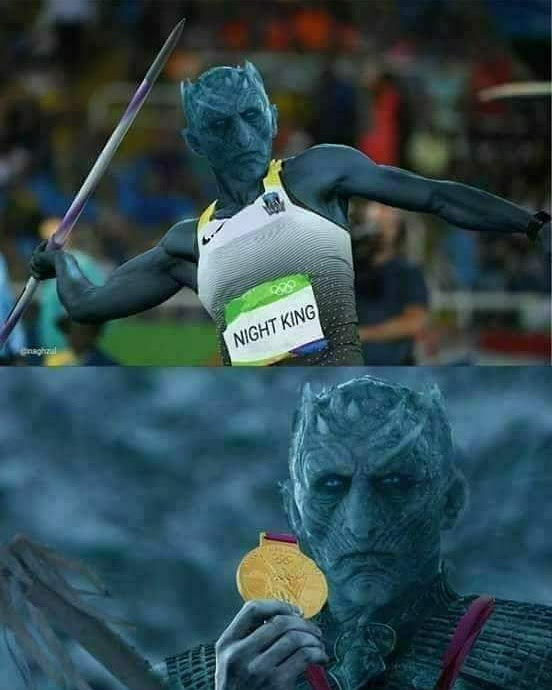
Okay, let's break down this image meme, applying the requested theoretical lenses. It's a humorous juxtaposition of the Night King from Game of Thrones photoshopped into the body of a javelin thrower, culminating in a triumphant pose with a gold medal.
Visual Description
The image is a composite of two photographs. The top image depicts the Night King's head superimposed onto the body of a female javelin thrower in the midst of a throw. She is wearing a Ukraine athletic uniform and a competition bib with "NIGHT KING" printed on it. The background shows a blurred stadium crowd and the green field of the athletic competition. The bottom image is a close-up of the Night King's head (still in the athletic body) holding a gold medal, looking somber or thoughtful. The image is digitally altered to blend the different elements, resulting in a comical and somewhat surreal visual.
Foucauldian Genealogical Discourse Analysis
This meme can be analyzed through a Foucauldian lens by examining how it disrupts discourses of power, athletic prowess, and national identity.
- Disruption of the "Athlete" Discourse: The established discourse surrounding athletes is one of physical peak performance, discipline, and national pride. Replacing the athlete's head with that of the Night King—a symbol of death, cold, and the "other"—directly challenges this. The Night King, by winning, fundamentally subverts the norms associated with athletic achievement.
- Power/Knowledge: The image plays with the power/knowledge relationship. We associate the Night King with a very different kind of power – the power of winter, death, and control through fear. Here, that power is transferred to the athletic arena, creating an unsettling paradox.
- Genealogy: Looking at the “genealogy” of the “athlete” and “villain” archetypes, this image forces us to question the constructed nature of these categories. The Night King is typically opposed to everything athletic achievement represents. The meme traces the historical lines of these concepts to create a new, unexpected association.
- Discipline & Punishment: The image can be seen as disrupting the disciplinary power of athletic competition – the rigorous training, the judging, the rules. The Night King, as a symbol of anti-life, fundamentally destabilizes the very foundations of the competition.
Critical Theory
The meme lends itself well to a critical theory analysis by highlighting themes of subversion, spectacle, and the critique of idealized representations.
- Critique of Spectacle: The meme comments on the spectacle surrounding the Olympics and athletic competitions. By inserting a figure of darkness and destruction, it introduces a note of absurdity and potential crisis into the seemingly celebratory event.
- Deconstruction of Hero/Villain Binary: The image deliberately disrupts the traditional hero/villain binary. The Night King is positioned as a winner, challenging our preconceived notions of who deserves triumph and recognition.
- Ideology: The image deconstructs the ideology surrounding athletic achievement. We typically view athletes as symbols of health, strength, and national pride. The Night King, representing decay and death, destabilizes this.
- The Absurd: The sheer absurdity of the image highlights the constructed nature of many social conventions. It forces us to question why we assign so much significance to athletic achievement in the first place.
Marxist Conflict Theory
From a Marxist perspective, the meme can be interpreted as a commentary on power dynamics and the inherent contradictions within competitive systems.
- Competition & Alienation: The image can be seen as critiquing the inherent conflict within competitive systems. The Night King’s victory, while humorous, highlights the potential for destruction and inequality within a system that prioritizes winning above all else.
- Power & Domination: The Night King’s triumph represents a subversion of the established power dynamics. He is an outside force that has “conquered” the arena, suggesting a critique of those who hold power and control.
- Class Struggle: While not immediately obvious, the meme could be interpreted as a metaphor for the struggle between the “haves” and the “have-nots.” The Night King, as a figure of destruction, could represent the forces that seek to dismantle the established order.
- Commodification of Victory: The meme could comment on how victory (and the accompanying gold medal) is a commodity within capitalist systems, and can be “taken” by those who are willing to disrupt the established rules.
Postmodernism
This meme embodies several key tenets of postmodern thought.
- Pastiche & Intertextuality: The image is a clear example of pastiche, blending elements from Game of Thrones and the world of Olympic athletics. It relies on intertextuality—the recognition of these separate cultural references—to create humor and meaning.
- Deconstruction of Grand Narratives: The image challenges the "grand narrative" of athletic triumph and national pride. By placing a figure of darkness on the podium, it undermines the celebratory nature of the event.
- Simulation & Hyperreality: The image can be seen as a simulation, a copy of a reality that is itself a construction. The combination of disparate elements creates a hyperreal effect, blurring the lines between fantasy and reality.
- Irony & Parody: The entire meme is infused with irony and parody. It mocks the seriousness of athletic competition while simultaneously celebrating it.
Queer Feminist Intersectional Analysis
While the image doesn't explicitly engage with queer or feminist themes, we can apply an intersectional analysis to explore potential readings.
- Subversion of Gendered Athletic Spaces: Historically, athletics has been a heavily gendered space. While women’s athletics have gained more prominence, they have often faced discrimination and marginalization. The Night King occupying a traditionally masculine athletic body challenges these norms, and can be read as a disruption of patriarchal structures.
- The "Other" and Marginalization: The Night King represents the “other,” the figure that is excluded from mainstream society. By placing him on the podium, the meme can be read as a commentary on the marginalization of marginalized groups.
- Intersection of Power and Representation: The image highlights the intersection of power and representation. The Night King, as a figure of darkness, occupies a traditionally privileged position (the winner's podium). This subverts the established power dynamics and challenges our assumptions about who deserves recognition.
- Deconstruction of "Ideal" Bodies: By placing a body so radically different from the typically athletic physique on the podium, the image deconstructs the “ideal” body image often promoted in sports and media.
Important Note: Interpretation is subjective. These are just a few potential readings of the image, and other perspectives are certainly valid. The richness of the meme lies in its ability to generate multiple layers of meaning.
simple-description (llama3.2-vision)
This meme is a humorous mashup of two popular culture references. It shows a photo of the actor Idris Elba, who played the role of Heimdall in the Marvel Cinematic Universe, dressed as the character Heimdall from the Marvel movies, but instead of his iconic armor, he's wearing a sports jersey and holding a javelin. The image includes the text "Night King" on the jersey, a reference to the villainous character from the Game of Thrones TV series.
tesseract-ocr
* a \ =] ww 4 Ae I = : a A Some ; lS es oy f A A be.