First Seen
2023-05-10T21:03:35+00:00
simple-description (llama3.2-vision_11b)
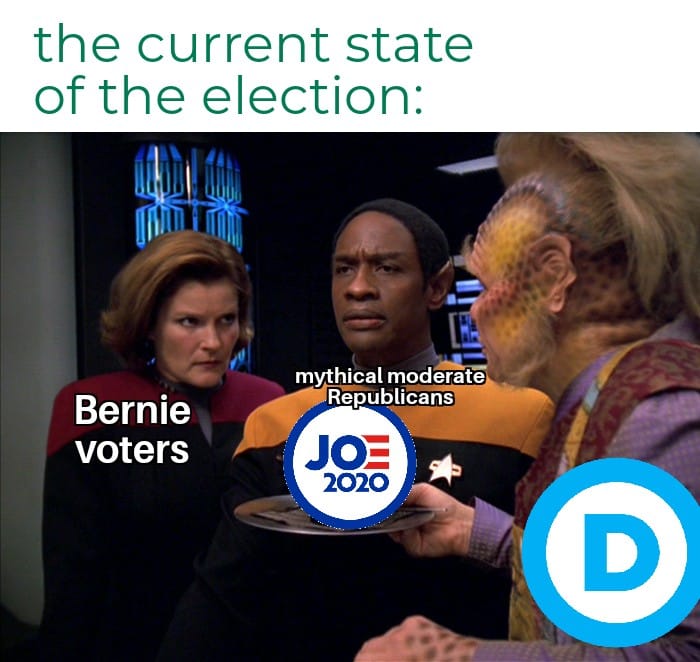
The meme is a humorous commentary on the 2020 US presidential election. It features a still image from Star Trek: The Next Crew, with a character holding a tray of "2020 election" cookies, labeled with different party affiliations. The text "the current state of the election" is at the top of the image, implying that the election is a mess, and the character is serving up a "2020 election" dessert with a label that reads "Bernie voters, Democrats, Republicans, and 'mythical moderate Republicans'".
detailed-analysis (gemma3-27b-vision)
Okay, let's break down this meme using the requested theoretical frameworks. It's important to note that applying these frameworks often involves interpretation and can be subjective, as the meme is open to multiple readings.
Visual Description
The meme is a digitally altered image taken from a scene on the bridge of the Star Trek: The Next Generation spaceship, the Enterprise. The original scene likely shows crew members at their stations. It has been manipulated to represent the 2020 US Presidential election, specifically the Democratic Party and its voters.
- Characters:
- Bernie Voters: Represented by the character Deanna Troi (Marina Sirtis) with bright red hair. She appears to be looking on with disapproval.
- Mythical Moderate Republicans: Represented by the character Geordi La Forge (LeVar Burton), who is looking in another direction with a confused/distracted look.
- Joe Biden/Democratic Party: Represented by Captain Jean-Luc Picard (Patrick Stewart) holding a "Joe 2020" badge.
- Symbolism: The bridge of the Enterprise implies a ship of state, and its crew are symbolically the electorate.
- Overall Impression: The image depicts a fractured or strained dynamic. The placement and expressions of the characters imply a disconnect between different voting blocs, and a feeling of disappointment or frustration among Bernie voters.
Foucauldian Genealogical Discourse Analysis
This meme can be analyzed through Foucault's lens of discourse and power/knowledge. The meme constructs a specific discourse around the 2020 election and the Democratic Party:
- Power/Knowledge: The meme operates within a pre-existing power structure. The very act of labelling groups ("Bernie voters," "Mythical Moderate Republicans") creates categories that implicitly exert power. Those labels define and classify, thereby limiting the possibilities of self-definition.
- Genealogy of 'Moderate Republican': The term "Mythical Moderate Republicans" is key. Foucauldian genealogy would trace the history of this term. It suggests a belief that moderate Republicans who used to be a significant voting block no longer exist, or have been absorbed into the Democratic Party. The meme constructs an image of them as almost legendary, a "phantom" group, which questions the reality of their existence within the current political landscape.
- Discursive Formation: The meme participates in a discursive formation around the perceived failures of the Democratic Party to embrace more progressive policies. It’s a short-hand way of saying that the “establishment” (represented by Biden/Picard) ignores the desires of its progressive base (Bernie voters).
- Control and Normalization: By visually depicting this imbalance, the meme implies a need for change in how the Democratic Party functions. It challenges the "normalization" of centrist politics.
Critical Theory (Frankfurt School)
From a Critical Theory perspective, this meme reflects a concern with the perceived manipulation and distortion of democratic processes.
- Culture Industry: The meme itself is part of the "culture industry"—a tool of mass communication used to shape public opinion. It’s a bite-sized critique of the political system, designed for easy dissemination via social media.
- Loss of Authenticity: The 'Mythical Moderate Republican' label suggests a lack of genuine political engagement and a decline in authentic political dialogue. It implies that moderate Republicans are not acting in their own interests or that they're being represented by a false proxy.
- Ideology: The meme subtly reinforces a specific ideology—that the Democratic Party is failing to live up to its potential and that it's too beholden to centrist interests. This ideology is presented as a common-sense critique, rather than as a consciously held belief system.
- Reason vs. Instrumental Reason: The meme suggests a need for a more rational approach to politics—one that prioritizes the needs of the people over the interests of power.
Marxist Conflict Theory
A Marxist interpretation views the meme as expressing tensions between different class interests within the Democratic Party.
- Class Struggle: While not explicitly about economic class, the meme implies a struggle for power within the Democratic Party between different ideological factions. Bernie voters, often representing working-class or socially conscious interests, are positioned as being marginalized by the establishment.
- False Consciousness: The 'Mythical Moderate Republican' label could be seen as a form of "false consciousness"—a way of obscuring the true interests of the ruling class (in this case, the centrist Democrats).
- Superstructure: The political sphere (the election, the Democratic Party) is viewed as part of the "superstructure" that reinforces the existing power relations in society. This meme is a critique of that superstructure.
- Alienation: Bernie voters might feel alienated from the Democratic Party because their values and concerns are not being adequately addressed.
Postmodernism
A postmodern reading highlights the constructed nature of reality and the instability of meaning.
- Simulacra and Simulation: The meme operates as a "simulacrum"—a copy of a copy that has lost its connection to any original reality. The political figures are represented by Star Trek characters, creating a layered and artificial representation of the election.
- Deconstruction: The meme deconstructs the traditional categories of political identity by associating them with fictional characters. It challenges the idea that these categories are fixed or natural.
- Fragmentation: The meme depicts a fragmented political landscape, where different groups are disconnected and unable to communicate effectively.
- Meta-narratives: The meme implicitly rejects the idea of grand narratives (e.g., the traditional American Dream) and suggests that political reality is complex and multifaceted.
Queer Feminist Intersectional Analysis
While not overtly focused on gender or sexuality, an intersectional analysis can offer a nuanced reading.
- Marginalization: The positioning of Bernie voters (often representing progressive, intersectional views) as being overlooked by the establishment can be seen as a metaphor for the marginalization of other historically oppressed groups.
- Power Dynamics: The meme implicitly acknowledges the power dynamics within the Democratic Party and the ways in which certain groups are privileged over others.
- Representation: The choice of characters—particularly a female character (Troi) representing a marginalized group—could be seen as a subtle commentary on the lack of representation in politics.
- Discourse and Identity: The meme participates in a broader discourse about identity and political affiliation, and the ways in which these categories are constructed and contested.
Important Note: These are just interpretations based on the theoretical frameworks. The meme is open to multiple readings, and its meaning will depend on the individual viewer and their own experiences and beliefs.
simple-description (llama3.2-vision)
This meme is a humorous commentary on the 2020 US presidential election. The image depicts a scene from the TV show Star Trek: The Next Generation, where the character of Deanna Troi is being served a "cake" with a label that reads "The 2020 US Presidential Election". The label is actually a cake with the words "Bernie voters", "Moderate Republicans", "The 2020 US Presidential Election", and "Democratic Party" labels on it, implying that the cake is a representation of the election's three main factions.
tesseract-ocr
the current state of the election: nO ul) — am lt? . mythical nods / Bernie P eemeis Be am v voters tH Ho: rg ©