First Seen
2023-05-10T21:03:35+00:00
simple-description (llama3.2-vision_11b)
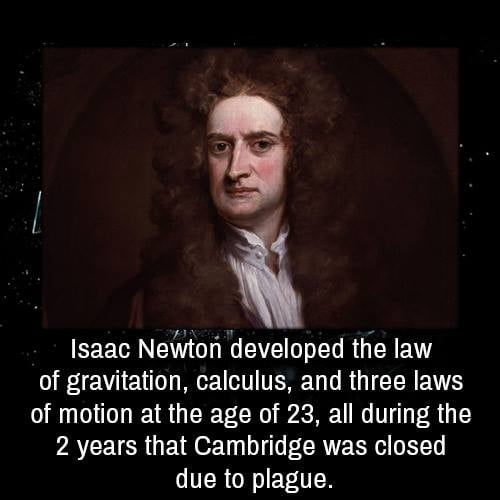
This meme is a humorous comparison between the famous scientist Isaac Newton and a fictional character from a medieval fantasy novel. The text at the bottom of the image reads, "Isaac Newton developed the law of gravitation, calculus, and three laws of motion at the age of 23, all during the 2 years that Cambridge was closed due to the plague." This is a play on the fact that the University of Cambridge was closed during the 2 years of the plague, and that Isaac Newton was a student at the university.
detailed-analysis (gemma3-27b-vision)
Okay, let's break down this image and text through the lenses you've requested. I'll organize it into sections, only including those relevant to the image and text.
1. Visual Description
The image is a portrait of Isaac Newton, depicted in a formal style typical of the 17th/18th century. He is a white man, wearing a brown coat, and a white shirt with a red tie/cravat. His gaze is directed toward the viewer, appearing serious and composed. The background is a dark, indistinct brown/black. The composition is classic portraiture, focusing on the individual's face and upper body. The lighting is somewhat dramatic, with highlights and shadows emphasizing his features. Beneath the image is text stating that Newton developed key scientific principles (gravity, calculus, laws of motion) at age 23, during the two years Cambridge University was closed due to plague.
2. Foucauldian Genealogical Discourse Analysis
This image and text provide a fascinating entry point for a Foucauldian analysis. Foucault would be less interested in Newton as a genius, and more interested in how Newton came to be understood as such, and how that understanding connects to power/knowledge.
- Discourse: The text establishes a discourse around "genius" and "productivity in isolation." It implies that Newton's breakthroughs were because of the plague, framing the crisis as a positive catalyst for intellectual progress. This discourse normalizes the idea that exceptional individuals can overcome adversity and produce great works, while potentially obscuring the systemic conditions that made this possible (access to education, resources, leisure time).
- Power/Knowledge: The portrayal of Newton solidifies his authority as a "father of modern science." This authority is not simply inherent in his discoveries but is produced by the historical processes of canonization and the selective emphasis on certain narratives. The text frames the story in a way that reinforces Newton's exceptionalism, reinforcing the power structures of scientific authority.
- Genealogy: A genealogical tracing would look at how the narrative around Newton and the plague developed over time, how it’s been used to legitimize certain forms of knowledge (scientific reason, individual achievement) and to marginalize others. The story becomes a “truth” that shapes our understanding of history, science, and even what constitutes productive work.
- The Abnormal and Normal: The plague itself is presented as an abnormal event that ironically allowed for normal scientific progress. This reinforces the idea that disruptions can have positive outcomes and justifies the idea that progress requires some sacrifice or disruption.
3. Critical Theory
From a critical theory perspective, especially influenced by the Frankfurt School, this image and text point towards the myth of "Reason" and "Progress."
- Instrumental Reason: The emphasis on Newton’s discoveries as “achievements” highlights the idea of reason as a tool for domination over nature. It implies that scientific progress is inherently positive, while potentially obscuring the social and ethical consequences of applying scientific knowledge.
- The Enlightenment Project: The story of Newton during the plague subtly reinforces the Enlightenment narrative of reason triumphing over superstition and disease. This narrative can obscure the darker side of the Enlightenment, including colonialism, exploitation, and the suppression of alternative knowledge systems.
- Commoditization of Knowledge: The image and text could be seen as a form of symbolic capital, where Newton's genius is used to legitimize the pursuit of scientific knowledge and technological advancement. This pursuit is often driven by economic and political interests, and the story of Newton helps to mask these underlying motivations.
- Mythmaking: The image and text create a myth around Newton, a “lone genius” working in isolation, overcoming adversity. This myth serves to obscure the collaborative nature of scientific inquiry and the role of social and economic forces in shaping scientific knowledge.
4. Marxist Conflict Theory
A Marxist analysis would see the story through the lens of class, power, and material conditions.
- Social Context: While it doesn't explicitly address class, the fact that Newton was a privileged individual (able to pursue education at Cambridge) is crucial. The ability to study, reflect, and conduct research was dependent on a specific social structure that afforded him that luxury. The plague affected different classes in different ways, and the narrative focuses on how the crisis benefited one individual.
- Ideology: The story of Newton as a lone genius serves to reinforce the dominant ideology of individual achievement and meritocracy. This ideology obscures the role of systemic factors (education, wealth, social connections) in determining success.
- Power Relations: The emphasis on Newton’s discoveries reinforces the power of the scientific elite and their control over knowledge production. It obscures the fact that knowledge is often used to maintain existing power structures.
- Contradictions: There’s a contradiction in celebrating intellectual progress during a time of widespread suffering and death. A Marxist perspective would emphasize the human cost of the plague and the inequalities that shaped who benefited from the crisis.
Let me know if you’d like me to elaborate on any of these sections or explore other analytical lenses!
simple-description (llama3.2-vision)
The meme is a humorous image of Isaac Newton as a child, with a caption that reads: "Isaac Newton developed the law of gravitation, calculus, and three laws of motion at the age of 23, all during the 2 years that Cambridge was closed due to plague." The image is likely a joke or a meme that is playing on the idea that Isaac Newton was a child prodigy who achieved great things at a young age.
tesseract-ocr
F , | 7 | 4 Isaac Newton developed TNE of gravitation, calculus, and three laws Co) miele Vater) esc eer- UROL U em UT) 2 years that Cambridge was closed due to plague.