First Seen
2023-08-17T20:08:53+00:00
simple-description (qwen3.5_2b-q8_0)
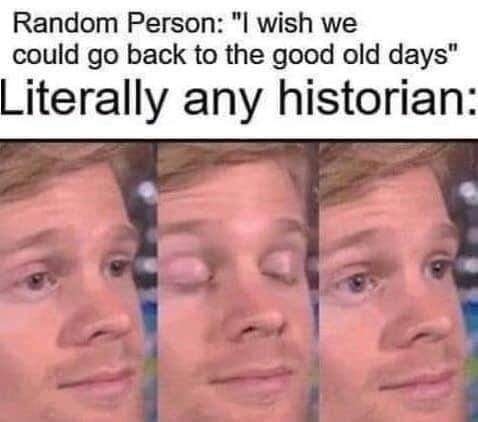
This meme is a joke about how ill-equipped modern people are when it comes to history. It features a sequence of three pictures of the same person, Alicia Bergstein, whose expression changes from confusion to annoyance, and finally to extreme disappointment.
The text at the top reads:
"Random Person: 'I wish we could go back to the good old days'"
"Literally any historian:"
The image satirizes this by implying that people who don't know the history of things are so stupid they need a historian to save them.
simple-description (llama3.2-vision_11b)
This meme is a humorous commentary on the challenges of being a historian. The image features a photo of a person with a confused expression, with the caption "I wish I could go back to the good old days" - a phrase that is often used to express nostalgia for a bygone era. The meme is poking fun at the idea that historians are often expected to be nostalgic for the past, but in reality, they are often more interested in understanding the complexities of the present.
detailed-analysis (gemma3-27b-vision)
Okay, let's break down this meme through the lens of the requested theoretical frameworks.
Visual Description
The meme is a three-panel image using the "Distracted Boyfriend" format, but with a single person, a white man (often identified as Michael Cera) presented three times, each with slightly more exaggerated eye roll. The top text reads "Random Person: 'I wish we could go back to the the good old days'" and underneath it reads "Literally any historian." The visual effect portrays growing irritation and exasperation. The repeated face emphasizes a consistent, almost involuntary reaction.
Foucauldian Genealogical Discourse Analysis
This meme resonates strongly with a Foucauldian approach. The phrase "the good old days" is a discourse – a system of thought, language, and practice that constructs a particular understanding of the past. Historians, especially those influenced by Foucault, would be deeply skeptical of such a claim because it naturalizes a particular power dynamic. The meme indicates that the historian would find the statement problematic, because the 'good old days' always implies an erasure of other realities, struggles, and experiences.
- Power/Knowledge: The idea of "good old days" implies a power structure that legitimized certain ways of life while silencing others. Historians would examine how that power operated, what knowledge was produced and suppressed, and who benefited from the construction of a nostalgic past.
- Genealogy: Rather than accepting the idea of a naturally "good" past, a genealogical approach would trace the historical emergence of this narrative. What conditions (social, political, economic) led to the creation of this nostalgia? How has the meaning of “the good old days” changed over time? The meme signifies a historian immediately rejecting the idea of a stable, universally agreeable past and calling for deeper inquiry.
- Discursive Formation: The nostalgic statement is not simply a description of the past, but an active creation of a particular history. The historian, in their frustrated expression, resists this creation.
Critical Theory
The meme’s humor stems from the critical tension between everyday assumptions and scholarly analysis. Critical Theory, particularly the Frankfurt School, deals with the critique of ideology and the uncritical acceptance of dominant narratives.
- Ideology: The phrase "the good old days" can be seen as an ideological statement that obscures exploitation, oppression, and social inequality. It presents a romanticized, often inaccurate picture of the past.
- Critique of Enlightenment Reason: The historian's reaction points to a rejection of the simple, linear idea of progress often associated with Enlightenment thought. The statement assumes a past better than the present, potentially ignoring the real and complex problems of that era.
- Emancipatory Knowledge: A critical historian wouldn't just point out the flaws in the nostalgic claim but would attempt to reveal the underlying power structures that maintain it. The meme suggests a weariness with having to constantly debunk this sort of simplistic thinking.
Marxist Conflict Theory
From a Marxist perspective, the phrase "the good old days" is deeply problematic because it often masks the inherent class conflict and exploitation present in any historical period.
- Class Struggle: The 'good old days' were good for whom? Marxist historians would immediately question whose interests are served by this narrative. For the ruling class? For those who benefited from colonialism or slavery? The meme implies a recognition that nostalgia often ignores the material conditions and struggles of the majority.
- False Consciousness: The nostalgic claim can be seen as a form of false consciousness – a way of obscuring the real material conditions of the past and preventing revolutionary thought.
- Mode of Production: The historian's reaction suggests an awareness that every historical period is characterized by a specific mode of production and the resulting class relations. To romanticize a past period ignores the inherent contradictions and injustices of that system.
Postmodernism
Postmodern thought would challenge the very idea of a unified, objective “past” that can be nostalgically idealized.
- Rejection of Metanarratives: The meme embodies a rejection of the idea of a singular, overarching historical narrative. There is no universal "good old days." History is fragmented, subjective, and constructed through multiple perspectives.
- Deconstruction: A postmodern historian would "deconstruct" the phrase "the good old days," exposing its internal contradictions and power dynamics. They would ask: good for whom? What is being omitted or silenced?
- Simulacra and Simulation: The nostalgic claim could be seen as a form of simulacrum – a copy without an original. It is a manufactured image of the past that has little to do with actual historical reality.
Queer Feminist Intersectional Analysis
The meme’s implications are particularly strong when viewed through a Queer Feminist Intersectional lens.
- Silencing of Marginalized Voices: "The good old days" often represent a period where marginalized groups – women, people of color, LGBTQ+ individuals – faced systemic oppression and discrimination. Nostalgia for that era inherently silences their experiences and minimizes their suffering.
- Intersectionality: The nostalgic claim ignores the complex and intersecting forms of oppression that shaped the lives of individuals in the past. It's not enough to say “things were simpler” if that simplicity was built on the backs of marginalized communities.
- Critique of Normativity: The very notion of "the good old days" implies a desire to return to a past characterized by traditional norms and hierarchies. A Queer Feminist historian would challenge these norms and expose their exclusionary nature.
In conclusion, this meme is cleverly layered. It's not just a funny image; it’s a concise expression of the critical skepticism that underlies much of historical scholarship, particularly when informed by these theoretical frameworks.
simple-description (llama3.2-vision)
This meme is a humorous take on the idea of nostalgia for a bygone era. It features a split-screen image of a person with a "wistful" expression, with the top half showing a person looking sad and the bottom half showing the same person with a "tongue-in-cheek" expression. The text above the image reads: "Random person: 'I wish we could go back to the good old days.' Literally any historian:".
tesseract-ocr
Random Person: "| wish we could go back to the good old days" Literally any historian: ae PP i, et <>,