First Seen
2023-05-10T21:03:35+00:00
simple-description (llama3.2-vision_11b)
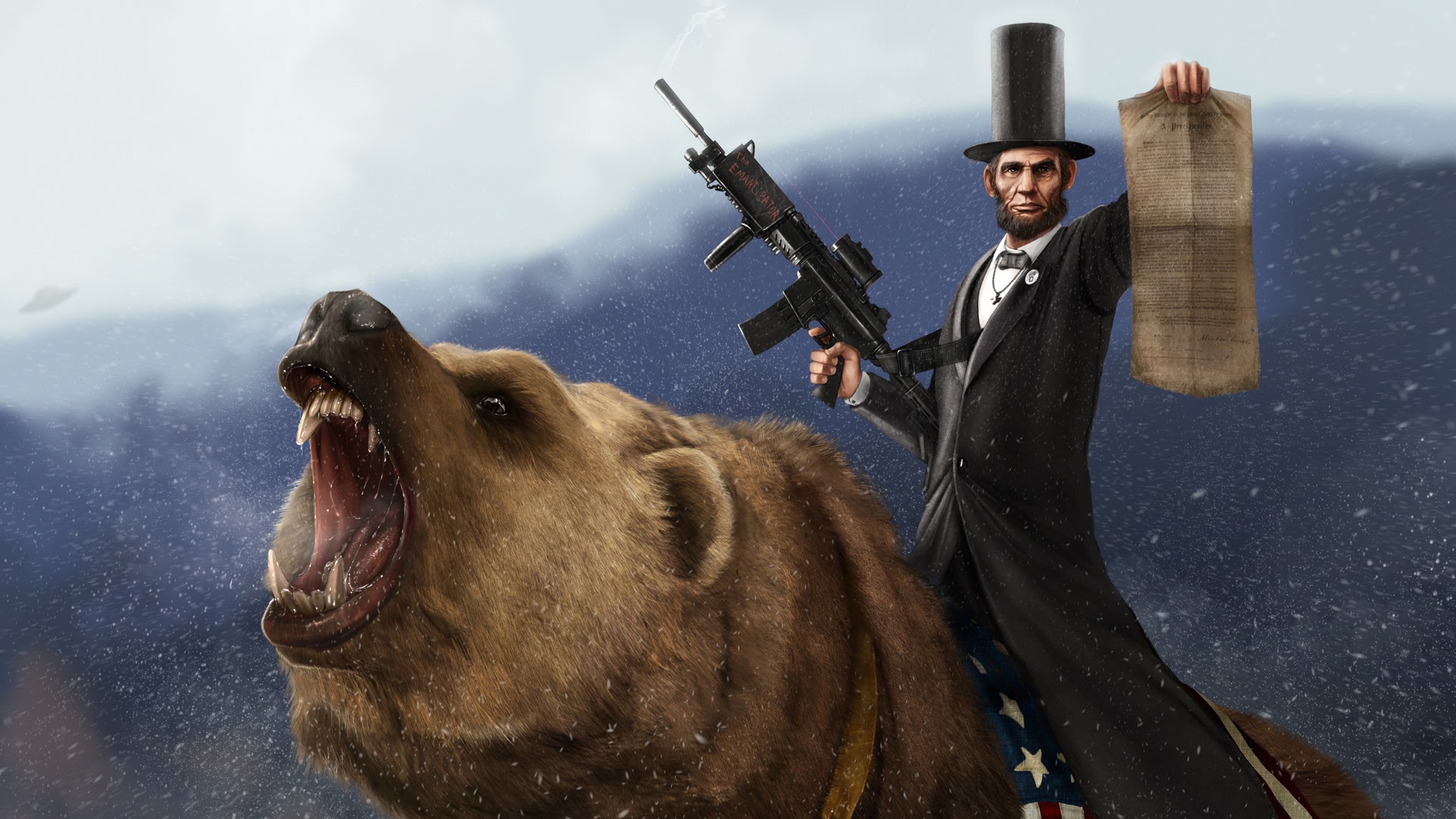
The meme is a humorous image of Abraham Lincoln, the 16th President of the United States, riding a bear while holding a gun and a copy of the Constitution. The image is a playful and absurd take on the historical figure, using a bear as a mount and a gun as a symbol of his "fear" of the bear. The image is likely meant to be humorous and satirical, poking fun at the idea of Lincoln as a "fear" of bears.
detailed-analysis (gemma3-27b-vision)
Okay, let's break down this… striking image through various theoretical lenses. It's quite a provocative piece, so several of these sections will be applicable.
1. Visual Description
The image depicts Abraham Lincoln riding a large, roaring grizzly bear. Lincoln is dressed in his iconic formal attire: a black coat, white shirt, and top hat. He holds a rolled-up document in his right hand and a modern assault rifle (an AR-15 style weapon) in his left. The bear is mid-roar, baring its teeth, and appears dynamically posed as though in motion. The background is a blurred, snowy landscape. Notably, the bear’s fur has a subtle pattern of the American flag embedded in it. The overall style is illustrative, leaning towards digital art, and exhibits a level of hyperrealism in the textures (bear fur, fabric) juxtaposed with a fantastical scenario. The composition is dynamic, emphasizing movement and power.
2. Foucauldian Genealogical Discourse Analysis
This image is ripe for a Foucault-inspired analysis. The image doesn’t simply show Lincoln, it constructs a discourse around power, authority, and American identity.
- Power/Knowledge: The juxtaposition of Lincoln with the bear and the AR-15 is a crucial power/knowledge nexus. Lincoln, historically a symbol of emancipation and union, is reimagined as a wielder of forceful, even aggressive, power. The bear represents raw, untamed power, and the weapon represents modern, lethal force. This suggests a reframing of American leadership – a shift from rhetoric of unity and progress to the assertion of dominance and control.
- Genealogy of the American Self: This image deconstructs the traditional narrative surrounding Lincoln and American identity. It traces how the image of Lincoln has been constructed and re-constructed over time. The introduction of the bear and the gun represents an almost primordial, survivalist aspect of the American psyche that is being asserted. This is a "genealogy" because it seeks the historical origins of power and how it evolves over time, revealing its constructed nature.
- Disciplinary Power: The image implies a disciplinary power – a kind of symbolic enforcement of order through fear and force. The roaring bear, as a symbol of potential violence, acts as a deterrent, reinforcing a particular vision of American authority. The AR-15 is a more direct embodiment of this force.
3. Critical Theory
This image strongly invites analysis through the lens of Critical Theory.
- Ideology: The image can be interpreted as a deeply ideological statement. It’s not a neutral depiction but an assertion of a specific worldview. It implicitly reinforces the idea that strength and even aggression are essential for maintaining order and protecting American interests. The flag woven into the bear’s fur signifies nationalism and a claim to a singular American identity.
- Hegemony: This image attempts to establish hegemony – the dominance of one group's ideas and values over others. The image’s appeal rests on the existing cultural reverence for Lincoln, which is then overlaid with a more aggressive and militaristic message. This seeks to normalize the idea of forceful power as a legitimate component of American leadership.
- Critique of Enlightenment Reason: The juxtaposition of an Enlightenment figure like Lincoln with untamed animalistic power challenges the notion of reason and progress as the sole drivers of history. It suggests that beneath the veneer of Enlightenment values lie primal instincts and a willingness to use force.
4. Marxist Conflict Theory
The image can be understood as representing a power dynamic fueled by class conflict and the ongoing struggle for resources.
- The State as Instrument of Class Rule: Lincoln, as a representative of the state, is positioned atop the bear, signifying control and dominion. The bear itself can be seen as representing the working class or the exploited masses – a powerful force that is harnessed and directed by those in power.
- Violence and the Means of Production: The AR-15 is a clear symbol of violence and control, and ultimately represents the means of enforcing the existing economic order. It suggests that maintaining power often requires the threat or use of force.
- Ideological Justification of Inequality: The image can be seen as an ideological tool used to justify social and economic inequalities. By portraying leadership as inherently forceful and dominant, it reinforces the notion that some groups are naturally suited to rule while others are meant to be ruled.
5. Postmodernism
The image embodies several characteristics of Postmodern art and thought.
- Pastiche & Juxtaposition: The image is a striking example of pastiche – the mixing of different styles and historical periods. Combining the 19th-century figure of Lincoln with a modern weapon and a wild animal creates a jarring and unsettling effect.
- Deconstruction of Grand Narratives: The image challenges the traditional “grand narrative” of American history – a narrative that typically emphasizes progress, freedom, and equality. By presenting Lincoln as a forceful, even intimidating figure, it deconstructs this narrative and exposes its underlying power dynamics.
- Simulation & Hyperreality: The image creates a hyperreal and simulated version of American leadership. It’s not a realistic depiction but a constructed representation that emphasizes certain themes and messages. The embedded flag in the bear's fur pushes this further - it's a symbol of a symbol.
6. Queer Feminist Intersectional Analysis
This lens is more nuanced in its application, but still relevant.
- Masculinity and Power: The image is overwhelmingly masculine. Lincoln is presented in a hyper-masculine pose – strong, authoritative, and wielding weapons. This reinforces traditional patriarchal norms and the association of power with masculinity. The bear itself embodies raw, aggressive masculinity.
- Intersectional Power Dynamics: While the image doesn’t explicitly address issues of race, gender, or class, it’s important to consider how these intersect with the themes of power and domination. A reimagining of a historically white, male figure atop a powerful beast could be read as a reinforcement of existing power structures.
- Challenge to Traditional Symbols: While the image primarily reinforces power dynamics, a queer feminist interpretation might also identify a subversive element in the jarring juxtaposition of elements. This might be a challenge to traditional symbols of authority and a call for a more nuanced and inclusive understanding of leadership.
In conclusion, this is a complex and provocative image that invites multiple interpretations. It’s a powerful statement about power, identity, and the ongoing struggle for control in American society. Each theoretical lens sheds light on different aspects of its meaning and significance.
simple-description (llama3.2-vision)
The meme features a picture of Abraham Lincoln, the 16th President of the United States, riding a bear while holding a rifle and a copy of the U.S. Constitution. The image is humorous because it juxtaposes the iconic image of Lincoln, known for his strong leadership and moral character, with a violent and unpredictable animal. The text "Honest Abe" appears in the image, referencing Lincoln's reputation for honesty and integrity.
tesseract-ocr
st) om ee 5 2 7 a ( eo ae A F a BN a la eo . a F oie > @ —_— ne q “OR yf es ae ee. 0 ‘i . Y i eS ea A i) yi i ual i ig a aL a —— HN Fi : vi. . 3 —" , ; eee len ROAR RASS : : eee eae os 7 1 ARRAS RRS OS = : - _- 2 = ae Gs as P Pid a as A SSN ¥ ; ria aad ii / AS RARRROR Sage On Mh, TMA. AN NN i y am 5 4 a . ‘N