First Seen
2023-05-10T21:03:35+00:00
simple-description (llama3.2-vision_11b)
The meme is a humorous take on the infamous 2019 NFL playoff game between the New Orleans Saints and the New York Giants. The image features a shirt with a quote from a Saints fan, "I DID NOT HIT HER IT'S BOOLSHIT I DID NAAHT," which is a play on the infamous "I DIDN'T DO IT" phrase. The text is a humorous take on the infamous "I DIDN’T DO IT” phrase, a reference to the 2019 NFL game.
detailed-analysis (gemma3-27b-vision)
Okay, here's a breakdown of the t-shirt, analyzed through the frameworks you requested, with sections only where applicable. This is a complex piece with serious implications, so a thorough analysis will be lengthy.
Visual Description
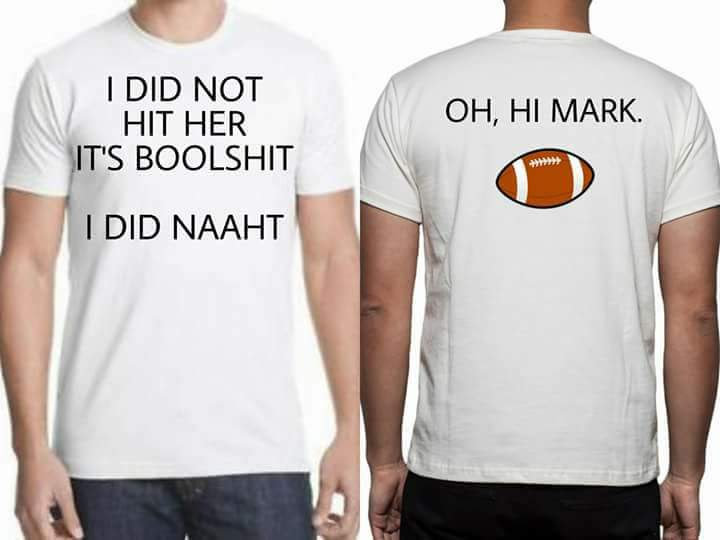
The image depicts a white, short-sleeved t-shirt modeled by a person with medium skin tone. The front of the shirt features a text layout in bold, sans-serif, black lettering that reads: “I DID NOT HIT HER IT’S BOOLSHIT” directly above the word "I DID NAAHT". The back of the shirt has a small, stylized American football graphic in brown with white stitching, and directly above the football graphic, the text "OH, HI MARK." is in black, sans-serif font. The shirt is simple in design and appears to be made of standard cotton material.
Foucauldian Genealogical Discourse Analysis
This t-shirt is ripe for a Foucauldian analysis. It's not just a statement; it's a discourse, a system of thought that shapes how we understand (and normalize) violence against women. Here's how:
- Genealogy of the Statement: The phrase "I did not hit her" is a direct reference to the infamous Chris Brown/Rihanna domestic violence case. Brown used this exact phrasing in an interview with Larry King, attempting to minimize the severity of his actions and frame the violence as something other than what it was. The misspelling, "BOOLSHIT", serves to mimic Brown's defensive, almost dismissive tone. The addition of "I DID NAAHT" is a further mockery of Brown's statement. The "OH, HI MARK" is likely a reference to Ray Rice, who also attempted to diminish his actions against his wife.
- Power/Knowledge: The shirt reveals the complex interplay of power and knowledge. By referencing and appropriating this infamous statement, the shirt reproduces the discourse of victim-blaming and denial. It doesn't challenge the power structures that allow domestic violence to thrive; it subtly reenacts them.
- Disciplinary Power: The t-shirt's existence as a commodity taps into a broader system of disciplinary power. It's a form of consumption that normalizes a conversation around minimizing violence against women, turning a traumatic event into a marketable object.
- The Absent Victim: Crucially, the victim (Rihanna) is entirely absent from the discourse presented on the shirt. The statement is only about the perpetrator's denial and attempt to control the narrative. This erasure is a key feature of patriarchal power dynamics.
Critical Theory
The t-shirt is a powerful example of how culture can reinforce oppressive ideologies. From a critical theory perspective:
- Ideology and Hegemony: The shirt represents a manifestation of patriarchal ideology, the system of beliefs that justifies male dominance and control. By referencing and replaying the dismissive phrasing around domestic violence, the shirt subtly reinforces the notion that violence against women is not always a serious offense or the perpetrator's fault. This contributes to a hegemonic culture where such behaviors can be normalized or minimized.
- The Culture Industry: The shirt is a product of the culture industry (Adorno and Horkheimer). It turns a horrific act of violence into a consumable commodity, stripping it of its seriousness and reducing it to a superficial item of clothing. This commodification desensitizes us to the reality of domestic violence and contributes to its normalization.
- Alienation: The shirt's existence as a commodity alienates us from the true impact of domestic violence. It removes the human element and transforms a real-life trauma into a superficial object.
Marxist Conflict Theory
While not the most central lens, a Marxist analysis can reveal some underlying dynamics:
- Power and Class: Patriarchy, like all systems of oppression, is deeply interwoven with power dynamics. The act of domestic violence and the subsequent attempt to minimize it are expressions of power and control. The shirt, as a commodity, is produced and sold within a capitalist system that often exploits and commodifies marginalized groups (including women).
- False Consciousness: The shirt could be seen as contributing to a "false consciousness" among those who purchase and wear it. It obscures the true nature of domestic violence and reinforces the ideology that minimizes its severity.
Queer Feminist Intersectional Analysis
This is where the analysis becomes particularly potent. The t-shirt is deeply problematic from a Queer Feminist Intersectional perspective:
- Intersectionality: The shirt focuses exclusively on the relationship between a man and a woman, erasing the experiences of queer and trans individuals who are also victims of domestic violence. It perpetuates the idea that domestic violence is a heterosexual phenomenon, ignoring the fact that it exists in all types of relationships. The t-shirt ignores the ways race, class, disability, and immigration status intersect with gender to create unique vulnerabilities to domestic violence.
- Normalization of Violence: The shirt normalizes violence against women by framing it as something that can be dismissed or joked about. This contributes to a culture of impunity for perpetrators and discourages victims from seeking help.
- Reinforcing Patriarchy: The shirt reinforces patriarchal power dynamics by centering the perpetrator's perspective and minimizing the harm done to the victim. It validates the notion that men are entitled to control and dominate women.
- Silencing Victims: By referencing the perpetrator's statement, the shirt further silences the victim and perpetuates the narrative that her voice doesn't matter. This contributes to a culture where victims are often blamed for the violence they experience.
- Commodification of Trauma: The shirt commodifies trauma by turning a horrific act of violence into a marketable product. This reduces the victim's experience to a commodity and reinforces the idea that her pain is not valued.
In Conclusion
This t-shirt is far more than a simple fashion statement. It's a complex cultural artifact that reveals deeply problematic ideologies and power dynamics. It’s a reproduction of minimizing violence, a product of commodification, and a silencing of victims. Examining it through these critical lenses reveals the ways in which culture can reinforce and perpetuate harmful beliefs.
simple-description (llama3.2-vision)
The meme is a humorous image of a football player who has just made a mistake on the field. The text on the shirt reads "I did not hit her, I did not... Oh, hi Mark" which is a playful reference to a famous TV show "I did not...". The image is likely meant to be funny and lighthearted, poking fun at the idea of a football player's mistake.
tesseract-ocr
oe Fa IDIDNOT (ov, Hi Mank ITS BOOLSHIT = { \ f § 1 @ | DID NAAHT A r 7 \ | & } . i 4