First Seen
2023-05-10T21:03:35+00:00
simple-description (llama3.2-vision_11b)
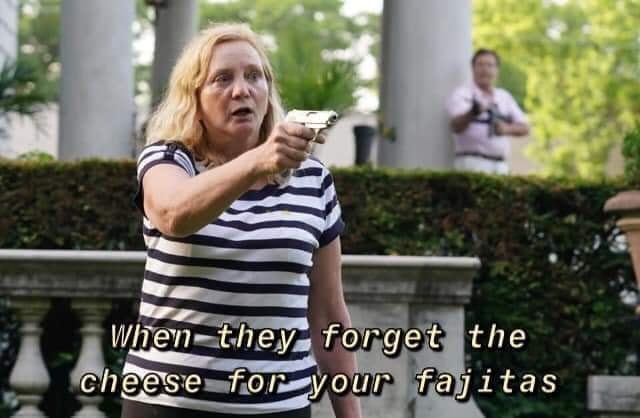
This meme features a woman from the popular TV show "Karen" from the series "Schitt's Creek" (played by Catherine O'Kerry) who is holding a plate of fajitas and is visibly upset. The text "When they forget the cheese for your fajitas" is overlaid on top of the image, indicating that the woman is furious because her fajitas were made without cheese.
detailed-analysis (gemma3-27b-vision)
Here's an analysis of the image, broken down into the requested theoretical sections. Please note that not every theoretical framework will necessarily apply with equal depth, and some might feel a little strained given the meme-like nature of the image. I'll try to indicate the strength of the application within each section.
Visual Description
The image is a still from a television show or movie, likely a comedic one given the absurd context. It features a middle-aged white woman, dressed in a striped shirt, aiming a handgun at the camera with an expression of intense seriousness. The background shows a manicured garden setting with hedges and classical-style columns, adding an odd layer of juxtaposition. Another person, similarly armed, is partially visible in the background. Text superimposed on the image reads "When they forget the cheese for your fajitas." The image is clearly intended as a humorous exaggeration – a hyper-dramatic reaction to a minor inconvenience. The focus is on the incongruity between the extreme response (brandishing a gun) and the trivial trigger (forgotten cheese).
Foucauldian Genealogical Discourse Analysis (Moderate Application)
This framework focuses on the historical development of power relations and the discourses that shape them. We can look at how this image plays with discourses surrounding authority, violence, and consumerism.
- Discourse of Self-Defense: The image borrows the visual language of self-defense (a person with a gun), but completely subverts it. Normally, firearms are linked to protection from serious threats. Here, it's about cheese. This destabilizes the established discourse, highlighting its constructed nature.
- Discourse of Consumer Rights: The "offense" – forgetting cheese – touches on the discourse of consumer expectations and entitlement. While humorous, it reflects a larger cultural trend of prioritizing individual preference and expecting immediate satisfaction. This expectation has been increasingly amplified by marketing and consumer culture.
- Genealogical Trace: To trace the "genealogy" (historical development) of this moment, we might look at how marketing has progressively created a culture of heightened expectations around even the smallest aspects of consumer experience. The power dynamics are skewed - one person feels justified in threatening violence over a consumer experience.
Critical Theory (Moderate Application)
Critical theory, particularly from the Frankfurt School, examines how power structures are embedded in culture and how this leads to domination.
- Culture Industry: The image can be viewed as a critique (however unintentional) of the "culture industry" – the mass production of entertainment and its effect on critical thinking. This image is made to be shared and generate quick amusement, and encourages the passive consumption of easily digestible humor.
- Commodification: The emphasis on the missing cheese subtly reflects a broader commodification of experience. Value is assigned to material possessions/additions to experiences (like cheese) that might have little intrinsic value.
- Loss of Authenticity: The exaggerated reaction points to a potential loss of genuine emotional response, replaced by performative outrage or exaggerated reactions for social media attention.
Marxist Conflict Theory (Weak Application)
While a stretch, we can attempt a Marxist reading:
- Class & Consumption: The image could be interpreted as a parody of the affluent consumerist class, displaying entitlement and an overreaction to a minor inconvenience. The ability to express rage over something as trivial as cheese suggests a privileged position where basic needs are easily met.
- Alienation: The woman's extreme reaction could be seen as a symptom of alienation – a disconnect from meaningful labor or social connection, leading to displaced anger. However, this is a rather forced interpretation.
- Ideology: The image could reinforce the ideology of consumerism, portraying it as so central to life that a missing ingredient warrants a violent response.
Postmodernism (Strong Application)
This framework lends itself well to the image:
- Hyperreality: The image is already a simulation of a simulation – a dramatic, over-the-top response to a mundane situation. It exemplifies the postmodern concept of hyperreality, where representations become more real than reality itself.
- Pastiche & Intertextuality: The image likely draws upon tropes from action movies and crime dramas, creating a pastiche (an imitation) of those genres. The humor arises from the incongruous juxtaposition of the serious visual style and the silly context.
- Deconstruction of Meaning: The image actively undermines traditional meanings. The conventional association of a gun with threat/danger is destabilized and replaced with the absurd – forgetting cheese. This is a classic postmodern technique.
- Irony & Playfulness: The image relies on irony and playful subversion of expectations to generate its comedic effect.
Queer Feminist Intersectional Analysis (Limited Application)
While not immediately apparent, a queer feminist reading could be constructed:
- Performance of Gender: The image could be seen as a performative exaggeration of traditionally "masculine" aggression (armed confrontation) enacted by a woman. This subverts gender norms, although in a relatively superficial way.
- Reclaiming Power: One could argue the woman is "reclaiming" power, taking control of a frustrating situation in a radical (albeit absurd) manner. However, this reading is somewhat strained, as the violence is directed towards a trivial issue, not systemic oppression.
- Intersectional Consideration: The focus is mostly on the absurdity, so intersections with race, class, or other identities aren't immediately present. It's worth noting, however, that the image features a white woman, and that particular positioning within a power dynamic might be relevant in certain analyses.
Disclaimer: These are just interpretations, and the "correctness" of any given reading depends on the perspective of the analyst. The image is primarily designed for amusement, and in-depth theoretical analysis might seem a bit heavy-handed. However, examining even seemingly simple media through these lenses can reveal underlying cultural assumptions and power dynamics.
simple-description (llama3.2-vision)
The meme features a photo of a woman holding a gun and looking shocked, with a caption that reads: "When they forget the cheese for your fajitas". The image is a humorous take on a common frustration when dining out, where the person is upset that their food is being prepared incorrectly.
tesseract-ocr
; , aed - ios le a ame id es ‘gi <1 = om 8 (7 \ Fon ( eA eG a Sane See 5 re J 5 a SE A - Ucar gets tl A | DOTS Ory Ko ; .. OeoNeear UP fajitas i _ _ _