First Seen
2023-05-10T21:03:35+00:00
simple-description (llama3.2-vision_11b)
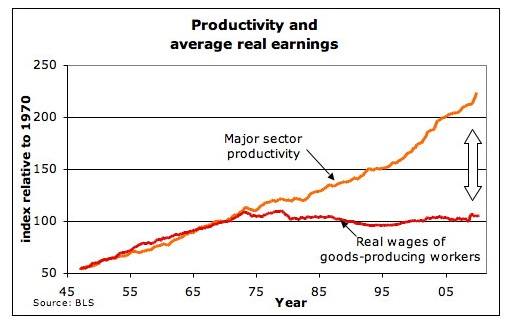
The meme is a graph showing the productivity and average real earnings of workers in the United States from 1950 to 1970. The top line, labeled "Major sector productivity," shows a significant increase in productivity, while the bottom line, labeled "Real wages of goods-producing workers," shows a decrease in real wages. The text at the top of the graph reads, "The productivity of workers has increased, but their wages have not."
detailed-analysis (gemma3-27b-vision)
Okay, let's break down this chart through the requested lenses.
Visual Description
The chart presents a line graph comparing “Major sector productivity” and “Real wages of goods-producing workers” from 1947 to 2007. The y-axis represents an index relative to 1970 (with values ranging from approximately 50 to 250). The x-axis depicts the year.
- Productivity Line: The "Major sector productivity" line steadily increases over the entire period, beginning around 60 in 1947 and rising consistently to around 215 in 2007. This line is above the "Real wages" line for most of the period.
- Real Wages Line: The "Real wages of goods-producing workers" line initially rises in parallel with productivity until approximately 1973. Then, it plateaus, fluctuating around an index of 100, with minimal increases after the mid-1970s. There’s a slight dip and then recovery around the early 2000s, but remains relatively flat.
- Overall Interpretation: The chart visually suggests a decoupling between productivity growth and wage growth. While productivity has substantially increased, real wages have stagnated, creating a growing disparity.
Marxist Conflict Theory
This chart is a textbook illustration of concepts central to Marxist thought.
- Exploitation & Surplus Value: Marx argued that workers produce more value than they receive in wages (surplus value). This chart seems to demonstrate that this surplus value is increasing. Productivity goes up, but wages don’t, meaning the capitalist class (owners of the means of production) are extracting increasing value from the labor of workers.
- Class Struggle: The diverging lines suggest intensifying class struggle. The stagnant wages despite rising productivity can be seen as evidence of capital's ability to suppress wage growth and accumulate wealth at the expense of labor. This can lead to increasing inequality and potential social unrest.
- Alienation: The disconnect between worker effort (manifested in productivity) and reward (wages) can contribute to worker alienation, where individuals feel detached from their work and the products they create.
- Crisis of Capitalism: The chart hints at a potential crisis within capitalism. If wages don’t keep pace with productivity, it can lead to underconsumption (lack of demand) and ultimately threaten the system's stability.
Critical Theory
From a Critical Theory perspective, the chart is not simply a neutral representation of economic data, but a reflection of power dynamics and social control.
- Ideology: The presentation of this data (or its lack of presentation to the public) can be seen as part of a broader ideological apparatus. The emphasis on “productivity” as the key economic indicator masks the underlying issues of wealth distribution and exploitation.
- Rationalization & Control: The relentless pursuit of increased productivity (as reflected in the upward line) can be linked to Max Weber's concept of rationalization – the increasing dominance of instrumental rationality and efficiency in all aspects of life. This can lead to a dehumanizing work environment and erosion of social values.
- Domination: The chart demonstrates how the capitalist system perpetuates domination by extracting value from labor and limiting the economic benefits to a select few. This form of domination is often subtle and normalized through institutional structures and cultural norms.
- Need for Emancipation: Critical theorists would argue that the data presented necessitates a critical examination of the capitalist system and a pursuit of more equitable and just social arrangements that prioritize human well-being over profit accumulation.
Foucauldian Genealogical Discourse Analysis
A Foucauldian approach would focus on how “productivity” and “wages” have become discursive constructs shaping our understanding of work and economic value.
- Power/Knowledge: The chart isn’t just a factual representation, but an exercise of power/knowledge. The very act of measuring and comparing “productivity” and “wages” constructs these concepts as objective and natural, obscuring the historical and social forces that shape them.
- Genealogy: Tracing the historical genealogy of "productivity" and "wages" would reveal how these concepts have evolved over time, shaped by specific power relations and social practices.
- Discipline and Control: The emphasis on productivity can be linked to the disciplinary techniques of modernity, where individuals are subjected to constant monitoring and evaluation. This contributes to a culture of control and self-regulation.
- Normalization: The presentation of stagnant wages as a neutral economic outcome normalizes exploitation and inequality. It obscures the fact that this outcome is the result of specific power dynamics and policy choices.
Postmodernism
From a Postmodern perspective, the idea of a singular, objective “truth” represented by these lines is questioned.
- Deconstruction: The chart's apparent "facts" can be deconstructed. What defines "productivity" or "real wages"? These are constructed metrics, not natural laws.
- Relativism: There's no single, universally accepted interpretation of the chart. Different individuals and groups will interpret the data based on their own subjective perspectives and interests.
- Rejection of Grand Narratives: Postmodernism challenges grand narratives like "economic progress" or "capitalist development." The chart doesn’t prove these narratives are true or false; it simply presents data that can be interpreted in multiple ways.
- Simulacra & Simulation: The very act of measuring and representing these concepts through graphs and statistics can be seen as a form of simulation, creating a representation of reality that is detached from the lived experiences of workers.
Queer Feminist Intersectional Analysis
Applying an intersectional lens highlights how the issues in the chart aren’t experienced uniformly across all groups.
- Interlocking Systems of Oppression: The wage stagnation and increasing productivity divide disproportionately impact marginalized groups. Gender, race, sexuality, class, and other social categories intersect to create unique experiences of economic exploitation.
- Gendered Labor: Certain types of labor (often performed by women and people of color) are systematically undervalued and underpaid. The chart doesn’t capture these gendered and racial disparities.
- Care Work & Unpaid Labor: The chart focuses on “goods-producing workers” and doesn’t account for the crucial role of care work (often performed by women) which is largely unpaid and contributes to economic inequality.
- Queer & Trans Experiences: Queer and trans individuals often face employment discrimination and wage gaps, exacerbating the economic challenges reflected in the chart.
- The need for inclusive economic policies: This data highlights the need for economic policies that address intersectional inequalities and prioritize the well-being of all members of society.
I've aimed to provide a detailed and nuanced analysis of the chart from the requested perspectives. Let me know if you'd like me to expand on any of these sections or explore other theoretical frameworks.
simple-description (llama3.2-vision)
The meme is a graph showing the relationship between productivity and average real earnings in the United States from 1970 to 2015. The graph shows that while productivity has increased significantly, average real earnings have actually decreased. The text in the image reads "In 1970, a worker making 50,000 in 1970 dollars is today making 73,000 in 2015 dollars, but the worker making 50,000 in 1970 dollars is making 35,000 in 2015 dollars."
tesseract-ocr
Productivity and average real earnings 250 8 $200 2 Major sector 8 productivity 2150 ; Lee 00 Penn ee z 2 £ , Real wages of goods-producing workers 50 45 55 65 75 85 95 05 source: BLS Year