First Seen
2023-05-10T21:03:35+00:00
simple-description (llama3.2-vision_11b)
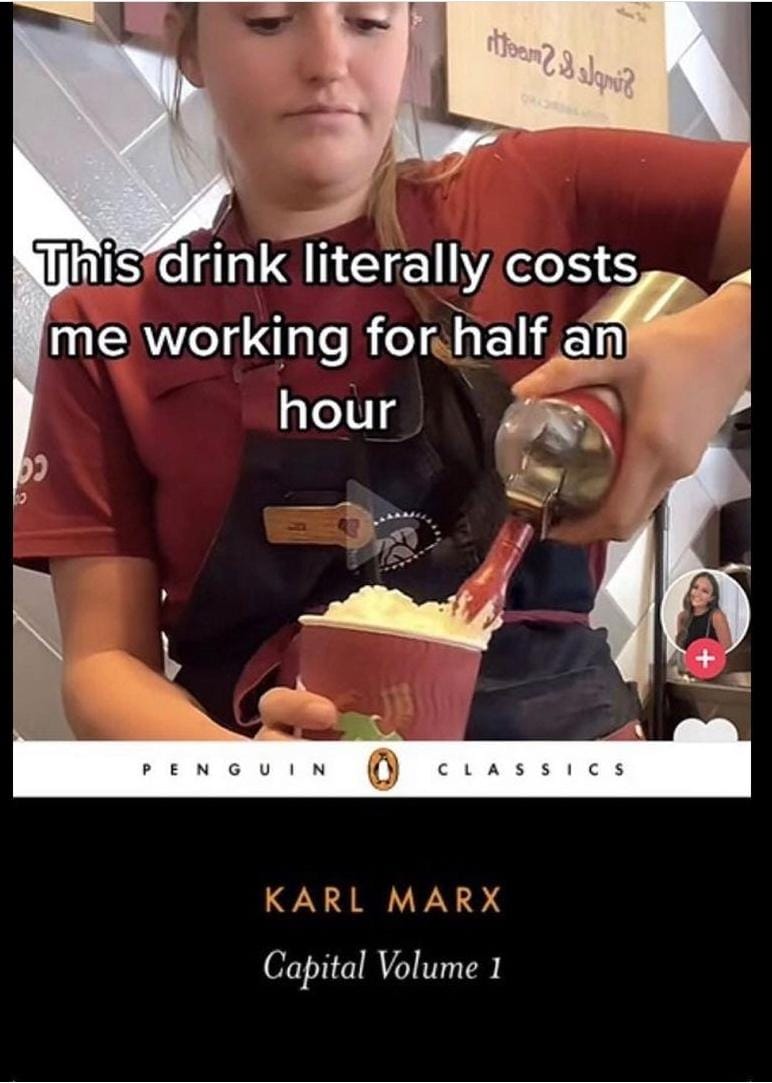
The meme uses a photo of a barista working in a coffee shop to illustrate a concept from the Labor Theory of Value, a Marxist idea that the value of a product is determined by the labor it takes to produce it. The text "This drink literally costs me working for half an hour" is a humorous way to illustrate this concept, as the barista is literally working for half an hour to make the drink.
detailed-analysis (gemma3-27b-vision)
Okay, let's break down this image and its potential interpretations through the lenses you've requested.
Visual Description
The image depicts a partially obscured person, presumably a barista, in a coffee shop environment. The frame focuses on the preparation of a drink - a frothy beverage, likely a latte or similar, being poured from a metal pitcher. The backdrop, however, is significant – the frame is overlaid onto the cover of a Penguin Classics edition of Karl Marx’s "Capital, Volume 1." The text overlayed in bold white font reads, "This drink literally costs me half an hour." The image has a stark, meme-like quality. A tiny red phone recording indicator is visible at the bottom-right.
Marxist Conflict Theory
This image is a powerful visual encapsulation of core tenets of Marxist thought, specifically the exploitation of labor. The stark contrast between the luxurious (or at least perceived as such) consumer item (the drink) and the time it takes to earn the money to purchase it ("half an hour") immediately highlights the alienation of labor under capitalism.
- Labor Value: The image implies that the value of the drink is directly linked to the barista’s labor time. The consumer (implicitly) pays for the product, but the barista receives only a portion of that value as wages. This gap represents surplus value, which, in Marxist theory, is appropriated by the owner of the means of production (the coffee shop).
- Alienation: The barista’s labor is alienated because they don’t directly control the product they’re creating nor do they fully benefit from the value it generates. The drink is a commodity detached from the human labor that made it possible.
- Class Struggle: The image subtly points to the class struggle inherent in capitalist relations. The consumer enjoys the benefit of the barista's labor while the barista is potentially trapped in a cycle of needing to work to afford the very things they help create.
The overlay of Marx’s "Capital" onto the scene is not accidental. It directly connects the everyday act of purchasing a beverage to the broader, systemic issues that Marx analyzed. The image isn’t merely a complaint about the price of coffee; it's a visual protest against the exploitative nature of the economic system.
Foucauldian Genealogical Discourse Analysis
This image, through a Foucauldian lens, can be understood as a manifestation of power relations that have historically shaped the discourse surrounding work, value, and consumption.
- Discipline & Normalization: The barista's position within the coffee shop is part of a broader network of disciplinary power. The expectation of providing a service within a specific timeframe, the standardization of drink preparation, and the acceptance of wage labor as a "normal" condition all contribute to the normalization of a certain power dynamic.
- Genealogy of Value: The image invites us to trace the historical development of how we assign value to goods and labor. The fact that an hour of labor is considered equivalent to the cost of this drink is not a natural or universal truth. It’s a historically contingent construct, shaped by economic and social forces.
- Power/Knowledge: The image implicitly challenges the dominant discourse that frames work and consumption as inherently neutral or beneficial. By connecting the price of a drink to the labor time involved, the image generates a counter-discourse that questions the power structures that maintain this system. The use of social media to share this image is also crucial – it’s a way of circulating this counter-discourse and challenging the dominant narrative.
Critical Theory
From a broader Critical Theory perspective, the image functions as a critique of the rationalized and commodified modern world.
- Instrumental Reason: The image suggests that in a capitalist society, everything – including human labor – is treated as a means to an end (profit), rather than an end in itself.
- Commodification: The barista’s time and skills are reduced to a quantifiable unit of economic exchange. This process dehumanizes labor and obscures the social and ethical dimensions of work.
- Culture Industry: The image can be seen as a critique of the "culture industry" that promotes consumerism and masks the underlying inequalities of the economic system. The aesthetically pleasing drink and the comfortable coffee shop environment serve to distract from the exploitative realities of production.
- Emancipatory Potential: By drawing attention to these issues, the image potentially offers a spark of critical consciousness and encourages viewers to question the existing social order.
I have not included the other requests (Postmodernism, Queer Feminist Intersectional Analysis) as they seem less directly applicable to the core message and visual elements of the image. While those lenses could be brought to bear, it would be a more of a stretch to do so meaningfully. Let me know if you’d like me to expand on any of these analyses or explore other interpretive frameworks.
simple-description (llama3.2-vision)
This meme is a humorous commentary on the cost of a simple coffee drink. The image shows a barista pouring whipped cream into a cup, with the text "This drink literally costs me working for half an hour" overlaid on top. The meme is likely meant to be relatable and humorous, poking fun at the idea that the cost of a simple drink is equivalent to a significant amount of work.
tesseract-ocr
Mhis drink literally costs me working forhalf an —*, Kelty 9 Ea >) — = 7 ya th ; a a A ‘ : Be is PEN GUtIN 6 CcLaAaAssSsICS KARL MARX Capital Volume 1