First Seen
2023-05-10T21:03:35+00:00
simple-description (llama3.2-vision_11b)
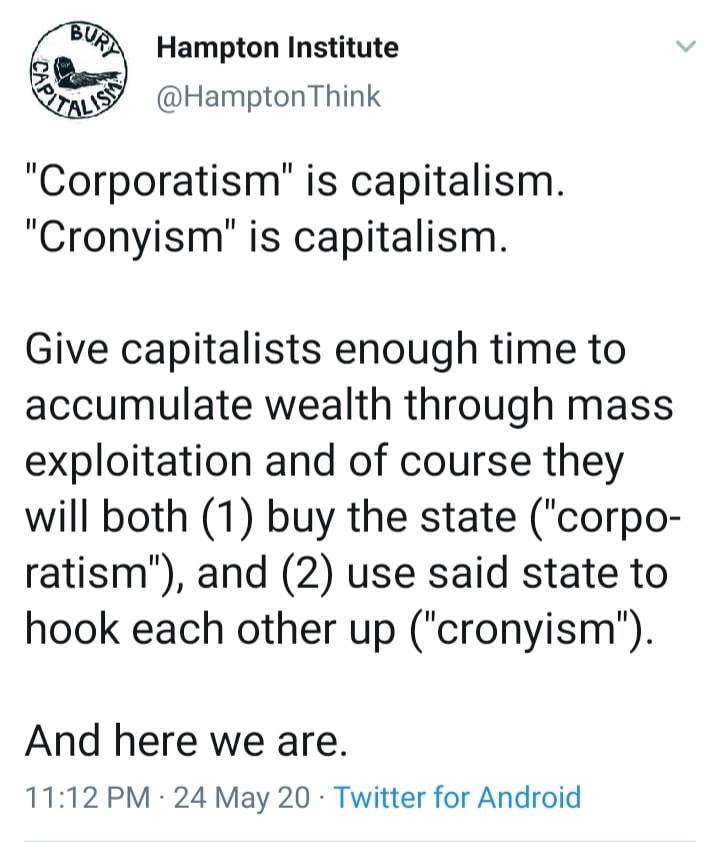
The meme is a satirical commentary on the differences between two economic systems, corporatism and cronyism, and how they are often used to exploit and benefit the wealthy. The text reads: "Corporatism is capitalism. Croneyism is capitalism. Give capitalists enough time to accumulate wealth through mass exploitation and of course they will both (1) buy the state (corporatism) and (2) use it to get the state to do it for them (croneyism). And here we are." The meme pokes fun at the idea that both systems are just different forms of the same thing, with the only difference being that one is called "corporatism" and the other is called "croneyism" (which is a play on the word "croneyism" meaning "a person who is a crone, or a friend of a crone", or a person who is a friend of someone in a position of power). The meme is a satirical commentary on the idea that both systems are the same and that they are both used to exploit and benefit the wealthy.
detailed-analysis (gemma3-27b-vision)
Okay, let's break down this tweet from the Hampton Institute through several critical theory lenses. It’s a dense statement, and lends itself to multifaceted analysis.
Visual Description
The image is a screenshot of a tweet from the Hampton Institute (@HamptonThink) on Twitter. The account has a circular logo with "BUR CAPITALIS" in an arc around a central image and "PITALLIS" in the bottom arc. The tweet text is the primary focus. It's formatted in simple black text on a white background. The timestamp and source ("Twitter for Android") are visible at the bottom. The visual design is minimalist and functional; it reinforces the message's directness. The account branding appears to use an ironic, slightly distressed aesthetic.
Foucauldian Genealogical Discourse Analysis
This tweet offers fertile ground for a Foucauldian analysis. It doesn’t present “corporatism” or “cronyism” as aberrations from a 'pure' capitalism but as intrinsic to its operation.
- Discourse & Power/Knowledge: The tweet asserts that these practices are not deviations, but inherent to the functioning of capitalism itself. The framing establishes a specific discourse – one where the "buying of the state" and the mutual support among capitalists are not seen as corruption, but as logical outcomes. This discourse creates a particular understanding of power – power isn’t simply held by capitalists but emerges from the systems they build.
- Genealogy: A genealogical approach would investigate how the concepts of "corporatism" and "cronyism" have been historically constructed. The tweet implies these aren't new phenomena, but have been woven into the fabric of capitalist development. It would ask how these concepts were defined, who defined them, and how those definitions served to obscure the underlying mechanisms of capitalist accumulation. For example, were they presented as exceptional cases or framed as inherent risks of a free market?
- Power/Knowledge: The tweet demonstrates how power operates through the creation of knowledge. By asserting these practices are capitalism, it challenges conventional understandings and attempts to shift the frame. It positions the author as someone who understands the “true” workings of the system. The goal is to challenge the narratives that present capitalism as a neutral force.
Critical Theory
This tweet deeply resonates with Critical Theory's core concerns.
- Critique of Ideology: The tweet dismantles the ideology that capitalism is a "free market" operating on merit. It contends that the "buying of the state" (corporatism) and the protection of one another (cronyism) are not bugs in the system, but features. This directly challenges the notion of a level playing field.
- Domination & Emancipation: The tweet implies that capitalist systems are inherently based on domination – through economic control of the state and the collusion of the wealthy. The statement implicitly calls for emancipation from these structures, even though it doesn't explicitly state it. The assertion that "this is what we have" suggests a need for critical awareness and potentially, for systemic change.
- Reason as Instrument of Domination: The "logical" assertion that capitalists will buy the state and protect each other points to how supposedly rational economic principles (maximizing profit, minimizing risk) can become tools for perpetuating inequality and reinforcing power structures.
Marxist Conflict Theory
The tweet is a succinct Marxist analysis.
- Class Struggle: The statement fundamentally underscores the class struggle. The “capitalists” are identified as an exploiting class. The “buying of the state” and “protection of each other” are mechanisms to consolidate power and maintain the conditions for continued exploitation.
- Capital Accumulation & Exploitation: The initial premise – "accumulate wealth through mass exploitation" – is explicitly Marxist. It frames wealth creation as inherently tied to the exploitation of labor and resources.
- State as Tool of the Ruling Class: The assertion that capitalists “buy the state” directly reflects the Marxist understanding of the state as an instrument of class rule. The state is not neutral; it serves the interests of the dominant economic class. The tweet frames the state not as an impartial regulator, but as a tool for maintaining and expanding capitalist power.
Postmodernism
While not overtly postmodern, some postmodern ideas can be applied.
- Deconstruction of Grand Narratives: The tweet deconstructs the “grand narrative” of capitalism as a free and fair system. It exposes the power dynamics and self-serving practices that underlie the idealized image.
- Relativizing Truth: By claiming that “corporatism” and “cronyism” are capitalism, it challenges the conventional definitions and narratives of these terms. It suggests that truth is not fixed, but rather constructed through power relations.
- Critique of Universal Claims: The tweet implicitly challenges universal claims about the benefits of capitalism. It suggests that these benefits are not shared equally and that the system is inherently exploitative.
Queer Feminist Intersectional Analysis
This is where the connection is more subtle, but present.
- Interlocking Systems of Oppression: While the tweet focuses on economic exploitation, it can be linked to queer feminist thought by recognizing that capitalism is interwoven with other systems of oppression (patriarchy, white supremacy, heteronormativity). The exploitative practices described in the tweet disproportionately impact marginalized groups.
- Critique of Power Dynamics: Queer feminist theory emphasizes the importance of challenging all forms of power imbalances. The tweet’s critique of capitalist power aligns with this perspective.
- Reclaiming Language: The blunt assertion that "cronyism" and "corporatism" are capitalism can be seen as a reclamation of language—challenging the narratives used to obscure systemic injustices. It forces us to recognize the ways in which seemingly neutral terms can mask oppressive structures.
In conclusion, the tweet is a powerful statement that lends itself to multiple layers of analysis. It is a succinct critique of capitalism, framed in terms of power, exploitation, and the inherent contradictions of the system. It is a potent example of how social and political issues can be analyzed through a variety of critical theoretical lenses.
simple-description (llama3.2-vision)
The meme is a humorous critique of the terms "capitalism" and "socialism" and how they are often misunderstood. The text reads: "I'm a capitalist and I'm a socialist, I'm both. I'm a capitalist because I own the means of production, I'm a socialist because I give all my money to the government."
tesseract-ocr
A Hampton Institute ken) @HamptonThink "Corporatism’" is capitalism. "Cronyism" is capitalism. Give capitalists enough time to accumulate wealth through mass exploitation and of course they will both (1) buy the state ("corpo- ratism'), and (2) use said state to hook each other up ("cronyism’). And here we are. 11:12 PM - 24 May 20 - Twitter for Android