First Seen
2023-05-10T21:03:35+00:00
simple-description (llama3.2-vision_11b)
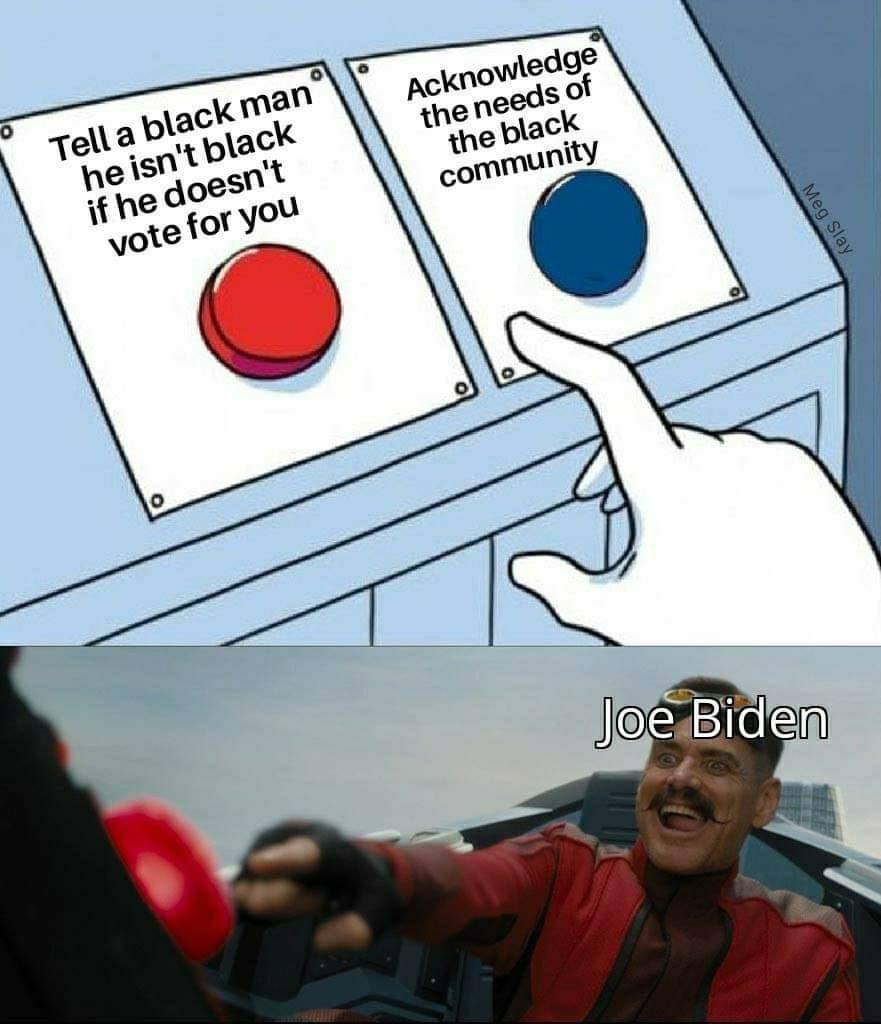
The meme is a play on the "Red Button, Blue Button" game show concept, where two buttons with different statements are presented to the viewer. In this case, the buttons say "Tell a black man he isn't black if he doesn't vote for you" and "Acknowledge the needs of the black community." The image is humorous because it implies that the only way to get a black man to vote for someone is to tell him he isn't black if he doesn't vote for them, which is a racist and discriminatory approach. The image is meant to be satirical and is likely to be used to criticize the way some politicians and politicians' supporters use racial and ethnic stereotypes to get votes.
detailed-analysis (gemma3-27b-vision)
Okay, here's an analysis of the meme, broken down into sections based on the theoretical frameworks you requested. I’ll prioritize those where the meme’s content strongly lends itself to analysis.
Visual Description
The image is a meme constructed from two separate visuals. The top panel depicts a button panel, styled like something from a control room or science fiction setting. There are two large red buttons. The left button is labelled "Tell a Black Man he isn't Black if he doesn't vote for you", while the right button is labelled "Acknowledge the needs of the Black community". A white hand is reaching toward the red button.
The bottom panel is a photograph of U.S. President Joe Biden, appearing to dramatically “push” (or pretend to push) a large red button. Text overlay reads "Joe Biden". The composition suggests a juxtaposition between what should be done (acknowledging needs) and the actions perceived as being taken (exercising control and gatekeeping).
Foucauldian Genealogical Discourse Analysis
This meme is ripe for analysis through a Foucauldian lens. It speaks to the construction of identity and the exercise of power/knowledge.
- Discourse & Identity: The meme highlights the discourse around Black identity and political allegiance. It suggests a history of how Blackness has been defined, not as an inherent quality, but through external validation – specifically, adherence to a preferred political stance. The meme proposes that being ‘authentically’ Black, within certain discourse, is tied to supporting a particular political figure or party.
- Power/Knowledge: The buttons symbolize the exercise of power by an external force (implied to be Biden/the Democratic Party) to define and control the narrative around Black identity. The power lies in the ability to decide who counts as "Black" based on their political choices. This is a form of "disciplinary power" – controlling through defining norms and excluding those who don't conform. The meme suggests this power operates through a discourse that is presented as ‘common sense,’ but is, in fact, a historically constructed set of rules.
- Genealogy: A genealogical approach would trace the historical development of this discourse – how has this idea of contingent Blackness (tied to political alignment) emerged? What historical factors and power dynamics have shaped this expectation? The meme hints at a history of attempts to control the Black vote through conditional acceptance.
Critical Theory
This meme operates well within the framework of Critical Theory. It is a critique of the power structures inherent in political campaigning.
- Hegemony: The meme points towards the operation of hegemony. Hegemony, in the Gramscian sense, isn’t simply domination, but the process by which dominant groups secure consent to their rule. The meme suggests that the Democratic party seeks to achieve consent from the black community by creating a condition for acceptance. By implying a need for "proof" of Blackness (through voting choice), it subtly reinforces a power imbalance. The message is that the Democratic Party believes that they have a right to control the acceptance of people into the Black Community.
- Ideology: The meme exposes an ideological function within political rhetoric. The ‘either/or’ choice presented on the button panel isn’t neutral. It implies that acknowledging the needs of the Black community is somehow separate from recognizing their agency and individuality. The meme demonstrates how this seemingly harmless political act is actually a form of dominance and control.
- Domination: The meme points to a symbolic form of domination. The act of 'pushing' the button is a way to exert control over the black community.
Marxist Conflict Theory
Though less direct than the Critical Theory or Foucauldian readings, a Marxist lens can still offer some insight.
- Class Struggle (modified): The meme doesn’t represent a pure class struggle, but it highlights a power dynamic rooted in resources and control. Political parties, as institutions seeking to maintain power, are constantly engaging in a struggle for the "vote base". The Black community can be viewed as a constituent group with specific needs and desires, and the meme suggests a struggle for control over their political allegiance.
- False Consciousness: The act of tying Blackness to voting choice could be interpreted as an attempt to create a "false consciousness" within the Black community – diverting attention from systemic issues and reinforcing a dependence on a single political party.
- Exploitation: While not explicit, there's a subtext of 'exploitation' of identity for political gain. The Democratic Party is portrayed as leveraging the identity of the black community to push the narrative they desire.
Postmodernism
A postmodern reading would focus on the fragmentation of meaning and the simulacra at play.
- Deconstruction: The meme deconstructs the seemingly straightforward link between identity and political choice. It challenges the idea that ‘being Black’ is a fixed, essential category, and demonstrates how it’s constructed and manipulated within the political arena.
- Hyperreality: The meme's format—a digitally created image juxtaposing political rhetoric and action—contributes to a sense of hyperreality. The image isn't a direct representation of reality; it's a simulation that creates a commentary on political discourse.
- Metanarratives: The meme rejects the metanarrative of unquestioning political allegiance. It suggests that simplistic narratives of “who belongs” are constructed and manipulative.
Queer Feminist Intersectional Analysis
While the meme doesn't explicitly address gender or sexuality, an intersectional approach can enrich the analysis.
- Interlocking Systems of Oppression: The meme demonstrates how race intersects with political power. It’s not simply about race; it's about how racial identity is used within a power structure to control access, allegiance, and ultimately, political representation.
- Gatekeeping: The ‘button’ metaphor represents a form of gatekeeping – deciding who ‘counts’ as legitimately part of a community. This is a common tactic used to marginalize and exclude based on perceived identity.
- Silencing: The implication of the meme is that Black individuals who do not vote for the preferred candidate are being implicitly silenced and denied full acceptance within the political landscape. This reinforces a power dynamic where their voices and choices are devalued.
I hope this detailed analysis, utilizing your requested theoretical frameworks, provides a thorough understanding of the meme's meaning and implications. Let me know if you'd like me to elaborate on any specific point or explore another theoretical lens.
simple-description (llama3.2-vision)
This meme is a play on the 2020 US presidential election. It shows a voting machine with two options: "Tell a black man he isn't black if he doesn't vote for you" and "Acknowledge the needs of the black community". The meme is likely referencing the controversy surrounding former President Donald Trump's 2020 election campaign and the Black Lives Matter movement. The image is likely accompanied by a humorous or satirical image of a character from a popular franchise, such as a meme featuring "Dwayne 'The Rock' Johnson" or "SpongeBob SquarePants" character "Squidward" with the caption "Joe Biden" over it.
tesseract-ocr
a unowled 9? man Mneneeds ° > rela pla ack ine lacy heist oesnt commu a if he Ox you é., vote e O %. ee Z ° OD ‘ Joe.Biden