First Seen
2023-05-10T21:03:35+00:00
simple-description (llama3.2-vision_11b)
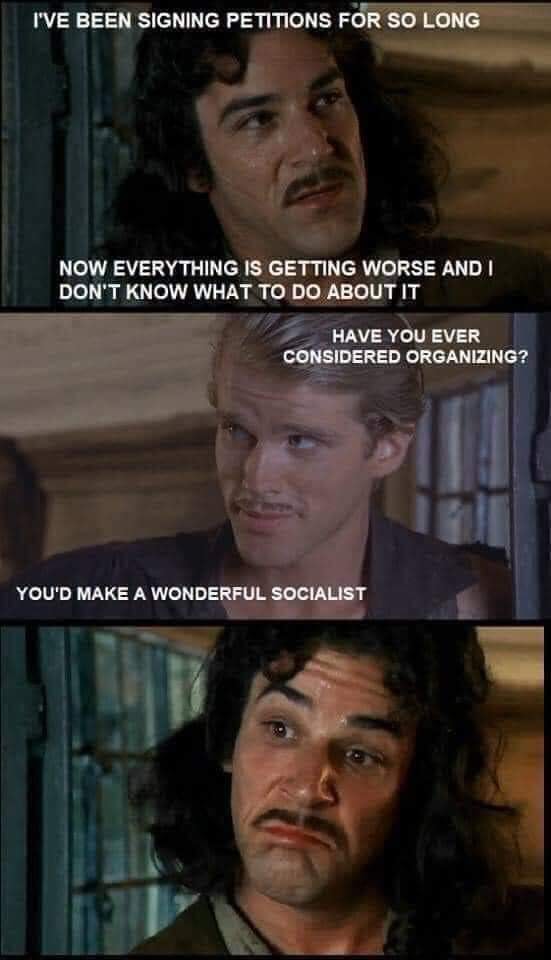
This meme is a humorous take on the left-wing ideology of socialism. It uses a quote from the 1985 film "The Princess Bride" to poke fun at the idea of making a "wonderful" socialist, which is a satirical commentary on the challenges of implementing a socialist system. The image features a quote from the film's character, the "Prince” (played by Chris “The Prince” – The Prince) who says “I’ve been signing petitions for so long, now everything is getting worse and I don’t know what to do about it” and the character “You’d make a wonderful socialist” which is a satirical commentary on the challenges of implementing a socialist system.
detailed-analysis (gemma3-27b-vision)
Okay, let's break down this meme using the requested theoretical frameworks. It's a pretty rich meme for such a simple format!
Visual Description
The meme is a three-panel image (double meme) based on a still from the 2008 film Burn After Reading. The panels feature a close-up of actor Michael Shannon, expressing increasing degrees of distress and incredulity.
- Panel 1: Shannon (as Osborne) delivers the line, "I've been signing petitions for so long." His expression is neutral, but hints at weariness.
- Panel 2: The text reads, "Now everything is getting worse and I don't know what to do about it." Osborne’s expression shows growing frustration and desperation.
- Panel 3: A person (presumably off-screen) asks, “Have you ever considered organizing?” To which Osborne responds with extreme, horrified disbelief. The text is “You’d make a wonderful socialist.”
The humor comes from the stark contrast between the relatively mild problem (signing petitions) and the intense emotional response to the suggestion of radical political action. The meme taps into a certain kind of online irony/cynicism surrounding performative activism and the limitations of individual action.
Critical Theory
This meme is a critique of the way contemporary society encourages illusionary or pacified forms of political engagement. The act of signing petitions, while not inherently bad, is presented as a symbolic gesture that does little to address systemic problems. It aligns with the Critical Theory idea that dominant systems subtly absorb and neutralize dissent. The meme suggests that the system wants us to feel like we've "done something" (signed a petition) so that we don't attempt more meaningful change. The horrified reaction to the suggestion of "organizing" suggests that challenging the status quo is seen as unacceptable or frightening. The implication is that many are content to operate within the system, rather than attempt to transform it.
Marxist Conflict Theory
This meme speaks directly to Marxist concepts. Signing petitions is a superstructural activity – a manifestation of ideological control within a capitalist society. It provides the illusion of political participation without actually challenging the underlying power structures.
The horrified response to "organizing" can be read as a symptom of false consciousness. Individuals, conditioned by the ruling class, are unable to conceive of collective action as a viable or desirable solution to their problems. The meme is humorous because it suggests the subject has accepted a state of alienation, where they feel powerless to effect change and are afraid of the disruption that genuine collective action might bring.
"You'd make a wonderful socialist" is the punchline, highlighting the ultimate taboo. The person has been conditioned to see "socialism" not as a solution but as a threat. The inherent conflict between capital and labor is implicit here: those benefiting from the status quo will naturally resist any challenge to their power.
Foucauldian Genealogical Discourse Analysis
From a Foucauldian perspective, the meme reveals how discourses shape our understanding of political action. The act of signing petitions has become a normalized, routinized practice, part of the accepted “script” of civic engagement. This creates a specific regime of truth: that participation in the system is the only legitimate form of political action.
The horrified reaction to “organizing” shows the power of biopolitics – the ways in which power operates on and shapes our bodies and behaviors. The subject has been disciplined to accept certain forms of political expression while rejecting others. The suggestion of collective action disrupts the established order and creates a sense of anxiety.
The meme also implicitly questions the genealogy of political participation. How did signing petitions come to be seen as the primary means of expressing dissent? What power relations shaped that development?
Postmodernism
The meme engages with Postmodern ideas by illustrating the fragmentation and irony of contemporary political engagement. There is a sense of playfulness and self-awareness in the way the meme deconstructs the idea of political action.
The juxtaposition of a relatively trivial activity (signing petitions) with a radical suggestion (organizing) highlights the instability of meaning. The meme suggests that our understanding of political action is often superficial and disconnected from real change.
The meme's irony can be read as a form of hyperreality – a simulation of reality that obscures the underlying power structures. We are so accustomed to performative activism that we struggle to imagine genuine political transformation.
Queer Feminist Intersectional Analysis
(This is more challenging to apply, but potentially present)
While the meme doesn't explicitly address issues of gender, sexuality, or intersectionality, it can be seen as speaking to a broader critique of inclusionary political practices that fail to address systemic oppression. Signing petitions often serves to make those in power appear responsive to marginalized groups without actually dismantling the structures that perpetuate inequality.
The horrified response to "organizing" can be interpreted as a fear of disrupting the status quo, which often benefits those in positions of privilege. Marginalized groups, who are most directly impacted by systemic oppression, are often encouraged to be "patient" and work within the system, rather than challenging it directly.
The meme, therefore, can be seen as a subtle critique of the ways in which mainstream political discourse often silences radical voices and marginalizes those who demand genuine change.
In Conclusion:
This meme, despite its simplicity, is a surprisingly complex cultural artifact. It taps into a range of critical theoretical concepts to offer a scathing commentary on contemporary political engagement. It's a reminder that genuine social change requires more than just symbolic gestures and that challenging the status quo often comes with a cost.
simple-description (llama3.2-vision)
This meme is a humorous take on the idea that the US has been signing petitions for a long time, but has not seen significant change. The text on the image reads: "I've been signing petitions for so long. Now everything is getting worse and I don't know what to do about it. Have you ever considered organizing?"
tesseract-ocr
WS iv a iol lo Ko) [a | |) “i | re A WORSE AND | : Baer ey ott a i— - “— ial ae FL = = i | | eee E : | we * _ | = Ps ait Aa.