First Seen
2023-05-10T21:03:35+00:00
simple-description (llama3.2-vision_11b)
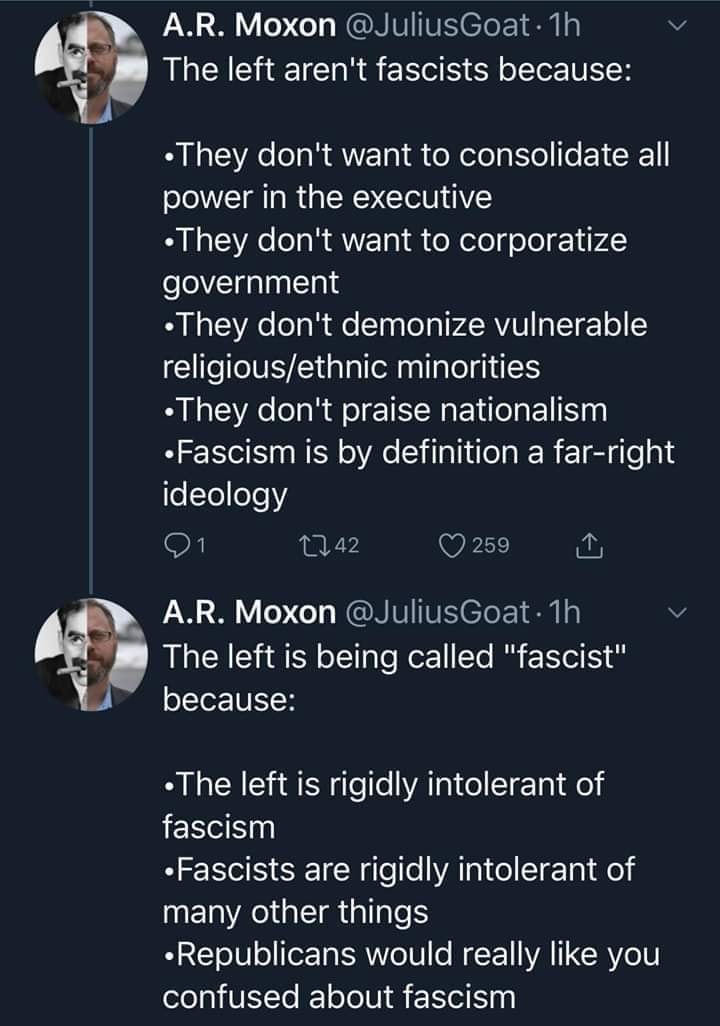
This meme is a humorous critique of the left's self-identification as "fascist" in order to criticize the right. The text, written in a sarcastic tone, lists various reasons why the left is not actually fascist, including the lack of desire to consolidate power, the lack of desire to create a corporate state, and the lack of demonization of vulnerable groups. The text ends with a humorous comment, saying that the left would be "confused” about what to call themselves if they were actually fascist.
detailed-analysis (gemma3-27b-vision)
Okay, here's an analysis of the provided Twitter thread, broken down into sections based on the theoretical frameworks you requested. Note that some frameworks will be more applicable than others, and some may not apply significantly. I will also be offering a disclaimer at the end.
Visual Description
The image contains a screenshot of a Twitter thread by user @JuliusGoat. Each tweet is presented as a social media post with user icon, name and timestamp. The first tweet is a list of points arguing against the label "fascist" being applied to the "left". The second tweet details why the left is being called "fascist" with a list of points about intolerance and attempts at misdirection. The visual composition is simple, characteristic of social media posts. It relies on textual arguments rather than imagery.
Foucauldian Genealogical Discourse Analysis
This thread is a prime example of how discourse constructs meaning around a historically loaded term – “fascism.” Foucault would be interested in the genealogy of this term: How did the meaning of "fascism" evolve over time, and what power dynamics shaped that evolution?
- Power/Knowledge: The user is actively engaging in a power/knowledge struggle. By defining what "fascism" is not (in the first tweet) and then attributing the accusation to specific motivations (second tweet), they are attempting to control the narrative. They are positioning themselves as the authoritative source on what constitutes fascism.
- Discursive Formation: The tweets attempt to establish a specific "discursive formation" around fascism. By emphasizing certain traits (centralization of power, nationalism) as definitive of fascism, and then claiming the "left" doesn't exhibit those traits, the user aims to exclude the left from the category altogether.
- Normalization: The second tweet implicitly suggests that calling the left “fascist” is a strategic misdirection, attempting to “normalize” a specific interpretation to delegitimize the accusation. The user assumes a “true” definition of fascism, positioning the accusation as an attempt to deviate from this true definition.
- Historical Context: The lack of engagement with the historical context of fascism is noticeable. The user sidesteps the complex historical evolution of fascism, focusing instead on abstract characteristics to define it.
Critical Theory
Applying a Critical Theory lens, we see this thread as engaging with the ideological battleground surrounding political labels.
- Hegemony: The user appears to be contesting the hegemonic framing of the left as "fascist." They aim to disrupt the dominant narrative and reassert a different understanding of political ideology.
- Ideology Critique: The core of the thread is an attempt at ideology critique. The user implicitly argues that the accusation of "fascism" against the left is a tool used to obscure political agendas and create false equivalencies.
- Dominant Discourse: The user challenges the "dominant discourse" surrounding fascism. By defining the left as not fascist based on specific criteria, they attempt to dismantle the oppositional framework that labels the left as such.
- The "Other": The framing of the accusation as strategically motivated to confuse people (second tweet) positions the accuser ("Republicans") as the "Other" and attempts to delegitimize their claims.
Marxist Conflict Theory
From a Marxist perspective, this thread reflects the class struggle and the use of ideology to maintain power dynamics.
- Ideological Warfare: The tweets can be seen as part of an ideological warfare between different political factions. The user is actively attempting to define the terms of the debate to advantage their side.
- False Consciousness: The second tweet ("Republicans would really like you confused about fascism") suggests that the accusation of fascism is a deliberate attempt to create false consciousness among the public, obscuring the true material interests at play.
- Power Relations: The entire thread is focused on power relations and the struggle to control the definition of key concepts. Defining "fascism" and assigning (or denying) the label to opponents is a way to exert influence and consolidate power.
- Superstructure: The discourse around “fascism” can be seen as part of the superstructure—the cultural and ideological institutions that support the underlying economic base. The battle over the definition of fascism is thus linked to the broader struggle for economic and political dominance.
Postmodernism
A Postmodern analysis focuses on the instability of meaning and the constructed nature of truth.
- Deconstruction: The user engages in a form of deconstruction by challenging the "essential" meaning of "fascism." They don't necessarily deny the historical existence of fascism but argue against its simple application to the left.
- Relativism: The thread implicitly suggests that definitions are not fixed but are relative to context and interpretation. The user presents their own interpretation of fascism as valid and challenges the "essentializing" tendencies of their opponents.
- Simulation & Hyperreality: (To a lesser degree) One could argue that the constant labeling and counter-labeling contribute to a hyperreality where the original meaning of “fascism” gets lost in a swirl of accusations and counter-accusations.
- Metanarratives: The attempt to establish a clear definition of fascism (“fascism is…”) in the face of competing definitions challenges the idea of universal truths or overarching metanarratives.
Queer Feminist Intersectional Analysis
This framework is less directly applicable, but we can still draw some insights.
- Power Dynamics: A Queer Feminist lens would be interested in how the accusation of "fascism" is used to marginalize and silence specific groups, potentially intersecting with systems of oppression based on gender, sexuality, race, etc.
- Essentialism: The thread challenges the essentializing of political ideologies, but it's important to note that essentializing language can also be used to demonize and exclude specific groups (e.g., by associating them with inherently "fascist" characteristics).
- Strategic Deployment of Labels: The use of the label "fascist" itself can be seen as a form of power assertion and a tool for maintaining dominance. A Queer Feminist perspective would analyze the ways in which this labeling can reinforce existing inequalities.
- Intersectionality of Oppression: While not explicit, the underlying power dynamics and struggles for recognition within the thread relate to broader patterns of social and political domination that intersect with other forms of oppression.
Disclaimer:
This is an interpretation based on the provided text. The intent and complete context of the author are unknown. Different theoretical frameworks can yield diverse interpretations. The analysis is intended as an exercise in applying these frameworks to the text, and should not be taken as a definitive or exhaustive explanation.
simple-description (llama3.2-vision)
The meme is a humorous comparison between the Left and the Right, using a series of bullet points to contrast their views on fascism. The text reads: "The left aren't fascists because...". The second part of the meme, "The left are fascists because..." is not shown in the image, but the text is likely to be similar to the first part, listing reasons why the left might be seen as fascist.
tesseract-ocr
A.R. Moxon @JuliusGoat: 1h S o) The left aren't fascists because: «They don't want to consolidate all power in the executive -They don't want to corporatize government -They don't demonize vulnerable religious/ethnic minorities «They don't praise nationalism «Fascism is by definition a far-right ideology oy any © 259 Pi A.R. Moxon @JuliusGoat: 1h v ee) The left is being called "fascist" because: The left is rigidly intolerant of fascism «Fascists are rigidly intolerant of many other things «Republicans would really like you confused about fascism