First Seen
2023-05-10T21:03:35+00:00
simple-description (llama3.2-vision_11b)
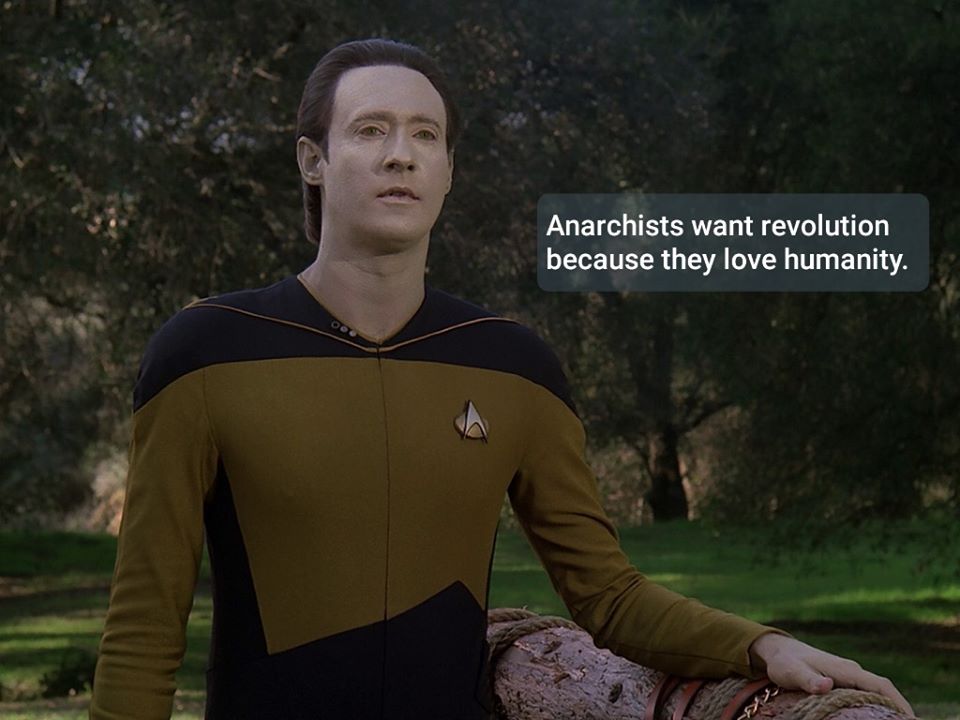
This meme is a still image from the TV show Star Trek: The Next Generation, featuring the character Data, a humanoid android, with a caption that pokes fun at the stereotype that leftists are always advocating for the destruction of society. The image is meant to be humorous, implying that leftists are so focused on their "revolution" that they would even want to destroy the very people who are making the "revolution" – themselves.
detailed-analysis (gemma3-27b-vision)
Okay, here's an analysis of the image, broken down into relevant theoretical frameworks. Given the content (a Star Trek character with an anarchist statement), certain frameworks will be more applicable than others.
Visual Description
The image features Data, an android character from Star Trek: The Next Generation. He is depicted sitting in a grassy outdoor setting, in a somewhat relaxed posture. He’s wearing a standard Starfleet uniform—a yellow long-sleeved shirt with black shoulders and the Starfleet insignia. A red, patterned fabric appears to be draped in his lap. The background is a blurry expanse of trees. A text bubble overlaid on the image says: "Anarchists want revolution because they love humanity." The lighting suggests either overcast conditions or a diffused light source. The overall aesthetic is slightly surreal, likely due to the combination of the well-defined character from a science-fiction context placed in a naturalistic, and somewhat undefined outdoor setting.
Foucauldian Genealogical Discourse Analysis
The statement "Anarchists want revolution because they love humanity" can be analyzed through a Foucauldian lens by examining the discourses that shape our understanding of both "anarchy" and "humanity."
- Power/Knowledge: The traditional discourse around "anarchy" is often linked to chaos, disorder, and a rejection of authority. This discourse is produced by power structures that benefit from maintaining hierarchical systems. The statement deliberately disrupts this discourse, framing anarchy as rooted in a positive affect – love for humanity. This challenges the established power/knowledge nexus.
- Genealogy: A genealogical approach would trace the historical development of the concepts of “revolution” and “humanity.” How have these ideas been constructed over time? What interests do they serve? Examining the historical association of revolution with violence (which is often used to delegitimize it) and the idealization of humanity as a justification for action highlights this complex relationship. The statement re-writes this history by proposing that love, not destruction, is the primary motivating factor.
- Disrupting Norms: The image, with its unlikely juxtaposition of Data, the symbol of order and reason, and an anarchist sentiment, further disrupts the dominant discourse. This challenges the assumed connection between rationality and the status quo.
Critical Theory
From a critical theory perspective, this image and statement can be seen as a commentary on the relationship between technology, humanism, and social change.
- Ideology Critique: The statement confronts the common ideological association of order with moral good and revolution with moral ill. The claim that anarchists love humanity disrupts this established framework. This is an attempt to expose the underlying assumptions that support existing power structures.
- Reason and Emancipation: Data, as an android, embodies reason and logical thought. Placing him in a position to advocate for a potentially radical ideology (anarchism) suggests that critical thought does not necessarily lead to the preservation of the status quo. It highlights the possibility that embracing an ideology like anarchism, which seeks to dismantle hierarchies, can be a form of emancipation.
- The Enlightenment Project: The figure of Data raises questions about the legacy of the Enlightenment project. Can rationality and reason, traditionally seen as tools for progress, be used to critique and dismantle structures of power? Does Data's embrace of anarchism represent a rejection of Enlightenment values or a radical reimagining of them?
Marxist Conflict Theory
From a Marxist perspective, the statement can be understood as highlighting the underlying contradictions within capitalist society and offering a potential path towards overcoming them.
- Class Struggle: Anarchism, in its critique of authority and hierarchy, aligns with the Marxist emphasis on class struggle. The statement suggests that the desire for revolution stems from a love for all of humanity, potentially transcending the divisions created by class.
- Alienation: The phrase "love humanity" can be interpreted as a response to the alienation inherent in capitalist systems, where individuals are reduced to economic units and disconnected from one another. The desire for revolution, therefore, is a desire to restore human connection and create a more equitable society.
- False Consciousness: The image can also be seen as a critique of "false consciousness" – the idea that dominant ideologies obscure the true nature of social relations. The statement challenges the notion that revolution is inherently destructive and suggests that it can be motivated by positive values.
Postmodernism
A postmodern reading would focus on the deconstruction of grand narratives and the rejection of universal truths.
- Deconstruction of Anarchy: The statement destabilizes the traditional understanding of anarchy. By associating it with "love," it challenges the binary opposition of anarchy/order and exposes the ideological biases that underpin this dichotomy.
- The Subject and Agency: Data, as an artificial being, raises questions about the nature of the subject and agency. Can an android genuinely "love" humanity? This challenges the notion of a unified, coherent self and highlights the constructed nature of identity.
- Rejection of Meta-Narratives: Postmodernism rejects the idea of grand narratives or universal truths. The statement’s association of love with anarchism suggests a rejection of the idea that progress or order are inherently good.
Queer Feminist Intersectional Analysis
While not immediately central, an intersectional lens can offer additional nuance:
- Reimagining Care: The phrase "love humanity" can be examined through a feminist ethic of care. Anarchist visions often prioritize mutual aid and community-based care. This redefines "strength" and "power" away from domination and towards relationality.
- Critique of Hierarchy: Anarchism’s inherent rejection of hierarchy is relevant to feminist and queer critiques of patriarchal and heteronormative power structures. Challenging all forms of domination is central to these frameworks.
- Margins and Revolution: The image raises questions about who is included in the concept of “humanity.” Does the anarchist vision encompass the needs and desires of marginalized groups?
I've tried to provide a thorough analysis, adapting the theoretical frameworks to the specific content of the image. Let me know if you'd like me to elaborate on any particular point.
simple-description (llama3.2-vision)
This meme features a screenshot from the TV show Star Trek: The Next Generation, with the character Data (played by Brent Spiner) looking puzzled. The text overlayed on the image reads: "Anarchists want to overthrow the government, but they also want to keep their smartphones and Netflix subscriptions. Anarchists want to live in a world without governments, but they also want to be able to use their iPhones and watch their favorite TV shows."
tesseract-ocr
t econ MS i ra ¢ mre Sah ie So ee ors Caan z 7 # o . a ee ie Ste rad ey es why bs ah 8 le PGSM Euan) aye, "Ls ay tala ah bo BARTEL Aa Lee pe . i, ae %; Me ’ ¢ oa . a 7\ , ¥ eal fo K : Be, : saci ~~ F foal 7 La eo) Sah) ” zo oe cane Sa ae ee <= ee : a aL = g - am _—————~ ere a> . Sern -