First Seen
2023-05-10T21:03:35+00:00
simple-description (llama3.2-vision_11b)
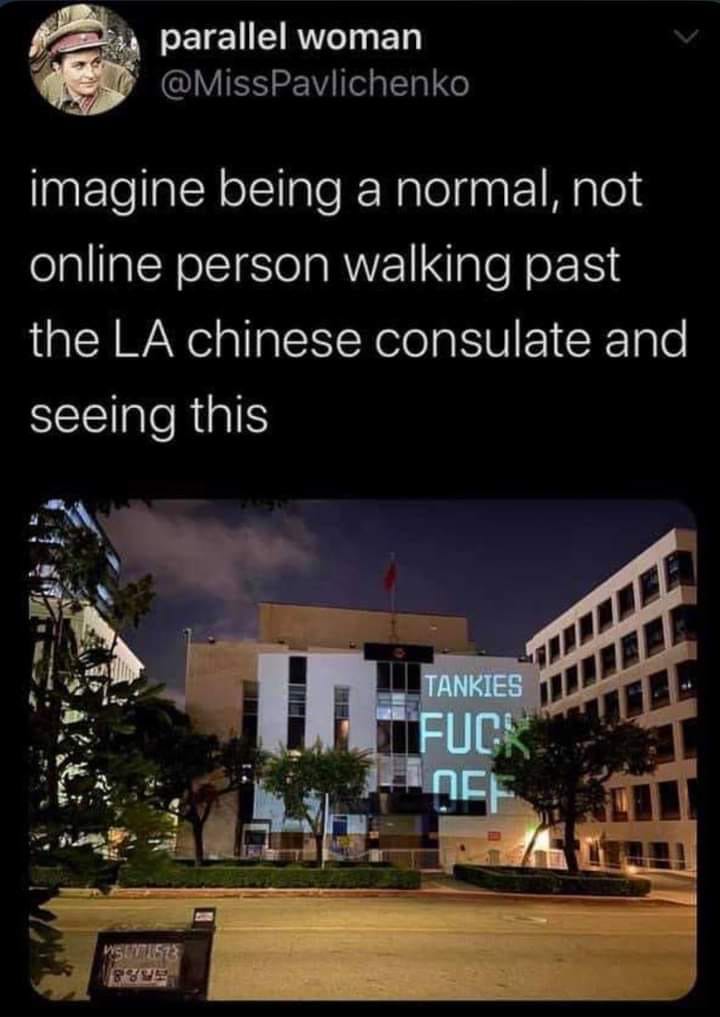
This meme is a satirical commentary on the left-wing online community's perception of the Chinese government's influence in the United States. The image shows a building with a sign that reads "TANKIES F**K OFF" in a style that is meant to be a parody of a popular left-wing meme. The text below the image reads "imagine being a normal, not online person walking past the LA chinese consulate and seeing this"
detailed-analysis (gemma3-27b-vision)
Okay, here's an analysis of the image and tweet, broken down into sections addressing the requested theoretical frameworks, focusing on what's relevant. It’s important to note that applying these theories is interpretive, and there's room for different perspectives.
I. Visual Description
The image depicts a nighttime view of the Chinese Consulate in Los Angeles. The consulate building is a multi-story structure, illuminated against the dark sky. A protest or demonstration is taking place in front of the consulate. A banner, prominently displayed, reads “TANKIES F*CK OFF”. The protest appears to be relatively small, with a few visible figures and protest paraphernalia. The image is taken from a slightly low angle, emphasizing the size of the consulate building. The overall impression is one of opposition directed towards the consulate, framed by an urban nighttime setting.
II. Foucauldian Genealogical Discourse Analysis
This image and the accompanying tweet can be analyzed through a Foucauldian lens by examining the discourses at play and how they’ve evolved historically.
- The Discourse of Political Protest: The protest itself represents a modern iteration of the discourse of political dissent. Foucault would ask how this form of protest came to be. Historically, protests evolved from localized, often physical rebellions to organized, public demonstrations with clear ideological aims. The use of banners and slogans is part of this evolution - a way to articulate power relations and challenge dominant narratives.
- The Term “Tankie”: The core of the analysis here lies in the term "tankie". Genealogically, "tankie" originated as a derogatory label for Western communists and socialists who expressed uncritical support for the Soviet Union's military interventions (like the use of tanks to suppress uprisings in Hungary and Czechoslovakia). Tracing its evolution reveals a shift in meaning: it’s now used more broadly to denounce those seen as defending authoritarian regimes or engaging in online “whataboutism” to justify problematic political stances.
- Power/Knowledge: The protest is an attempt to exercise power through the articulation of a counter-discourse. By labeling others "tankies," protesters attempt to delegitimize certain political positions and exert control over the terms of debate. Knowledge (about historical Soviet actions, contemporary authoritarian regimes) is crucial to this exercise of power.
III. Marxist Conflict Theory
This image is overtly tied to Marxist Conflict Theory.
- Class Struggle: While not directly depicting workers versus owners, the protest implies a struggle over ideology and political alignment. The protestors are likely positioned against perceived authoritarian tendencies, and against those who defend them.
- Ideological Conflict: The core conflict is ideological. The term "tankie" signifies a difference in political ideology—a perceived adherence to authoritarian, state-centered socialism versus other interpretations of leftist politics. The protest is an attempt to assert dominance over a particular ideological position.
- Imperialism/Anti-Imperialism: The Chinese Consulate as a site is inherently connected to power dynamics of international relations, imperialism, and anti-imperialist movements. The protest could be viewed as a reaction against perceived Chinese foreign policy or the actions of the Chinese state, within the framework of global power struggles.
IV. Postmodernism
Postmodern readings would emphasize the deconstruction of grand narratives and the fluidity of meaning.
- Deconstruction of "Leftist" Identity: The protest challenges the idea of a monolithic "left" or a unified leftist identity. The use of the term "tankie" highlights internal divisions and disagreements within the left, rejecting the notion of a cohesive ideological bloc.
- Meta-Narratives: The protest rejects the meta-narrative of uncritical support for authoritarian states, demonstrating a distrust of overarching ideologies.
- Simulation & Hyperreality: The tweet itself—a post on a social media platform—adds another layer. The protest is mediated through the digital realm, creating a simulation of real-world political action. The image may be more about "performing" dissent for an online audience than about achieving concrete political change.
V. Queer Feminist Intersectional Analysis
This is the least directly applicable framework but can offer insights.
- Critique of Authoritarianism: Queer and feminist movements are often critically engaged with any form of authoritarianism, as it inherently restricts individual freedoms and reinforces hierarchical power structures. The protest against perceived authoritarianism can be seen as aligned with these concerns.
- Intersectionality: While the image doesn't explicitly address intersectional concerns, the dynamics of power and ideology are always mediated by social categories like gender, race, and class. The protestors may be motivated by multiple forms of oppression.
- Challenging "Solidarity": The term "tankie" often carries implications of defending problematic states regardless of their human rights records or treatment of marginalized groups. A queer feminist analysis could highlight the particular harms caused by such regimes to LGBTQ+ individuals and women.
Overall Interpretation:
The image and tweet represent a complex moment of political contestation. It’s a microcosm of ideological battles playing out within the left, a rejection of uncritical support for authoritarian states, and a demonstration of how dissent is now frequently expressed and mediated through social media. The analysis through various theoretical lenses reveals how this seemingly simple image embodies broader power dynamics, historical legacies, and struggles over meaning and identity.
Disclaimer: These interpretations are subjective and open to debate. The complexities of political discourse and the nuances of theoretical frameworks mean that multiple readings are possible.
simple-description (llama3.2-vision)
The meme is a photo of the Los Angeles Chinese Consulate, but with a humorous alteration. The sign on the building has been changed to read "TANKIES FK OFF" instead of the usual "TANKS FK OFF".
tesseract-ocr
We ean v @MissPavlichenko imagine being a normal, not online person walking past the LA chinese consulate and seeing this ei to os 4 me” D \ ee ees hs A Le ead a Te Waa K oe eee ‘ a aay Bb | Sl elon sabes 6 BY hin a , ren — = a |