First Seen
2023-05-10T21:03:35+00:00
simple-description (llama3.2-vision_11b)
This meme is a satirical reference to the 1985 film "The ... . It features a ... , a ... , and the phrase "Join the ... ." The image is meant to be humorous and ironic, poking fun at the idea of ... .
detailed-analysis (gemma3-27b-vision)
Okay, here's an analysis of the image, broken down into the requested theoretical frameworks. I'll indicate sections that don't apply or have limited application up front.
Image Description
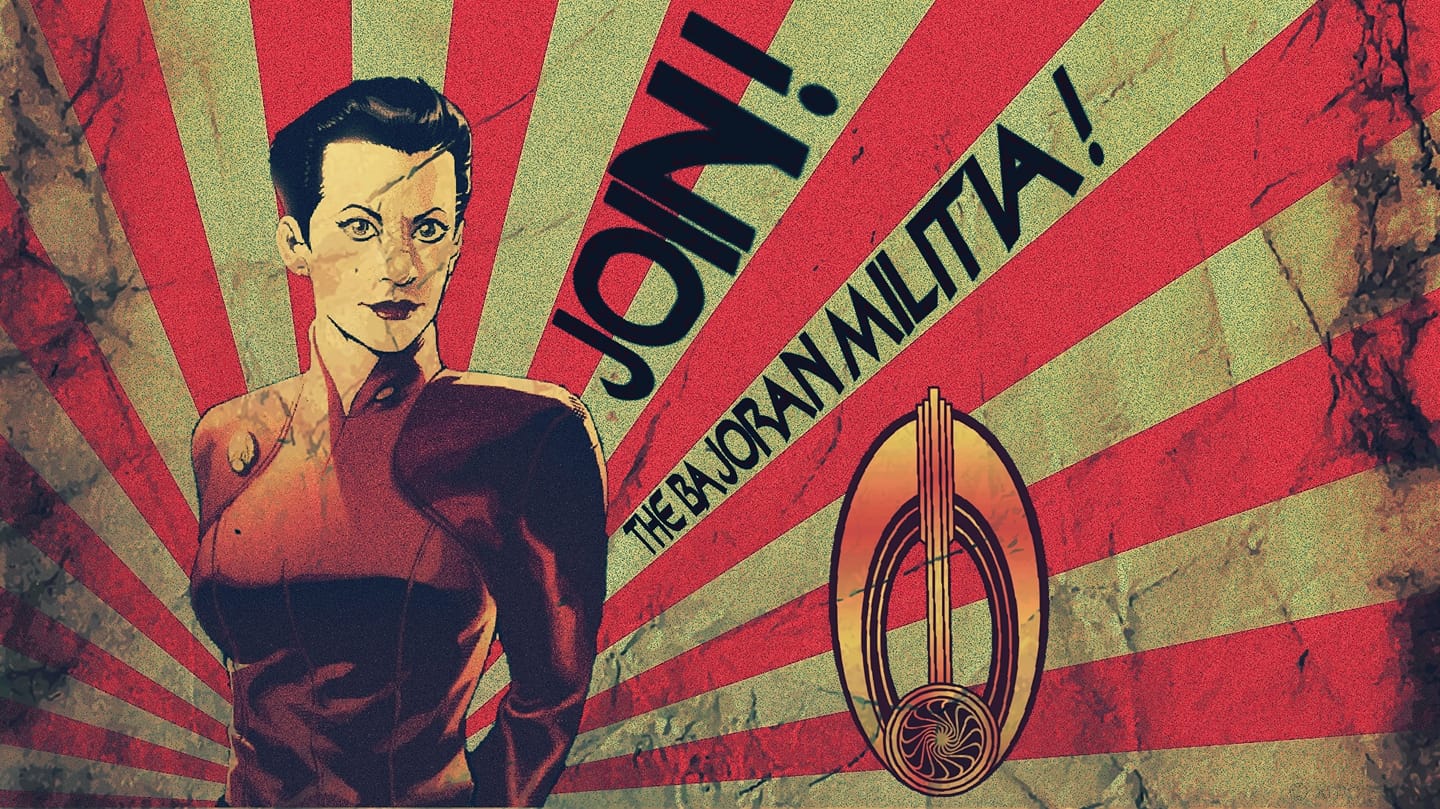
The image is styled like a propaganda poster, reminiscent of Soviet or early 20th-century political art. It features a strongly built, androgynous figure from the science fiction television series Star Trek: Deep Space Nine, specifically the Bajoran character Kira Nerys. Her muscular back and shoulder are prominently displayed, emphasizing strength and physical power. She’s depicted in her Bajoran militia uniform.
The background is comprised of radiating red lines against a yellowish-green background, giving the poster a sense of dynamism and urgency. The text "JOIN! THE BAJORAN MILITIA!" is boldly displayed diagonally across the image.
A circular emblem of the Bajoran militia is placed to the right of the figure. The emblem includes a stylized representation of a Bajoran symbol and what appears to be a blade. The overall effect is one of recruitment, power, and nationalistic/militia appeal. The texture also appears to be aged and distressed, giving the image a vintage or historical feel.
Foucauldian Genealogical Discourse Analysis
This image is ripe for a Foucauldian analysis. The poster represents a discourse surrounding power, security, and identity.
- Power/Knowledge: The poster doesn’t just ask for recruits; it produces the idea of "Bajoran-ness" as inextricably linked to military service. The image defines what it means to be Bajoran at this specific historical moment (post-occupation, in need of self-defense) through the association with militia participation. It creates a link between the individual, the collective (Bajorans), and the exercise of power (through the militia).
- Disciplinary Techniques: The image subtly employs disciplinary power. It doesn't use overt threats but rather fosters a sense of duty and obligation. By presenting a strong, physically powerful figure, the poster implicitly sets a standard and subtly disciplines viewers to see militia service as a normal, desirable, even necessary part of Bajoran identity.
- Genealogy of Power: Tracing the "genealogy" of this image would reveal the historical conditions that led to the need for a militia. The poster isn't simply about a present-day recruitment drive; it's a product of centuries of oppression under the Cardassian occupation. It's a response to a specific historical trauma and a strategy for preventing its recurrence. The imagery taps into a desire for self-determination and revenge.
- Normalization: The poster normalizes militarization as a solution to Bajor's problems. It presents armed struggle as a natural, inevitable response to the threat of ongoing instability and possible re-occupation.
Critical Theory
Drawing on the Frankfurt School, we can examine this image through the lens of ideology and the culture industry.
- Ideology: The poster promotes a specific ideological worldview: that collective security is paramount, and that military force is the most effective means of achieving it. It's a nationalist ideology, focusing on the collective identity of the Bajoran people and presenting a unified front against external threats.
- False Consciousness: (Potential application): One could argue that the poster potentially creates a "false consciousness" by obscuring the underlying socio-political complexities of Bajor. It simplifies the issue, presenting military service as the sole solution without addressing the root causes of conflict or the potential for peaceful resolution.
- Culture Industry: The poster is a product of the “culture industry” – a system that mass-produces cultural artifacts designed to reinforce dominant ideologies. It is designed to create a desire for participation in the militia through manipulation and the construction of idealized images.
- Commodification of Identity: It could be said that the poster commodifies Bajoran identity, framing it in terms of military service and creating a market for “Bajoran-ness” built around a nationalized defense force.
Marxist Conflict Theory
From a Marxist perspective, the image reveals the underlying class and power dynamics at play within Bajoran society.
- Class Struggle: While not immediately obvious, the poster can be linked to a potential class struggle. The militia represents a force to maintain the existing power structure, and could potentially be used to suppress internal dissent or protect the interests of a ruling class. Recruitment may disproportionately affect certain socio-economic groups.
- Means of Production/Control: The militia is a means of production of security and control in Bajoran society. It is the physical embodiment of the state's power. Control over the militia is therefore control over Bajor's future.
- Ideological State Apparatus: The poster serves as an “Ideological State Apparatus” (Althusser), propagating the dominant ideology and ensuring the reproduction of the existing power relations.
- Superstructure: The militia and its associated propaganda (like this poster) are part of the "superstructure" that reinforces the "base" of economic and social relations on Bajor.
Postmodernism
Postmodern analysis might focus on the image’s deconstruction of traditional notions of heroism and identity.
- Simulacra and Simulation: The poster is a simulacrum – a copy without an original. It’s a constructed image of Bajoran strength and unity that may not reflect the complex realities of Bajoran society. It becomes hyperreal, a more perfect representation of the idea of “Bajoran-ness” than actual lived experience.
- Deconstruction of the Hero: The androgynous figure challenges traditional notions of heroism as inherently masculine. This deconstruction of gender roles is a postmodern characteristic.
- Meta-Narrative: The poster relies on the meta-narrative of national liberation and self-defense. Postmodernism would question the validity and universality of this narrative, highlighting its inherent biases and power dynamics.
Queer Feminist Intersectional Analysis
This framework examines the image through the lens of gender, sexuality, and other intersecting identities, revealing how power operates to marginalize and oppress.
- Challenging Gender Norms: The androgynous figure is significant. While not explicitly queer, it challenges the traditional hyper-masculine representation of military strength. It provides a space for non-normative gender expressions within a traditionally masculine domain.
- Intersectionality: Analyzing who is not represented in the poster is crucial. Are women, non-binary individuals, or people of color (within the fictional context of Bajor) adequately represented? The absence of diversity suggests the exclusion of certain groups from the national narrative and the perpetuation of power imbalances.
- Patriarchal Structures & Militarization: The poster, even with its androgynous figure, still reinforces the association of strength and power with militarization, which is historically and culturally linked to patriarchal structures.
- The Body as a Site of Control: The muscular body is both empowering and a site of control. It represents physical strength but also conforms to certain beauty standards and expectations. This tension highlights the complex relationship between the body, power, and identity.
I hope this detailed analysis, broken down by theoretical frameworks, is helpful! Let me know if you'd like me to elaborate on any of these points.
simple-description (llama3.2-vision)
The meme is a reference to the 1984 film "The Terminator" and the 1986 film "RoboCop." It features a still image from "The Terminator" with the character of a cyborg assassin (The Terminator) and the phrase "I'll be back" in a bold, futuristic font.
tesseract-ocr
— 7 |, ls Ne i A | << S/o , 2 Basra: : * Om AC rd 4 e 4 Bee > F ae a YY es W TAN) se 4 — ~ — fi > a S Ye Meg 6 - - ; r F “~> ye a t ae ~~ is Pies Go) — a. ee ayaa ey,