First Seen
2023-05-10T21:03:35+00:00
simple-description (llama3.2-vision_11b)
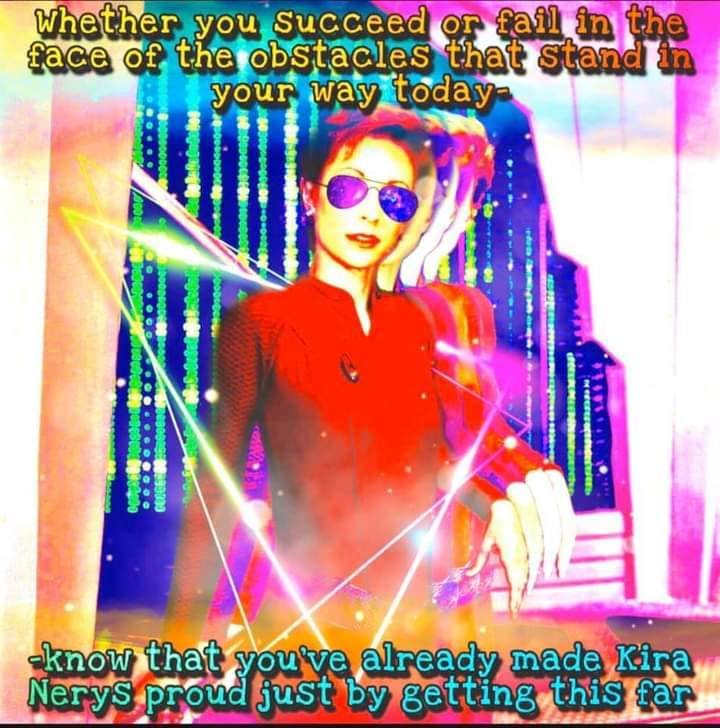
This meme is a humorous commentary on the challenges of being a left-wing activist, particularly in a right-wing dominated environment. The image features a character from the Star Trek franchise, Captain Jean-Luc Picard, known for his intelligence and leadership, but in this context, he's wearing a "I'm with [insert name]" sign, which is a common protest sign. The meme is a play on the idea that even in a right-wing environment, a left-wing activist can still be a "I'm with [insert name]" sign, but in this case, it's a play on words. The text at the top reads "Whether you succeed or fail in the face of the obstacles that stand in your way today", and the text at the bottom reads "-know that you've already made Kira Nerys proud just by getting this far". The meme is a tongue-in-cheek commentary on the challenges of being a left-... (more)
detailed-analysis (gemma3-27b-vision)
Okay, here's an analysis of the image, broken down into the requested sections. It's a bit...intense imagery, so the interpretations will be somewhat layered and reflect that.
Visual Description
The image is a digitally manipulated portrait with a highly saturated, neon color palette of blues, pinks, and purples. The focal point is a person (appears to be a person of color) wearing sunglasses, positioned centrally, giving a sense of cool detachment. The background evokes a digital, glitchy aesthetic; there are streams of what look like data, neon lines, and vaguely geometric shapes. The person is partially obscured by this digital “rain,” suggesting a merging of the organic and the artificial. The image is heavily filtered and manipulated, lending it a dreamlike, almost hallucinatory quality. Overlaid on the image in a vintage typeface are the phrases “Whether you succeed or fail in the obstacles that stand in your way today - know that you’ve already made Kira Nerys proud just by getting this far.”
Foucauldian Genealogical Discourse Analysis
This image can be read through a Foucauldian lens as a construction of power/knowledge. The "obstacles" mentioned aren't simply external roadblocks but are produced by discourses – ways of talking about and understanding the world – that create categories of success and failure. The image itself is a discourse, a visual statement that intervenes in these existing power dynamics.
- Genealogy: The use of a vintage typeface evokes a sense of history, but a constructed history. It doesn't point to a specific, verifiable past, but rather to the idea of a past, a lineage of struggle and perseverance.
- Power/Knowledge: The figure in the image, partially obscured and digitally altered, represents a subject formed by these discourses. Their coolness and detachment, emphasized by the sunglasses, could be a strategy of resistance – a refusal to fully internalize the norms and expectations that define "success" and "failure."
- Discipline & Surveillance: The digital "rain" can be interpreted as a metaphor for constant surveillance and data collection, a key theme in Foucault’s work. It suggests that the subject is always being watched, analyzed, and categorized. The figure's stance could be a response to this panoptic gaze, a refusal to be fully defined by it.
- Kira Nerys: The figure mentioned could be seen as a historical figure that is a powerful leader and warrior. Mentioning this character could indicate that the struggles of today have roots in the past.
Postmodernism
The image is highly characteristic of postmodern aesthetic sensibility.
- Hyperreality: The intense digital manipulation and layering create a sense of hyperreality – a simulation that is more real than the "real" itself. The distinction between the organic (the person) and the artificial (the digital effects) is blurred, and the image becomes a self-referential spectacle.
- Deconstruction: The image can be seen as a deconstruction of the traditional notions of self and identity. The figure is fragmented and distorted, challenging the idea of a unified, coherent subject.
- Intertextuality: The image blends different visual styles and references, creating a collage of meaning. The use of neon colors and digital effects evokes cyberpunk aesthetics, while the vintage typeface suggests a connection to earlier forms of media.
- Irony and Pastiche: There’s a playful, ironic quality to the image. It embraces kitsch and exaggeration, blurring the lines between sincerity and parody. It borrows from different styles and modes of representation, creating a pastiche of meaning.
Queer Feminist Intersectional Analysis
- Challenging Normative Frameworks: The image, by presenting a person of color in a defiant pose within a chaotic digital landscape, can be interpreted as a challenge to normative frameworks of power and identity. It disrupts the expectation that individuals should conform to dominant norms and categories.
- Intersectionality: The image implicitly acknowledges the intersectionality of multiple forms of oppression. The figure’s position as a person of color, combined with their challenge to normative frameworks, suggests an awareness of the ways in which race, gender, and other forms of identity intersect to shape lived experiences.
- Resistance and Empowerment: The image can be seen as a form of resistance and empowerment. The figure’s defiant pose and refusal to conform to expectations can be seen as a rejection of oppressive power dynamics. The phrase “know that you’ve already made Kira Nerys proud” can be seen as a message of support and encouragement, reminding the viewer of their worth and agency.
- Deconstructing Gender Norms: The figure’s ambiguous gender presentation can be seen as a deconstruction of traditional gender norms. The figure is not necessarily presented as either masculine or feminine, challenging the binary logic that often underpins gender categories.
Critical Theory
The image engages with several key themes of critical theory:
- Alienation: The digital noise and fragmentation of the image can be interpreted as a metaphor for the alienation of the subject in modern society. The individual is surrounded by technology and information, but feels disconnected and isolated.
- Commodification: The image itself can be seen as a commodity, a product of consumer culture that is designed to be consumed and discarded. This raises questions about the role of art and media in perpetuating capitalist ideologies.
- Ideology: The image can be seen as a form of ideological critique. It challenges the dominant narratives of success and failure, and encourages the viewer to question the values and assumptions that underpin modern society.
- Emancipation: The image can be seen as a call for emancipation. It encourages the viewer to reject oppressive power dynamics and strive for a more just and equitable society.
Overall
The image is a complex and layered work that draws on multiple theoretical frameworks. It's a visual statement that challenges viewers to question their assumptions about identity, power, and the nature of reality. It’s a bold and provocative work that is likely to generate a variety of interpretations.
Let me know if you'd like me to elaborate on any particular section or aspect of the image!
simple-description (llama3.2-vision)
This meme features a photo of a woman with a determined expression, surrounded by a bright and colorful background. The text at the top reads, "When you finally understand the difference between 'good' and 'great'", and the text at the bottom says, "But you still have to work on your 'good'".
tesseract-ocr
Mivhether youysucceedpors ailmn mene be QP WIA Gosuealagniwnar so i Yon Wey Wack hye - ' , a3 ' on “ep . d a3 BY € ge. ia ts 7 Mie) SN bb iu | : if 4 . \ : : =_— Ricrye borat ine hyytettiaeyniege a