First Seen
2023-05-10T21:03:35+00:00
simple-description (llama3.2-vision_11b)
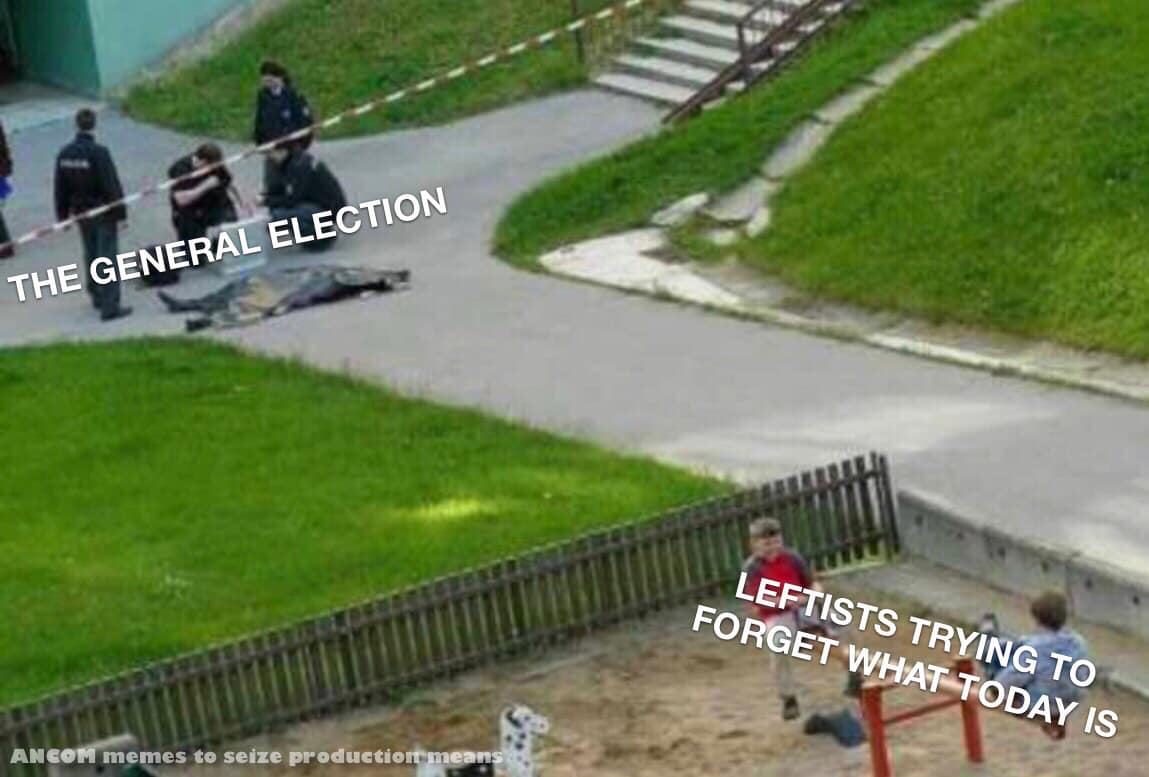
The meme is a play on the idea that leftists often struggle to remember what happened today, and are often "left" (pun intended) behind in the conversation. The image shows a group of people in a park, with one person sitting on a bench, and the text "THE GENERAL ELECTION" and "LEFTISTS TRYING TO FORGET WHAT TODAY IS" superimposed over the image. The meme is a humorous way to poke fun at the idea that leftists are often forgetful and struggle to keep up with current events.
detailed-analysis (gemma3-27b-vision)
Okay, let's break down this image and the text overlaid onto it through various theoretical lenses. It's important to remember that applying these theories is interpretive, and different readings are possible.
Visual Description
The image depicts a slightly blurry, low-angle outdoor scene. A robotic vacuum cleaner appears to be struggling to navigate over a small, grassy knoll/hill. There's a low wooden fence and a flight of concrete steps in the background. The overall aesthetic is somewhat awkward and amateurish, reminiscent of a quickly captured moment. Overlaid on the image are the phrases "THE GENERAL ELECTION" and "LEFTISTS TRYING TO FORGET WHAT TODAY IS," along with a small "ANCOM memes to seize production means" at the bottom. The use of all-caps text is attention-grabbing and potentially aggressive.
Foucauldian Genealogical Discourse Analysis
This image can be interpreted through a Foucauldian lens as a miniature instantiation of power dynamics. The robotic vacuum—a symbol of automated efficiency and technological 'progress'—is struggling. This struggle can be seen as a microcosm of how discourse shapes reality. The overlaid text asserts that "The General Election" is akin to this struggle – a system that appears to function on its own terms, yet is often inefficient and fails to navigate complex terrains (i.e., societal problems).
The claim that "Leftists are trying to forget what today is" is a performative statement—it isn’t necessarily true, but rather constructs a narrative. It's an attempt to define leftists as amnesiac and disconnected from the concrete realities of time and civic duty. The struggle of the robot is thus discursively linked to perceived failings of the left.
Foucault would ask us to trace the genealogy of these concepts: "the election" as a modern tool of governance, "the left" as a historical political designation, and the discourse around their perceived failures. He'd see the image as a site where power operates by framing a specific narrative and constructing 'truth' through rhetoric and visual representation.
Marxist Conflict Theory
The image can be read as a metaphor for the inherent contradictions within the capitalist system, and, by extension, political processes like elections. The robotic vacuum, a product of technology developed within capitalist production, is struggling to perform its basic function—a metaphor for the system's inability to address fundamental needs or resolve its own internal conflicts.
The claim that "leftists are trying to forget what today is" might be interpreted as a critique of their perceived disconnect from the "material conditions" of everyday life—the actual struggles of working people. It suggests a failure to acknowledge the concrete realities of class struggle.
The "ANCOM memes to seize production means" at the bottom aligns directly with Marxist thinking, specifically anarchist communism (ancom). The call to seize the means of production is a central tenet of Marxist theory, advocating for the workers to control the factories, resources, and distribution of wealth, rather than the capitalist class. The image could be seen as a call to action—a visual representation of the need to disrupt the existing power structures and reclaim control.
Postmodernism
This image strongly embodies postmodern characteristics. The image itself is a low-quality, somewhat absurd visual. The text overlays disrupt the original scene, creating a fragmented and ironic effect. The juxtaposition of the mundane (a vacuum cleaner struggling) with the political (“The General Election,” “Leftists trying to forget today”) is characteristic of postmodern pastiche—a combination of disparate elements to create a new meaning.
The statement about leftists "forgetting what today is" could be interpreted as a rejection of grand narratives or universal truths. Postmodernism often questions the idea of objective reality and the possibility of finding meaning in overarching ideologies. The meme’s meaning is not inherent in the image itself, but rather created through its ironic juxtaposition and the viewer’s interpretation.
The meme relies on a playful, self-aware irony. It isn't necessarily making a sincere political argument, but rather commenting on political discourse through absurdity and deconstruction.
Critical Theory
From a Critical Theory perspective, the image is a symptom of a larger cultural and political malaise. The struggling robotic vacuum can be seen as a representation of the failing promise of technological progress and efficiency—a key tenet of modern capitalist ideology. The "General Election" is positioned as another system that doesn’t work as advertised.
The statement about leftists "forgetting what today is" is a powerful assertion that plays into anxieties about political apathy and disengagement. It implies a critique of the left’s ability to connect with the concerns of ordinary people and to offer a viable alternative to the status quo.
Critical theorists would examine the image's ideological function – how it reinforces or challenges existing power structures. The image could be seen as a subtle form of propaganda, designed to discredit the left and to promote a cynical view of politics.
Queer Feminist Intersectional Analysis
This lens is the most difficult to apply directly, but we can consider it. The image’s absurdity and fragmentation can be read as mirroring the experience of marginalized communities whose voices and experiences are often obscured or erased within dominant narratives. The breakdown of the vacuum cleaner and the fragmented text can represent the disruption of established systems and the demand for new ways of seeing and understanding the world.
The idea of “forgetting what today is” could be interpreted as a critique of the dominant culture’s tendency to erase or ignore the histories and struggles of marginalized groups. The call to "seize production means" from an anarcho-communist position is also inherently feminist and queer-affirming since this position is typically rooted in the dismantling of all oppressive hierarchical structures.
The analysis here might focus on who is doing the “forgetting” and what is being forgotten. Is it a privileged group ignoring the needs and experiences of others? Is it a system that actively suppresses dissent and marginalizes certain voices?
It's important to remember that these are just possible interpretations, and the meaning of the image is ultimately open to debate. Different theoretical lenses will reveal different aspects of its complexity and significance.
simple-description (llama3.2-vision)
This meme is a play on the phrase "the leftists are always so predictable" and the phrase "the rightists are always so predictable." The meme features an image of a crime scene with a police officer saying "the leftists are always so predictable" and a bystander responding with "no, the rightists are always so predictable."
tesseract-ocr
re Pox < ae . tgs Kee : “ ‘ ae — a ~ : y . 5 (Aa ae od pe BinlS ic) ea » : ie ' . Bs i —— = . p o> et ees oe ite aa —_— he, —s ee ya c ae . US 4 a, a ao SY ee at ———— - —% - ny ~ - a Lara