First Seen
2023-05-10T21:03:35+00:00
simple-description (llama3.2-vision_11b)
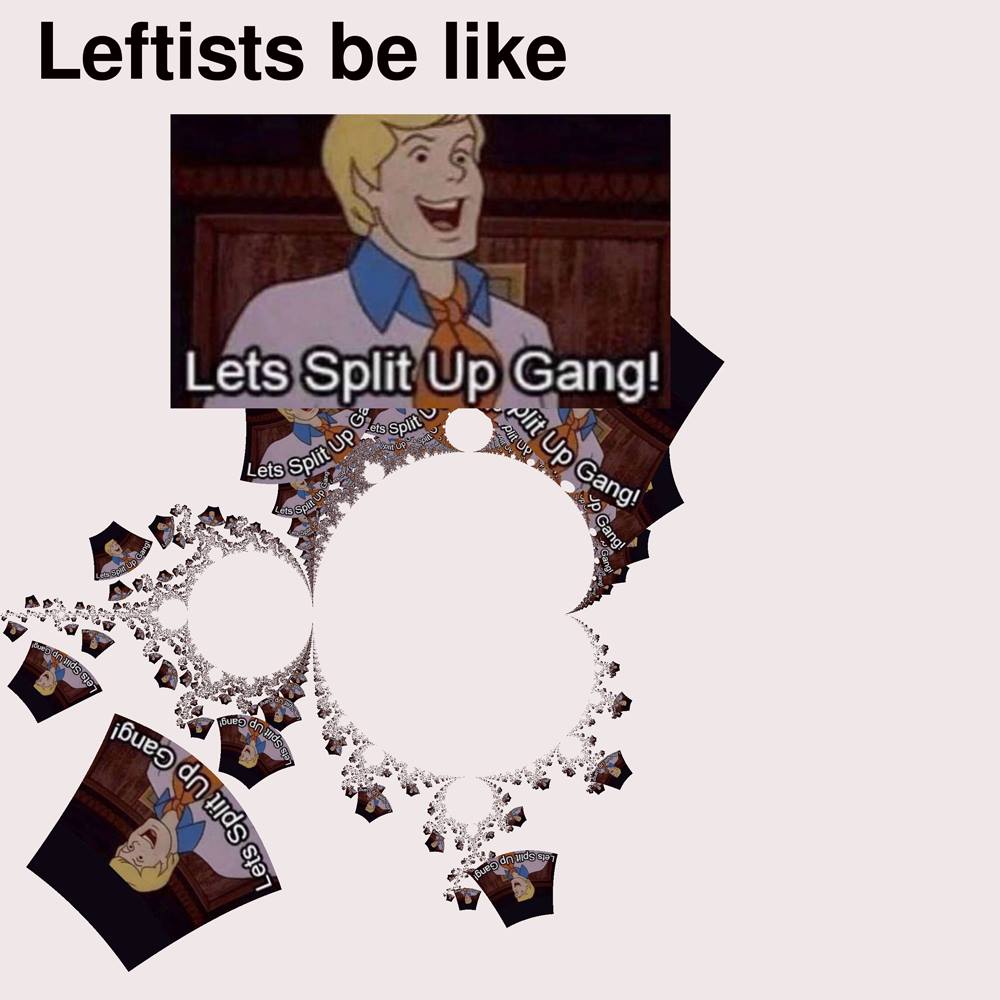
This meme is a humorous take on the stereotype that leftists are often split into multiple factions or subgroups, with each one having its own "gang" or "group" that they are part of. The image features a character from the classic cartoon "Scooby-Doo" with the caption "Let's split up, gang!" which is a reference to the common leftist practice of splitting up into smaller groups to cover more ground or to have a more effective "split-up" strategy. The image is meant to be humorous and satirical, poking fun at the idea that leftists are always trying to "split up" and "get a group" to work together.
detailed-analysis (gemma3-27b-vision)
Okay, let's break down this meme using the requested theoretical lenses. It's a layered image, so we'll need to address each layer and how it interacts with these theories.
Visual Description
The image is a digitally manipulated meme. It features a still image of Prince Eric from Disney's The Little Mermaid. He’s shown with an excited expression and the text "Lets Split Up Gang!" imposed over him. This single image is then digitally "fractalled" – replicated and slightly rotated around a central point, creating a spiral or vortex effect. Each replicated image also includes the text “Lets Split Up Gang!” with slight variances in orientation. The background is a blurred, dark room suggesting an interior space. The overall visual impression is of chaotic proliferation and a descent into fragmentation. The fractal effect creates a sense of infinite replication, bordering on being visually overwhelming.
Foucauldian Genealogical Discourse Analysis
This meme can be analyzed through a Foucauldian lens as an articulation of a particular discourse about "leftists." Foucault emphasizes that power operates not through repression, but through the production of discourses – systems of thought, language, and practice that shape our understanding of the world.
- Genealogy: A genealogical approach would investigate the historical emergence of the phrase "Let's split up gang!" and its association with leftist tactics. It isn’t about finding a “true” origin, but rather tracing how the phrase became associated with perceived fragmentation and internal conflict within leftist movements. The meme performs a genealogy by visually connecting a specific tactic with a caricature of leftist behavior.
- Power/Knowledge: The meme suggests a power/knowledge dynamic, implying that the meme creator (and those who share/approve of it) possess a “truthful” understanding of leftist tendencies, while the "leftists" themselves are depicted as irrational and chaotic. The visual overload created by the fractal replicates the chaos and fragmentation, framing it as inherently problematic.
- Disciplinary Power: The meme doesn't directly discipline leftists, but subtly constructs a narrative that normalizes criticism of their internal dynamics. It positions unity and coherent strategy as the norm, implicitly framing dissent and diversification as signs of weakness or instability.
Critical Theory
From a Critical Theory perspective, this meme is a commentary on (and potentially a critique of) leftist political organization and strategy.
- The Culture Industry: The meme can be seen as a miniature example of the "culture industry" (Adorno & Horkheimer). It's a piece of popular culture that reinforces dominant ideologies. In this case, it suggests that internal divisions are inherently problematic in political movements, which may serve to delegitimize leftist causes. The rapid replication and sharing of the meme within online spaces further amplifies this message.
- Reason & Emancipation: Critical Theory is often concerned with the role of reason in achieving emancipation. This meme, however, presents a lack of reason as a defining characteristic of the “leftists” it targets. The chaotic visual representation implies that they are driven by emotion or impulse rather than rational thought, hindering their ability to achieve meaningful change.
- Ideology Critique: The meme implicitly critiques the notion that "splitting up" – i.e., forming different factions, pursuing diverse strategies, or engaging in internal debates – is inherently harmful. It suggests that a unified front is always preferable, which may serve to obscure the potential benefits of internal critique and adaptation.
Marxist Conflict Theory
Looking through a Marxist lens, the meme highlights an internal tension within a potential revolutionary class (leftists).
- Class Struggle: Although the meme doesn't directly portray class conflict, it can be seen as an example of ideological struggle within the left. The internal divisions depicted suggest a lack of class consciousness or a failure to overcome individual interests in favor of collective action.
- False Consciousness: The meme could be interpreted as reinforcing a "false consciousness" among those critical of leftist infighting. By portraying internal disagreements as chaotic and unproductive, it obscures the potential for these disagreements to lead to innovative solutions or a more nuanced understanding of power dynamics.
- Hegemony: The widespread circulation of the meme could contribute to a hegemonic narrative that portrays leftist movements as inherently unstable and ineffective. This narrative could serve to discourage participation and undermine the potential for collective action.
Postmodernism
A Postmodern reading focuses on the meme's deconstruction of meaning and its embrace of fragmentation.
- Simulacra and Simulation: (Baudrillard). The meme doesn't represent a "real" conflict within the left, but rather a simulation of it. The endless replication of the phrase and image creates a hyperreality that obscures any underlying substance. The meme becomes the perceived problem, rather than being a reflection of it.
- Deconstruction: The meme deconstructs the idea of a coherent "leftist" identity. By emphasizing internal divisions, it undermines the possibility of a unified political subject.
- Meta-narratives: Postmodernism rejects grand narratives or universal truths. The meme implicitly critiques any claim to a single, "correct" way of organizing or fighting for social change. It suggests that fragmentation and diversity are inevitable (and perhaps even desirable) aspects of political life.
Queer Feminist Intersectional Analysis
This is where the analysis gets more nuanced. The meme, while seemingly generic, can be read through an intersectional lens considering who is being stereotyped and how.
- Internalized Oppression & Policing: The meme can be seen as "policing" leftist behavior, setting up an expectation of seamless unity that is often unrealistic and harmful, especially for marginalized groups within leftist spaces. The focus on "splitting up" can implicitly silence dissenting voices (e.g., those challenging dominant ideologies within the left) and discourage critical self-reflection.
- Diversity & Coalition Building: Leftist movements are often characterized by a diversity of perspectives and experiences. The meme’s implication that this diversity is inherently problematic ignores the value of intersectional coalition building, where different groups come together to fight for shared goals. The critique of “splitting up” can actually be a critique of accountability - when marginalized groups call out harmful behaviors within the left.
- Emotional Labor & Expectation of Conformity: Marginalized groups often bear the brunt of emotional labor in leftist spaces, attempting to mediate conflicts and address harmful behaviors. The meme’s implicit demand for unity can place an undue burden on these groups to suppress their concerns in order to maintain the appearance of cohesion.
Important Note: It’s crucial to remember that this is an interpretation. The meaning of a meme is always open to debate and depends on the context in which it’s encountered. These analytical frameworks offer different ways of understanding the meme's potential implications, but they don't necessarily represent a definitive or objective truth.
simple-description (llama3.2-vision)
This meme is a humorous take on the concept of "leftists" and their perceived behavior. The image features a character from the cartoon "Scooby-Doo" with a caption that reads, "Let's split up gang!" The meme is meant to be ironic, implying that leftists are not capable of working together or making decisions as a group, and instead, they need to "split up" to accomplish anything. The image is likely meant to be satirical and not taken seriously.
tesseract-ocr
Leftists be like ay “a : Pe ed BR, | Lets}Split|Up|Gang! Gite a es | ‘s & Ont » Pew © ip we et 3 * pa) é 8 |