First Seen
2023-05-10T21:03:35+00:00
simple-description (llama3.2-vision_11b)
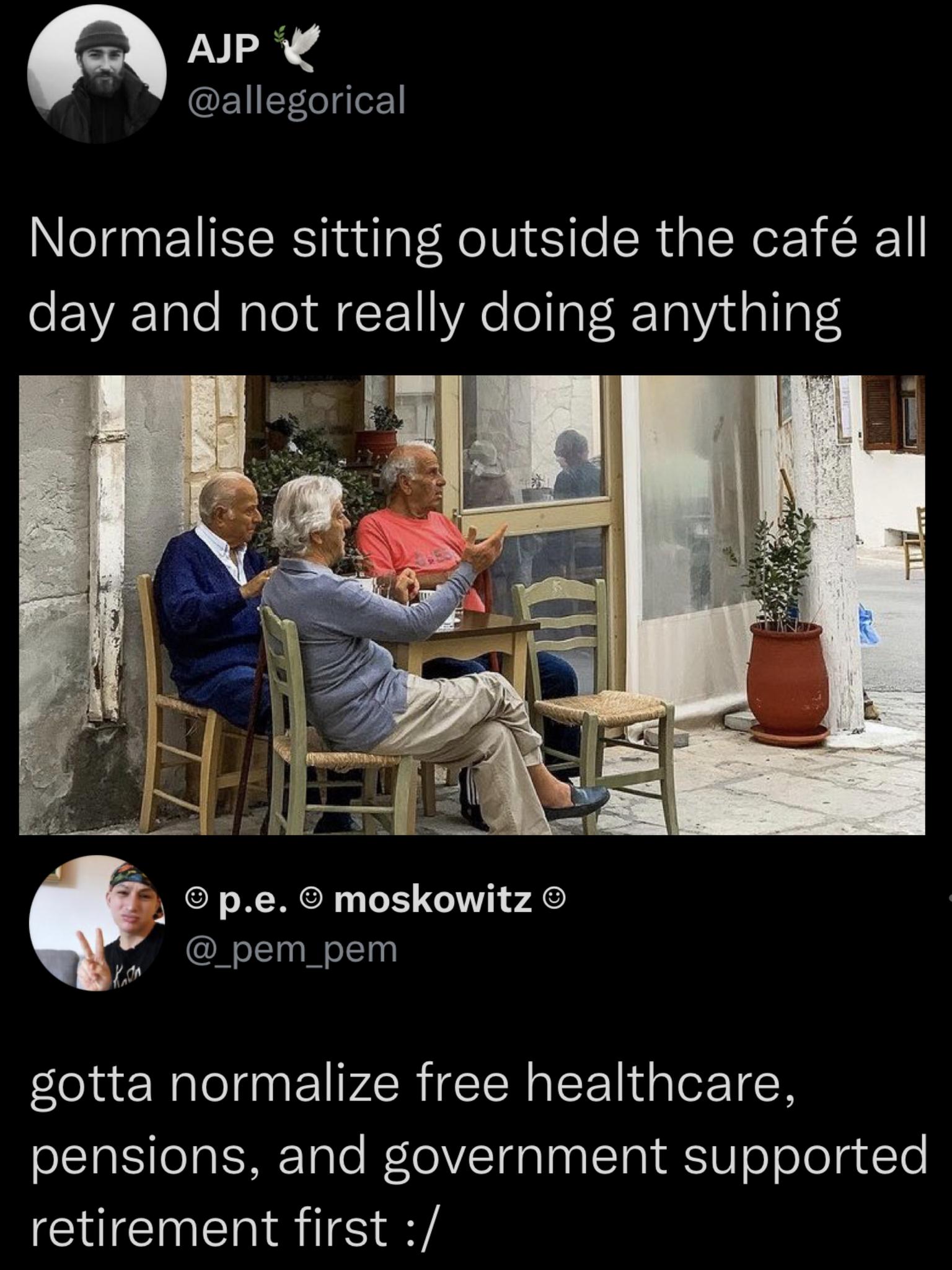
This meme is a commentary on the societal expectation of older people to be active and engaged in their communities. The image shows three elderly people sitting in a cafe, but instead of participating in the usual social interactions, they're simply sitting and staring out the window. The text "normalise sitting outside the cafe all day and not really doing anything" is a satirical commentary on the expectation of older people to be active and engaged in their communities. It's a humorous and relatable take on the societal expectations of older people.
detailed-analysis (gemma3-27b-vision)
Okay, here's an analysis of the image and associated text, broken down into relevant sections as requested. Given the content, some sections will be more developed than others, and some sections won't be applicable.
Visual Description
The image depicts three older people seated at a table outside a cafe or restaurant in what appears to be a Mediterranean town. The setting is characterized by stone walls, a narrow street, and a terracotta plant pot. The individuals are dressed in casual clothing, and they appear to be engaged in conversation, though their expressions aren't clearly visible. The light suggests a warm, sunny day. The scene evokes a sense of leisure, relaxation, and community, and a slower pace of life.
Foucauldian Genealogical Discourse Analysis
The posts implicitly ask us to normalize certain behaviors and socioeconomic realities. Foucault's genealogical approach would be interested in how these 'normalizations' came about.
- Discourse & Power: The first post asks for the normalization of idle leisure. This is seemingly harmless, but a Foucauldian analysis would ask: who benefits from the idea that a certain type of leisure (specifically, having the time and financial security to simply be in a public space) is normal? How has this normality been constructed through historically-specific discourses around work, productivity, and value? The second post explicitly links this 'normalization' of leisure to social welfare programs.
- Historical Contingency: The idea of an extended, financially-secure retirement—even the ability to afford to sit at a cafe all day—is not universal or timeless. It’s a historically specific outcome of social and economic changes (e.g., the development of welfare states, the rise of pension systems). A genealogical investigation would trace how these systems emerged, what power relations shaped them, and how they’ve shifted over time.
- Subjectivation: The posts also speak to how we become subjects within these discourses. If someone feels guilt or anxiety about enjoying leisure without being ‘productive,’ that’s evidence of the internalization of a specific (capitalistic) disciplinary regime. The call to ‘normalize’ is therefore a call to challenge those internalizations and create space for alternative ways of being.
Critical Theory
The image and text both lend themselves to a critical theory perspective, particularly relating to concepts of alienation and the potential for reclaiming everyday life.
- Alienation from Labor: The call to normalize "doing nothing" at the cafe is a tacit critique of the demands of capitalist labor. It suggests a rejection of the idea that one's worth is solely defined by their economic productivity. This resonates with Marx's concept of alienation, where labor becomes external to, and opposed to, the worker. The desire to simply be suggests a longing to overcome this alienation.
- The Culture Industry & Leisure: Adorno and Horkheimer’s work on the culture industry is relevant here. The cafe itself can be seen as part of a system that commodifies leisure. However, the call to "normalize" occupying this space without consuming excessively (or at all) potentially represents a subversion of that system. It's a reclamation of public space for non-commercial enjoyment.
- Reification and the Lifeworld: The image touches on the idea of reclaiming a “lifeworld” (Habermas), a sphere of everyday life free from the instrumental rationality of capitalism. The act of simply being present, enjoying conversation, and observing the surroundings can be seen as a form of resistance to the commodification of time and experience.
Marxist Conflict Theory
The posts are strongly rooted in Marxist thought, particularly concerning class struggle and the distribution of resources.
- Class Privilege & Leisure: The ability to spend time at a cafe, “doing nothing,” is inherently a privilege, linked to economic security and access to social welfare. The posts’ linkage of this freedom to free healthcare, pensions, and government-supported retirement highlights the role of the state in ensuring a minimum standard of living that allows for such leisure. This is a challenge to the idea that leisure is a purely individual achievement, arguing that it’s a socially-constructed right.
- Exploitation & Surplus Value: The implicit critique of relentless productivity also hints at the exploitation inherent in capitalist labor. The call to "normalize" leisure can be interpreted as a demand for a fairer distribution of surplus value – a recognition that workers deserve to enjoy the fruits of their labor, not just be perpetually driven to produce more.
- The Welfare State as a Site of Struggle: The second post explicitly positions free healthcare, pensions, and retirement as essential components of a just society. This highlights the importance of the welfare state as a site of ongoing class struggle – a constant negotiation between those who benefit from the system and those who seek to dismantle it.
Postmodernism
While less central than the Marxist/Critical Theory interpretations, some postmodern elements are present:
- Deconstruction of Productivity: The very act of deliberately embracing "doing nothing" can be seen as a deconstruction of the dominant discourse around productivity and efficiency. It challenges the idea that worth is solely defined by economic output.
- Rejection of Grand Narratives: The posts subtly question the “grand narrative” of endless economic growth and the pursuit of material wealth. It suggests an alternative value system based on leisure, social connection, and well-being.
- Simulation & Hyperreality: One could argue that the cafe itself is a "simulacrum" – a representation of a more authentic experience of community and relaxation. The act of occupying that space, while superficially enjoyable, might also be seen as a form of escapism.
Queer Feminist Intersectional Analysis
This is the least applicable lens, but certain intersections can be explored:
- The Gendered Nature of Leisure: Leisure time is not evenly distributed among genders. Historically, women have often been burdened with unpaid domestic labor and childcare, limiting their access to leisure. A feminist analysis would consider how the "normalization" of leisure might contribute to a more equitable distribution of time and resources.
- Intersectional Access to Welfare: Access to social welfare programs (healthcare, pensions) is often unevenly distributed along lines of race, class, gender, and sexuality. An intersectional analysis would highlight the specific barriers faced by marginalized groups in accessing these resources and the need for policies that address these disparities.
- Challenging Normative Productivity: The rejection of relentless productivity can also be seen as a challenge to the heteronormative and ableist assumptions that often underpin the emphasis on work and achievement. Queer and disability activism has often challenged these norms, advocating for alternative ways of living and being.
Let me know if you’d like me to elaborate on any of these points or explore other theoretical frameworks!
simple-description (llama3.2-vision)
The meme features a photo of three elderly individuals sitting outside a cafe, accompanied by the text "Normalise sitting outside the cafe all day and not really doing anything." The image is overlaid with a caption that reads, "Gotta normalise free healthcare, pensions, and government-supported retirement first." The meme humorously suggests that before people can relax and do nothing, they need to prioritize essential services like healthcare, pensions, and government support for retirement. The image and text work together to convey a lighthearted commentary on the importance of these services.
tesseract-ocr
ro IN| 4 ~ ™ @allegorical Normalise sitting outside the cafe all day and not really doing anything aa | oe | ee lly | fi Fe OS a ee ee , ~ Stes = la \—7 a Se ae | 1 a =i mh — | 8 , Op.e. © moskowitz © | iv @_pem_pem gotta normalize free healthcare, pensions, and government supported eid celealyal ani acl aee