First Seen
2023-05-10T21:03:35+00:00
simple-description (llama3.2-vision_11b)
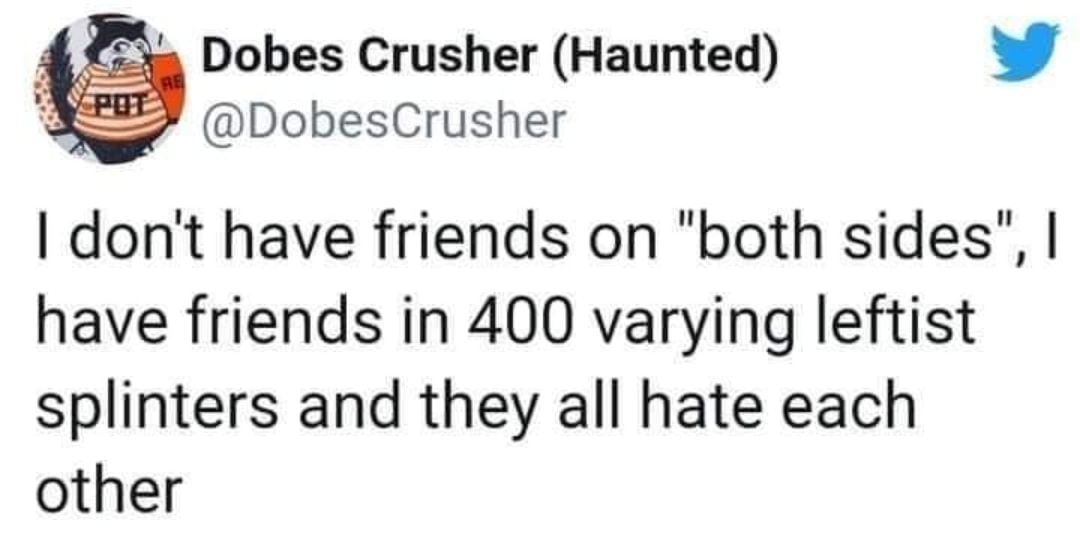
The meme is a tweet from the Twitter account @DobesCrusher, which states: "I don't have friends I have friends in 400 splinters and they all hate each other (Haunted) on 'both sides', I am a varying leftist I hate all of them." The tweet is a satirical commentary on the leftist movement, suggesting that even within the left, there are many different groups and people who are not liked by each other. The tweet is likely intended to be humorous and satirical, but may also be seen as a commentary on the divisions within the left.
detailed-analysis (gemma3-27b-vision)
Okay, let's break down this Twitter post through various theoretical lenses. It's a surprisingly rich little statement for analysis.
Visual Description
The post is a screenshot of a Twitter profile and tweet. The profile picture depicts a stylized, cartoon-like skull with the letters "POT" on it, rendered in a military/tactical aesthetic (camo pattern, helmet-like shape). The username is "DobesCrusher," and the handle is "@DobesCrusher," followed by "Haunted." The tweet itself is a declarative statement about the speaker's social network, characterized by a refusal of binary oppositions ("both sides") and the extreme fragmentation of their leftist circles. The presence of an icon, skull with letters, and choice of handle and username suggest a potentially ironic, antagonistic, or subversive tone.
Foucauldian Genealogical Discourse Analysis
This post can be analyzed through a Foucauldian lens as a commentary on the production of truth within leftist discourse. The speaker is subtly critiquing the expectation that political stances neatly fall into "sides." Foucault would be interested in the discursive formations that encourage this binary thinking and the power dynamics embedded within them. The statement "400 varying leftist splinters" implies that the speaker is witnessing a proliferation of micro-discourses within the left—each with its own rules, terms, and concepts.
The claim that these "splinters" "all hate each other" is crucial. Foucault wouldn't see this as simply a matter of individual dislike but as evidence of how power operates within the left. Each "splinter" is attempting to establish its own truth claims as dominant, creating internal conflicts and anxieties. The speaker isn't necessarily lamenting this conflict; they may be observing it as an inherent characteristic of the ways power operates within discourse. We'd need more context to know if they see this fragmentation as productive or destructive.
Critical Theory (Frankfurt School)
From a Critical Theory perspective, this post reflects the fragmentation and self-destruction often observed within progressive movements. The speaker’s claim suggests that the left has become so focused on internal purity and ideological infighting that it’s lost sight of any overarching goals.
This aligns with Adorno and Horkheimer's concept of the "dialectic of enlightenment," where reason and progress, rather than liberating, lead to new forms of domination—in this case, domination within the progressive space itself. The internal hatred and fragmentation of the leftist "splinters" may be interpreted as a sign of a failure to develop a cohesive critique of power. The speaker's refusal to identify with either "side" could be seen as a rejection of the false oppositions promoted by the dominant ideology. This could be seen as an indication of a crisis of legitimation.
Marxist Conflict Theory
From a Marxist perspective, the claim that leftist "splinters" "all hate each other" is a direct consequence of the internal contradictions within the left itself. These contradictions arise from differing interpretations of class struggle, the path to revolution, and the nature of oppression.
Each "splinter" represents a different fraction of the proletariat or a different understanding of the forces shaping the class struggle. The “hatred” isn’t simply emotional; it's a manifestation of the material interests and ideological positions of these competing factions. The speaker’s stance of refusing to align with either "side" could be interpreted as a rejection of the limitations of traditional class analysis and a recognition of the complex and fragmented nature of contemporary class relations. It suggests that the simplistic binary of "us vs. them" no longer adequately captures the dynamics of conflict.
Postmodernism
Postmodern thought would see the statement as a celebration of fragmentation and the rejection of grand narratives. The "400 varying leftist splinters" exemplifies the postmodern emphasis on multiplicity, difference, and the deconstruction of essentialist categories.
The speaker is implicitly rejecting the idea of a unified "left" with a singular purpose or ideology. The “hatred” between these groups isn’t necessarily seen as negative; it’s a natural consequence of the inherent instability and contingency of meaning. There is no single "truth" about how to achieve social justice; only a multitude of competing perspectives. The refusal to take sides can be read as an affirmation of this multiplicity and a rejection of the totalizing tendencies of grand narratives.
Queer Feminist Intersectional Analysis
This statement, viewed through an intersectional lens, highlights the complexities and tensions within movements claiming to be progressive. The "400 varying leftist splinters" could represent differing approaches to issues like race, gender, sexuality, and class—each with its own priorities and blind spots.
The "hatred" between these groups could stem from power dynamics within the left. For example, there might be tensions between those who prioritize class struggle and those who prioritize racial justice or LGBTQ+ rights. The speaker's refusal to take sides could be interpreted as a rejection of the tendency to rank oppressions or to prioritize one form of liberation over another. Intersectionality would insist that these forms of oppression are interconnected and cannot be addressed in isolation. This statement suggests the complexities and internal struggles of a movement grappling with its own privilege and biases.
Let me know if you'd like me to elaborate on any of these analyses or apply a different theoretical framework!
simple-description (llama3.2-vision)
The meme is a tweet from Dobes Crusher that says, "I don't have friends I have friends in 400 splinters and they all hate each other." The tweet is accompanied by a Twitter bird icon, indicating that it was posted on the platform. The text is presented in a simple, black font on a white background, making it easy to read and understand.
tesseract-ocr
(5 Dobes Crusher (Haunted) yw X @DobesCrusher | don't have friends on "both sides", | have friends in 400 varying leftist splinters and they all hate each other