First Seen
2023-05-10T21:03:35+00:00
simple-description (llama3.2-vision_11b)
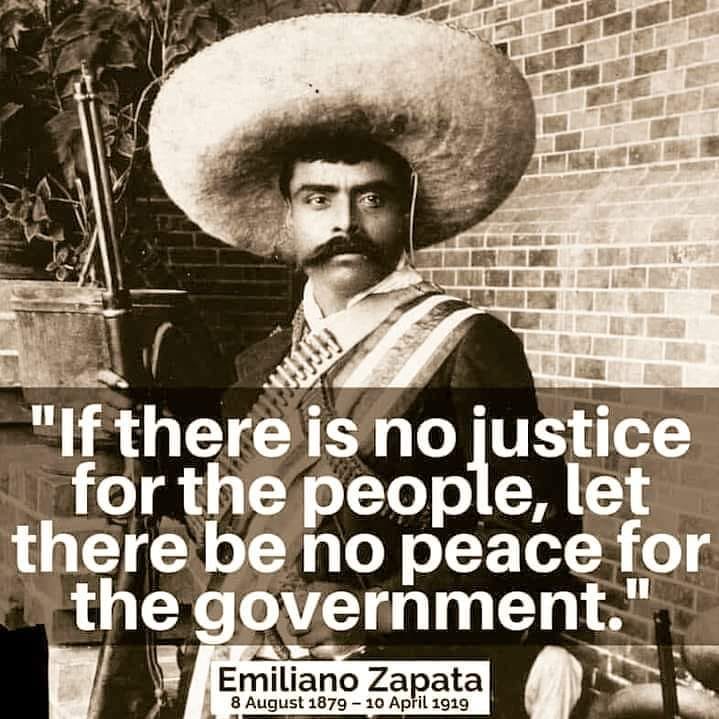
The meme is a quote from Mexican revolutionary leader Emiliano Zapata, known for his left-wing politics and advocacy for social justice. The image likely features a photo of Zapata, and the quote "If there is no justice for the people, let there be no peace for the government" emphasizes the importance of addressing social and economic inequalities.
detailed-analysis (gemma3-27b-vision)
Okay, here's an analysis of the image as requested, divided into relevant sections. Given the nature of the image and quote, some sections are more strongly applicable than others.
Visual Description
The image is a sepia-toned photograph of Emiliano Zapata, a leading figure in the Mexican Revolution. He is depicted from the chest up, wearing a formal military-style uniform, including epaulettes and a high collar. A large, wide-brimmed sombrero dominates the composition, drawing the eye upwards. His expression is serious, appearing resolute and perhaps somewhat stern. The background appears to be a wall of bricks. The image is overlaid with bold white text featuring a direct quote attributed to Zapata, "If there is no justice for the people, let there be no peace for the government." The bottom of the image includes his dates of birth and death (August 8, 1879 – April 10, 1919). The overall aesthetic is historical, aiming to evoke the era and the figure’s importance.
Foucauldian Genealogical Discourse Analysis
This image and quote can be approached through a Foucauldian lens by examining the discourse surrounding Zapata and the construction of his legacy. Foucault would not be interested in whether the quote is historically accurate in a direct sense, but rather in how the quote functions to construct a certain understanding of power, resistance, and justice.
- Power/Knowledge: The image positions Zapata as an authority figure capable of defining justice and challenging the legitimacy of the government. The quote is a statement of power, framing justice as a prerequisite for peace. This statement is presented as knowledge – as a self-evident truth.
- Genealogy of ‘Justice’ and ‘Government’: We can trace how the concepts of ‘justice’ and ‘government’ were understood in early 20th-century Mexico and how Zapata’s statement actively challenges those dominant definitions. For Zapata (and the agrarian movement he represented), justice likely meant land redistribution, economic equality, and local autonomy, which fundamentally challenged the existing system of haciendas and centralized political power.
- Disciplinary Power: The quote functions as a subtle threat; it implies that if the government fails to uphold its responsibilities, it will face consequences. This is a form of "counter-power", challenging the government’s monopoly on legitimate force.
- Archival Silencing/Emergence: The image as circulated online represents an “emergence” from the archives – a selection from the historical record that highlights a particular interpretation of Zapata’s thought and actions. How the image is circulated (on social media, in historical texts, etc.) influences the "genealogy" of its meaning.
Critical Theory
This image aligns with key tenets of Critical Theory, especially those related to ideology and hegemony.
- Ideology: The image presents a clear ideological position: that the welfare of the people must be prioritized over the stability of the state. It implicitly critiques ideologies that prioritize the interests of the ruling class or uphold existing power structures.
- Hegemony: The quote challenges the hegemonic legitimacy of the government. Hegemony refers to the ways in which dominant groups maintain power not just through force, but through shaping the beliefs, values, and perceptions of the broader population. Zapata's statement rejects the idea that the government has an automatic right to peace or obedience.
- Emancipatory Potential: The image carries a sense of emancipatory potential. It suggests that resistance to unjust power structures is not only justifiable but necessary. This is a common theme in Critical Theory.
- False Consciousness: The quote implicitly suggests that the population should be aware of the injustices perpetrated by the government and resist them, challenging any form of “false consciousness” (the acceptance of ideology that serves the interests of the oppressor).
Marxist Conflict Theory
The image is deeply rooted in Marxist Conflict Theory, as it clearly reflects a class-based struggle for power and resources.
- Class Struggle: Zapata was a champion of the peasantry and Indigenous communities, representing a clear opposition to the landowning elite (hacendados) and the political establishment. The quote embodies the conflict between the exploited and the exploiters.
- Material Conditions: Zapata’s struggle was fundamentally about access to land, resources, and economic justice. The quote highlights the material basis of conflict – that peace is contingent upon meeting the basic needs of the people.
- Revolutionary Praxis: The image and quote can be seen as a call to revolutionary praxis – action taken to transform the existing social order. Zapata's legacy is one of armed resistance against an unjust system.
- Base & Superstructure: The quote connects to the concept of the base and superstructure. The "injustice" suffered by the people is rooted in the material conditions of their lives (the "base"). The government (part of the "superstructure") must address these material conditions to maintain legitimacy.
Postmodernism
A postmodern reading is a bit more complex, but possible.
- Deconstruction of Power: Postmodern thought questions the monolithic nature of "power." This image subtly deconstructs the traditional understanding of governmental authority, suggesting that it is not inherently legitimate.
- Rejection of Grand Narratives: While Zapata’s revolution was a "grand narrative," the image circulated today doesn’t necessarily adhere to a singular, cohesive interpretation of the past. The image can be re-appropriated and used to support diverse political agendas.
- Emphasis on Local Knowledge: Zapata’s struggle was rooted in the specific material conditions and cultural contexts of Morelos and other regions of Mexico. The image acknowledges the importance of local knowledge and resistance.
- Simulacra and Simulation: In a modern context, the image itself is a simulation of Zapata – a representation divorced from the original historical figure. It’s a “simulacrum” that circulates in the digital realm, carrying its own set of meanings and associations.
Queer Feminist Intersectional Analysis
This section is the least directly applicable, but still relevant.
- Intersectional Oppression: While the image focuses on class and land rights, it’s crucial to remember that the oppression faced by the peasantry and Indigenous communities was often compounded by gender and sexual identity. Indigenous women faced specific forms of exploitation and discrimination. Queer and gender non-conforming individuals likely faced additional marginalization within both revolutionary movements and traditional social structures.
- Challenging Hierarchies: Zapata’s movement, while patriarchal in some respects, challenged traditional hierarchies and power structures. A queer feminist analysis would focus on the ways in which the movement could have or did create spaces for marginalized voices.
- Critique of State Violence: The quote implicitly critiques state violence and oppression, which disproportionately affects marginalized communities.
- Reclaiming Narratives: By re-circulating the image today, we can reclaim Zapata’s legacy and use it to support contemporary struggles for social justice, including those led by queer and feminist activists.
I hope this detailed analysis is helpful! Let me know if you’d like me to elaborate on any of these sections.
simple-description (llama3.2-vision)
The meme features a sepia-toned photograph of Emiliano Zapata, a Mexican revolutionary leader, wearing a sombrero and holding a rifle. The image is overlaid with a quote in white text, which reads: "If there is no justice for the people, let there be no peace for the government." The quote is attributed to Emiliano Zapata, and the image also includes his name and dates of birth and death. The overall tone of the meme is one of social commentary, suggesting that without justice for all, there can be no peace for those in power.
tesseract-ocr
es fy ; io steal Sar an 79 ees rie \ c ONT? ie eo | al . ) "Ifthereisno eee for the people, let there be no peace for the government,” | MY Emiliano Zapata” ee