First Seen
2023-05-10T21:03:35+00:00
simple-description (llama3.2-vision_11b)
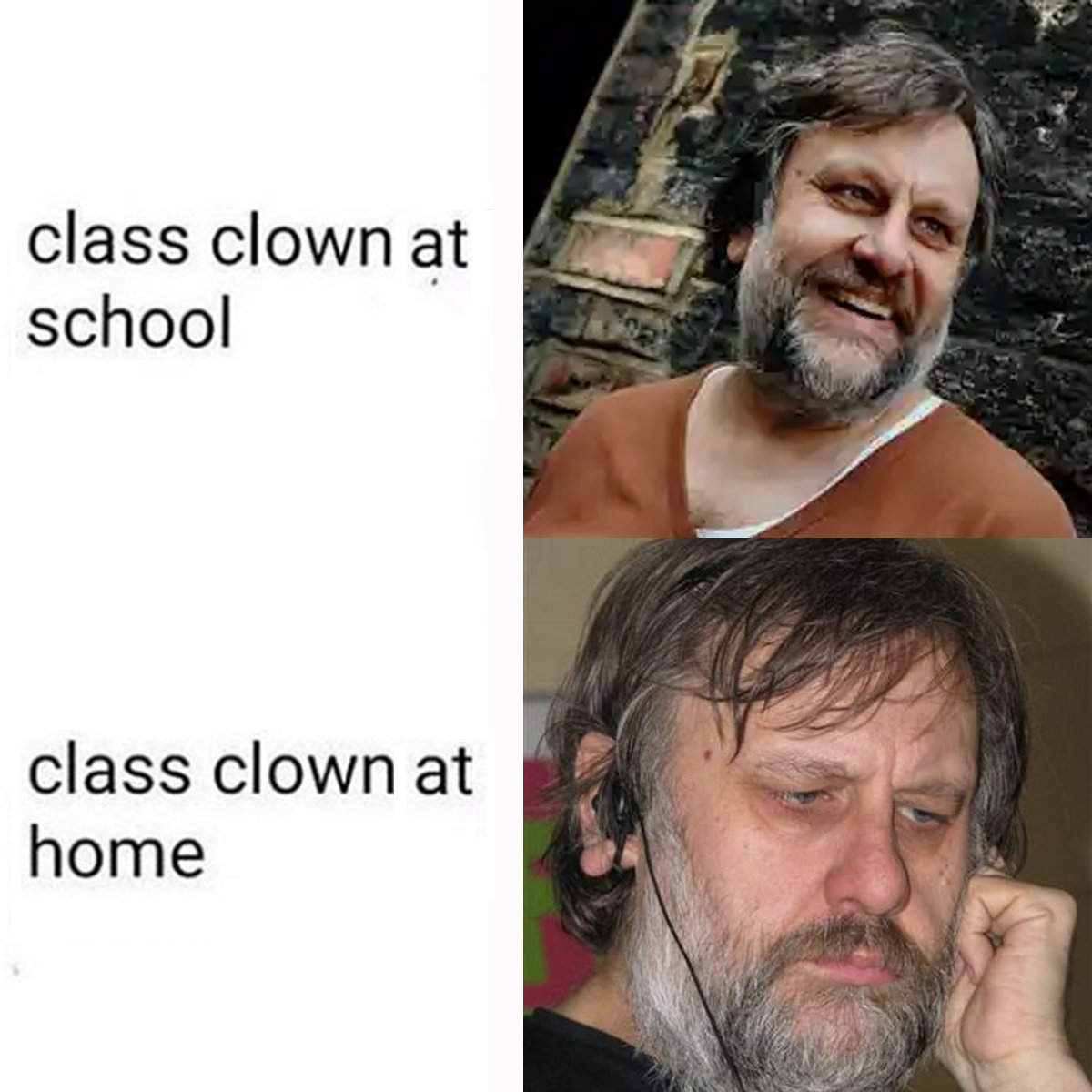
The meme is a split image, with the top left showing a picture of a disheveled, unshaven man with a scowling expression, and the bottom right showing the same man, but with a more relaxed and smiling face. The text "class clown at school" is above the top image, and "class clown at home" is below the bottom image. The meme is a humorous commentary on the idea that a person who is a class clown at school (i.e. someone who is often the center of attention and has a good sense of humor) can be a different person when they are at home, where they are more relaxed and can be themselves.
detailed-analysis (gemma3-27b-vision)
Okay, let's analyze this meme using the requested theoretical frameworks. This is a fascinating image that opens up to various readings.
Visual Description
The meme utilizes the "Drakeposting" or "Two Buttons" format. It presents two contrasting images of the same person (actor/director, Xavier Samuel) labeled "Class Clown at School" and "Class Clown at Home."
- Image 1 ("School"): Samuel is smiling, leaning back in a chair, looking somewhat smug and confident. He has good posture, and his expression suggests outward performance. The lighting is warmer, and the background seems more public/institutional.
- Image 2 ("Home"): Samuel looks distressed, eyes red and watery, posture slumped, with a generally defeated and melancholic expression. The lighting is cooler, and the background is dark, suggesting a private, interior space. The contrast between the two images is stark, emphasizing a shift in mood and presentation.
Foucauldian Genealogical Discourse Analysis
This meme can be examined through Foucault’s lens by focusing on the discourse of "the class clown." Foucault argued that knowledge and power are intertwined, shaping how we understand concepts.
- The “Class Clown” Discourse: The meme reveals how the role of "class clown" is constructed. At school, this role is potentially a performative response to power structures (teachers, the classroom environment). It’s a way of negotiating, challenging, or seeking recognition within a highly regulated space. The performance (smiling image) is a strategic adaptation.
- Discipline & Normalization: The school environment is a disciplinary space, attempting to normalize behaviors. The "class clown" might disrupt this normalization, but also potentially accept its terms by performing for an audience within that system.
- The Private Self: The "at home" image reveals the cost of this performance. The exhaustion, sadness, and defeat suggest that the outward performance requires a significant expenditure of energy and might mask underlying anxieties or vulnerabilities. The meme highlights the difference between the curated self presented publicly and the authentic self experienced privately. Foucault would be interested in how this difference is constructed and maintained through disciplinary practices.
Critical Theory
From a Critical Theory perspective (especially drawing on the Frankfurt School), this meme exposes a key element of modern alienation:
- The Authentic vs. Inauthentic Self: The meme illustrates a divide between the “authentic” self (the distressed figure at home) and the “inauthentic” self demanded by social roles (the smiling clown at school). This split is characteristic of modern life, where individuals are forced to adopt roles to conform to societal expectations.
- Repressive Conformity: The “class clown” persona, while appearing liberating, can be seen as a form of repressive conformity. The individual adapts to the demands of the school environment by playing a role, potentially sacrificing genuine emotional expression.
- Commodification of Personality: The meme touches on the idea that personality itself can be commodified. The "class clown" learns to perform for attention, validation, or social currency.
Marxist Conflict Theory
While not the most obvious application, Marxist theory can be applied by framing the "class clown" as a response to social stratification and power imbalances.
- The Classroom as a Microcosm of Society: The classroom reflects broader social hierarchies. The "class clown" might use humor to challenge or subvert these hierarchies, providing a momentary equalization of power. The performance can be a form of resistance, albeit a limited one.
- Alienation from Labor: The "at home" image suggests the emotional "labor" involved in maintaining the "class clown" persona. The exhaustion and sadness can be seen as a form of alienation – the individual is disconnected from their authentic self, having to expend energy on maintaining a performance for the benefit of others.
- False Consciousness: The performance might be a manifestation of "false consciousness," where the individual is unaware of the underlying social forces shaping their behavior. They believe they are simply being funny, but their actions are actually a response to systemic power dynamics.
Postmodernism
Postmodern thought emphasizes the instability of meaning and the constructed nature of identity. This meme embodies those principles:
- The Death of the Authentic Self: The meme suggests there is no singular, authentic self. Identity is fluid and constructed through performance. The "class clown" is not simply revealing a hidden self but creating a self through their actions.
- Simulacra and Simulation: The meme highlights the idea of simulacra—copies without originals. The "class clown" persona is a simulation of a "fun" or "outgoing" individual. It has no underlying essence, existing only as a performance.
- Deconstruction of Roles: The meme deconstructs the traditional notion of identity by showing how we inhabit multiple roles and how these roles can be contradictory and exhausting.
Queer Feminist Intersectional Analysis
This framework, while requiring more nuanced application, can explore how performativity intersects with gender and power.
- Performativity: Drawing on Judith Butler's concept of performativity, we can see the "class clown" as doing gender and social roles through their actions. The performance is not simply expressing an inner identity but creating that identity through repeated acts. This is particularly relevant if we consider the societal expectations surrounding masculinity and humor.
- Emotional Labor & Gender: The "at home" image suggests the emotional labor required to maintain the "class clown" persona. This labor is often disproportionately placed on marginalized groups, and particularly on women and gender non-conforming individuals.
- Masking & Vulnerability: The meme can be read as an exploration of the ways in which individuals are forced to "mask" their true selves to conform to societal expectations. This masking can be particularly damaging to those who are already marginalized.
I hope this thorough breakdown helps! Let me know if you’d like me to focus on a specific theoretical framework in more detail.
simple-description (llama3.2-vision)
This meme features two images side-by-side, each with a bearded man in a different setting. The top image shows him in a school setting, with a slightly more youthful appearance and a smile. The bottom image shows him at home, with a more worn and tired appearance. The text accompanying these images reads "class clown at school" and "class clown at home," respectively, suggesting that the same person can appear differently depending on their environment. The meme humorously highlights the idea that someone who is known as a class clown in a school setting may not be as well-liked or accepted in a home setting.
tesseract-ocr
class clown at Bay Ps } school Be FY. ey: ay ee he class clown at ( ae home eg SP pt eh a f