First Seen
2023-06-06T01:31:22+00:00
simple-description (qwen3.5_2b-q8_0)
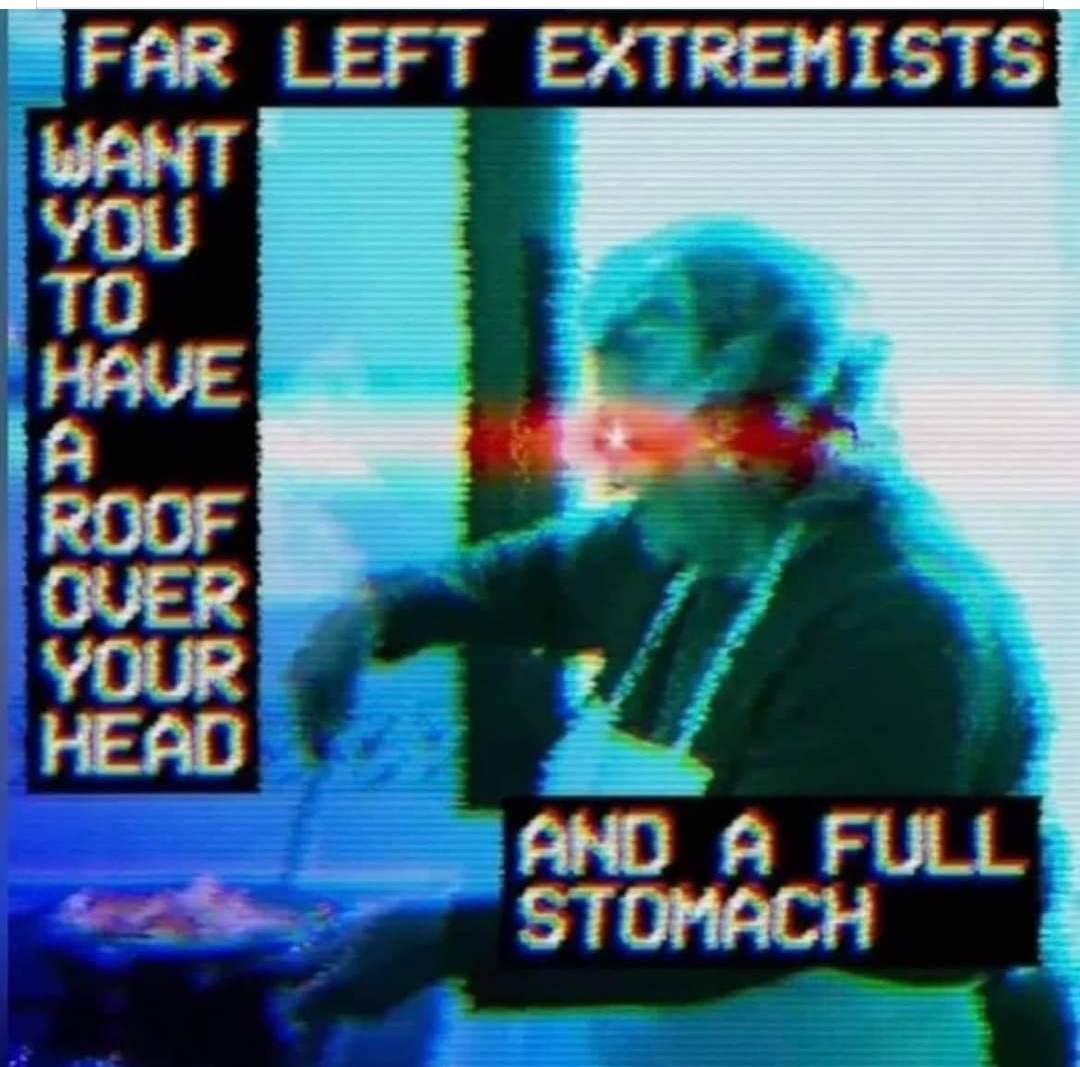
This meme is a political joke that ironically uses the 1970s folk song "Have You Met Your People?" by Joan Baez as an anthem for the New Left. The text sarcastically mocks the rhetoric of radical political opponents, claiming they demand that people "have a roof over your head and a full stomach"—describing the demand for basic shelter and sustenance as an absurd political extreme.
simple-description (llama3.2-vision_11b)
The meme features a screenshot of a character from the TV show "Rick and Morty" with a caption that reads: "When you're a left-wing extremist and you can't even get a decent meal." The image is a play on the character's absurd and chaotic personality, exaggerating the stereotype that left-wing extremists are always hungry and can't even get a decent meal.
detailed-analysis (gemma3-27b-vision)
Okay, let's break down this image through several theoretical lenses. It's a politically charged meme/image, so there's a lot to unpack.
Visual Description
The image is a digitally manipulated photograph of a person, likely a protestor, wearing a balaclava (mask) and a bandana, with a hand visible holding what appears to be a black flag. The image is heavily distorted with a glitch effect, characterized by static-like vertical lines and color displacement, evoking the aesthetic of internet "error" or digital corruption.
Text overlays the image: "FAR LEFT EXTREMISTS WANT YOU TO HAVE A ROOF OVER YOUR HEAD AND A FULL STOMACH". The text is in a white, bold, and slightly pixelated font. The overall effect is deliberately sensationalist and arguably propagandistic. The use of glitch aesthetic, in particular, feels very online, as if it's meant to be shared and distributed quickly on social media.
Foucauldian Genealogical Discourse Analysis
This image operates as a specific discourse that constructs and reinforces a particular understanding of "far-left extremists."
- Power/Knowledge: The image attempts to create a relationship between the "far-left extremist" figure and basic human needs (housing and food). The implication is that providing these needs is somehow radical or dangerous. This demonstrates how power operates through discourse – by defining what is "normal" or "acceptable" and framing anything outside that as threatening. The image presents a narrative where providing for basic needs is positioned as a radical act, subtly linking it to danger and extremism.
- Genealogy: A genealogical analysis would examine the historical roots of this framing. The term "extremist" itself has a specific history, evolving as a tool to delegitimize political opposition. The association of leftist ideas with chaos or danger is a long-standing rhetorical strategy. This meme taps into those existing narratives.
- Disciplinary Power: The image implicitly seeks to discipline viewers by fostering fear and suspicion toward the "far left." The mask and flag, paired with the "extremist" label, contribute to the construction of an "othered" group, justifying social control and potentially repression.
Critical Theory
From a Critical Theory perspective, this image functions as a form of ideological critique… but in a counter-critical way.
- Hegemony: The image attempts to disrupt the perceived hegemony (dominance) of left-wing thought. By labeling those advocating for basic needs as “extremists,” it tries to discredit their arguments and maintain the status quo.
- False Consciousness: The image can be seen as an attempt to create false consciousness – a situation where people are unaware of their true interests and are manipulated into supporting systems that harm them. The implication is that anyone advocating for basic needs for all is somehow a dangerous radical, diverting attention from the systemic inequalities that cause poverty and homelessness.
- Culture Industry: The image resembles a product of the “culture industry” (as described by Adorno and Horkheimer). It’s a quickly consumable piece of media designed to shape public opinion, albeit in a potentially manipulative way.
Marxist Conflict Theory
Applying a Marxist Conflict Theory lens:
- Class Struggle: The image subtly speaks to the underlying tensions of class struggle. It implies that advocating for basic necessities like housing and food is a threat to the existing power structure, which benefits from exploitation and inequality.
- Ideology & False Consciousness: As mentioned earlier, the image can be seen as a tool for maintaining ideological dominance. It reinforces the idea that those seeking to address material inequality are radicals, obscuring the true source of exploitation (the capitalist system) and maintaining the power of the ruling class.
- Means of Production: There’s an implicit argument that the means of production (housing, food, etc.) are distributed appropriately, and that demanding access to them for all is an unreasonable, “extremist” demand.
Postmodernism
From a Postmodern perspective:
- Deconstruction: This image invites deconstruction. The label "extremist" is itself a socially constructed category, its meaning fluid and context-dependent. The meme aims to delegitimize the ideas and arguments of the "far left" by framing them as fundamentally beyond the pale of legitimate political discourse.
- Simulacra and Simulation: The image operates as a simulacra – a copy without an original. It's a digital representation of a potential protestor, stripped of nuance and flattened into a symbol of threat. The message isn’t about actual policies or ideas but about a fear-mongering representation.
- Meta-Narratives: The image challenges, or at least attempts to undermine, the meta-narrative that everyone deserves basic necessities. It positions providing for these needs as a radical departure from the norm.
Queer Feminist Intersectional Analysis
While the image does not explicitly address issues of gender or sexuality, an intersectional analysis can still be applied:
- Marginalization and Control: The image represents a broader pattern of attempting to control and marginalize groups perceived as challenging the existing power structure. This pattern often overlaps with the oppression of marginalized gender and sexual identities. The "extremist" label acts as a means to silence voices advocating for social justice.
- Basic Needs as Radical: The insistence that providing basic needs is “extreme” can be linked to systems of oppression that deny access to resources based on gender, race, sexuality, and class. Denying access to housing, food, and healthcare are tools of control historically used against marginalized communities.
- Visibility & Threat: The masked figure can be seen as symbolic of the vulnerability of those who challenge the status quo. The image attempts to disempower and silence by demonizing those who advocate for change.
Important Note: It's important to remember that these are interpretations based on theoretical frameworks. The image itself is complex and open to multiple readings. The purpose of this analysis is to demonstrate how different theoretical lenses can illuminate the underlying power dynamics and ideological assumptions embedded within it.
simple-description (llama3.2-vision)
The meme features a character from the popular show "The Office" called Dwight Schrute, who is known for his eccentric and often disturbing personality. The text in the image reads, "Far left extremists want you to have a roof over your head and a full stomach." This is a satirical statement, as it is unlikely that far left extremists would want to provide these basic needs for people. The image is likely meant to be humorous and satirize the idea that far left extremists are not only interested in helping others, but also to have them as followers.
tesseract-ocr
FAR LEFT EXTREMISTS 1 — = ae = ts ef: ROOF 65 34 p48 8 4 2 i at8 e -. ee ee i STOMACH |