First Seen
2023-11-17T02:51:01+00:00
simple-description (qwen3.5_2b-q8_0)
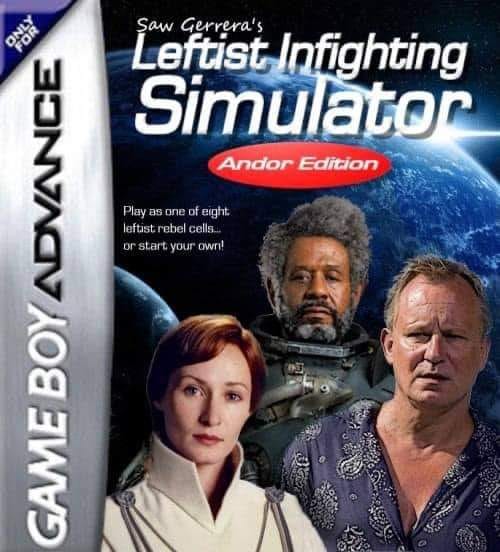
The meme likely plays on the irony of Enoch Powell, a prominent far-right figure, appearing as a pacifist in a game titled "Leftist Infighting Simulator." It also references the character Saw Gerrera, a leader known for being racist and referring to political opponents as "Leftists," by placing him in a game focused on political infighting. The text "Play as one of eight leftist rebel cells..." frames the game as a satirical parody of left-wing political squabbles, specifically referencing the controversial "Leftist" subgenre of the Andor series.
simple-description (llama3.2-vision_11b)
The meme is a screenshot from the video game "Left 4 Dead 2" featuring a character named Bill, who is a conservative, and another character named Rochelle, who is a liberal. The image is captioned "Left 4 Dead 2: Where the Leftist is the one who's always getting killed". The meme is a play on the idea that in the game, the "leftist" (Rochelle) is often the first to die, and the caption is a humorous commentary on this stereotype.
detailed-analysis (gemma3-27b-vision)
Okay, here’s a breakdown of the image, analyzed through the requested theoretical frameworks. It’s important to remember this is a deliberately ironic image playing on internet culture and political commentary.
Image Description
The image is a parody of a Game Boy Advance game cover. The title reads “Saw Gerrera’s Leftist Infighting Simulator – Andor Edition”. The cover features three characters from the Star Wars series: Mon Mothma, Saw Gerrera, and Cassian Andor, all in serious poses. The Game Boy Advance logo and "Only for Advance" are visible. Below the title is text that reads "Play as one of eight leftist rebel cells...or start your own!". The background is a nebula/space scene. The overall aesthetic is designed to evoke nostalgia for early 2000s handheld gaming.
Foucauldian Genealogical Discourse Analysis
This image is rich in material for a Foucauldian analysis. The “Simulator” framing immediately suggests a system of categorization and control. Foucault would be interested in how "leftism" itself is constructed as a discourse. The cover does not present a unified "left" but rather emphasizes "infighting."
- Power/Knowledge: The very idea of a "simulator" implies the ability to model, and therefore, to understand and potentially control a complex social phenomenon. The image highlights how categorizing political ideologies as fixed entities like “leftist rebel cells” is a simplification serving power dynamics. The simulated nature reinforces this – it's a representation of conflict, not the conflict itself.
- Genealogy of “Leftism”: A genealogical approach would ask how the concept of "leftism" emerged, tracing its historical transformations and the power relations embedded within those transformations. The depiction of characters from a sci-fi franchise suggests that contemporary political categories are often constructed through cultural narratives and symbolic representation.
- Disciplinary Power: The “simulator” aspect can be seen as a form of disciplinary power. It implies a system of classification and assessment – players are implicitly judged based on how they play their "rebel cell," reinforcing normative expectations within the simulated political landscape.
Critical Theory
Drawing on the Frankfurt School, a critical theoretical perspective would focus on the ideological function of the image and its relation to broader societal power structures.
- Culture Industry: The parody of a game cover can be seen as a commentary on the commodification of political debate. The simulation aspect reduces complex political struggles to a form of entertainment, reinforcing a passive, consumerist approach to political engagement. It mirrors how the "culture industry" (Adorno and Horkheimer) produces standardized forms of cultural product, inhibiting critical thought.
- Ideology Critique: The image’s emphasis on “infighting” can be interpreted as a cynical commentary on the self-destructive tendencies within leftist movements. It suggests that internal divisions are inherent to these movements, masking the underlying structural inequalities that contribute to those divisions.
- The Authoritarian Personality: A focus on the characters themselves (Saw Gerrera specifically) could tie into concerns about extremism and authoritarian tendencies within political groups. Saw Gerrera is a radical and ruthless character, and framing a “simulator” around him could be interpreted as a critique of those who prioritize action over ethical considerations.
Marxist Conflict Theory
From a Marxist perspective, the image is inherently focused on conflict and power relations.
- Class Struggle: While not explicitly stated, the “rebel cells” can be interpreted as representing different factions within a struggle against a dominant power structure (the Empire, in the Star Wars context, but potentially reflecting contemporary power dynamics).
- False Consciousness: The “simulator” aspect could be seen as contributing to false consciousness. By reducing complex political struggles to a simplified game, it obscures the underlying material conditions that drive conflict.
- Ideological Struggle: The “infighting” between the rebel cells represents an ideological struggle within the broader movement. Different factions prioritize different strategies and ideologies, hindering their collective ability to challenge the dominant power structure.
Postmodernism
A postmodern reading would emphasize the image's self-reflexivity and deconstruction of meaning.
- Simulacra and Simulation: The image is a perfect example of Baudrillard's concept of simulacra. The "simulator" is a representation of a representation – a simulated political conflict that has no direct connection to reality. The distinction between the "real" political struggle and the simulated version becomes blurred.
- Deconstruction of Grand Narratives: The image challenges the idea of a unified "leftist" ideology. It highlights the fragmentation and internal contradictions within the movement, dismantling the grand narrative of a cohesive political force.
- Pastiche and Intertextuality: The parody of the Game Boy Advance game cover is an example of pastiche and intertextuality. It draws on familiar cultural references to create a new meaning, disrupting the original context and creating a layer of irony.
Queer Feminist Intersectional Analysis
While not immediately obvious, an intersectional lens can be applied by considering the systemic exclusion often present in political movements (even simulated ones).
- Marginalization and Inclusion: The image implicitly asks whose voices are included and excluded in the "rebel cells." The characters presented are all male or conventionally presented (Mon Mothma being an exception), raising questions about the representation of gender, sexuality, and other marginalized identities. The fact it is a simulator also asks who gets to play these roles, and therefore whose perspectives are centered.
- Power Dynamics within Movements: An intersectional analysis would examine how power operates within the simulated rebel cells. How do different factions prioritize certain forms of oppression over others? How do they address issues of privilege and inequality within their own ranks?
- Challenging Hegemonic Narratives: By portraying a fragmented and infighting leftist movement, the image challenges the hegemonic narrative of a unified and effective political force. This can be interpreted as a critique of dominant political ideologies that often ignore or marginalize the experiences of marginalized communities.
Disclaimer: This analysis is based on interpretation and is open to debate. The image itself is designed to be provocative and encourage critical thinking.
simple-description (llama3.2-vision)
The meme is an image of a Game Boy Advance game cover with a woman and a man in a science fiction setting. The title "Saw Gerrera's Leftist Infighting Simulator" is written in bold, white letters, and below it, in smaller text, is the phrase "Andor Edition" in a red oval. The image is meant to be humorous, suggesting that the game is about infighting among leftists, which is a topic of interest in the TV show Andor.
tesseract-ocr
= _ a eS SR asad oe aa i » oe —_ ‘ x F \ ee ig | eed ye rie -