First Seen
2024-05-06T18:27:50.592467+00:00
simple-description (qwen3.5_2b-q8_0)
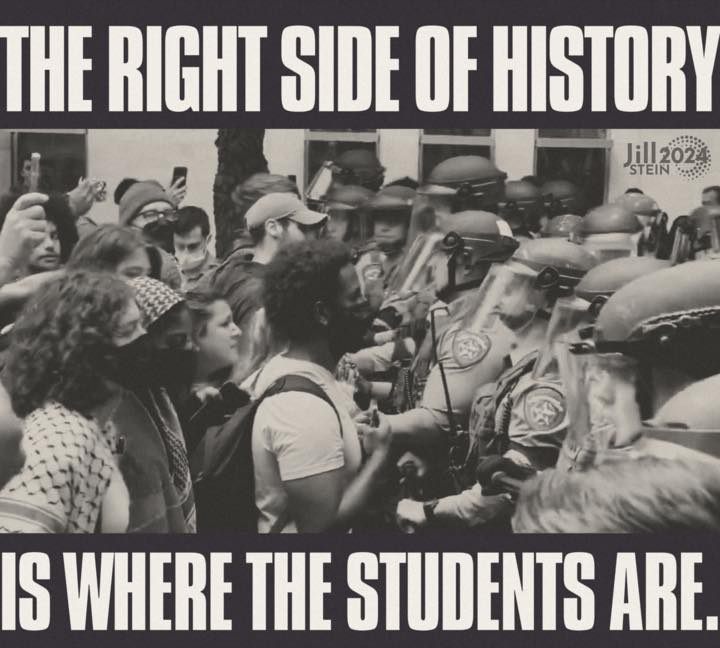
This meme uses a violent confrontation image to ironically subvert the slogan "The Left is here to stay." From a leftist perspective, it frames the 2024 election as a hostile clash between marginalized communities (represented by the students) and the law-and-order faction (the rioters and police). The image suggests that the political establishment is too rigid and exclusionary to welcome the students, treating them as violent agitators instead of partners in justice. The text "Jill Stein 2024 STEIN" is used to mock the political correctness of the phrase, implying that the right-wing candidate is being labeled an "enemy" by the very slogan the meme is repurposing.
simple-description (llama3.2-vision_11b)
The meme is a humorous take on the idea that students are often more radical and progressive than their professors, implying that the right-wing views of professors are not as prevalent among students. The image is likely a photo of a protest or demonstration with a caption that reads "The right side of history is where the students are."
detailed-analysis (gemma3-27b-vision)
Okay, here's an analysis of the image, broken down into sections as you requested, focusing on applicable theoretical frameworks. I'll note if a section isn't fully relevant.
Image Description
The image is a black-and-white photograph depicting a dense crowd of people, likely at a protest or demonstration. Individuals of varying ages, genders, and ethnicities are visible, though the sheer density makes specific details difficult to discern. Many are wearing hats, and the scene suggests a close, tightly packed gathering. The composition emphasizes the mass of people, creating a sense of collective energy and participation. A small sign for "Jill Stein 2024" is visible in the background on the upper right. Superimposed over the image, in bold white capital letters, are the phrases "THE RIGHT SIDE OF HISTORY" above the crowd and "IS WHERE THE STUDENTS ARE" below. The phrasing suggests a claim of moral or historical correctness for the cause represented by the protesters.
Foucauldian Genealogical Discourse Analysis
This image offers a rich area for Foucauldian analysis. The phrase "The Right Side of History" is itself a discourse – a system of thought, ideas, and practices that constructs a particular understanding of the world. The image and accompanying text produce and circulate a specific version of historical "truth."
- Power/Knowledge: The claim to be on the "right side of history" isn't about objective truth but a claim to power through the creation of knowledge. It suggests those participating in this protest possess the correct understanding of current events, and that understanding justifies their actions. The act of labeling participants as being on the “right side of history” is a means of control and legitimization.
- Genealogy: Examining the history of the phrase "right side of history" would reveal its origins and how it’s been used historically. The genealogy of this phrase as a rhetorical tool could reveal it has been used for a variety of different causes - or as a justification for atrocities.
- Discipline & Normalization: The image and text normalize a particular form of political participation (protest) as the correct and legitimate way to enact change. It implicitly positions those not participating as being on the "wrong side," therefore outside the norm.
- Subjectivation: The act of participating in the protest (and potentially identifying with the phrase) contributes to the subjectivation of individuals – their construction as particular kinds of political subjects. They are positioning themselves as progressive, concerned citizens.
Critical Theory
Critical Theory, stemming from the Frankfurt School, is highly relevant here. The image and slogan aim to expose, and ultimately challenge, existing power structures.
- Ideology: "The Right Side of History" functions as an ideological claim. It presents a specific worldview (likely progressive or left-leaning) as universally correct and natural. This masks the inherent partiality of the viewpoint.
- Domination & Emancipation: The image suggests the protestors are fighting against systems of domination (e.g., economic inequality, social injustice). The claim to be on the "right side" implies an effort to liberate others from these oppressive structures.
- Culture Industry: One could interpret the image as part of the "culture industry" – the mass production of ideas and symbols designed to manipulate and control public opinion. The slogan seeks to create a narrative that gains support from a wide variety of people.
- Reason and Enlightenment: The phrase hints at the Enlightenment idea of progress and the possibility of achieving a more just society. But Critical Theory would challenge this assumption, suggesting that the notion of progress can itself be used to justify domination.
Marxist Conflict Theory
Marxist Conflict Theory sees society as characterized by class struggle and conflict over resources.
- Class Consciousness: The image implies a developing "class consciousness" among the protesters – an awareness of their shared interests and a willingness to collectively challenge the existing order.
- Base and Superstructure: The protest might be seen as part of the "superstructure" – the social and political institutions that reflect and reinforce the "base" – the economic system. The specific issues being protested likely relate to conflicts within the base (e.g., labor rights, wealth distribution).
- False Consciousness: It’s possible that the image and slogan are being used to obscure underlying power dynamics. Those in positions of power may manipulate the narrative to maintain their control.
- Revolution: The image hints at the possibility of social change, potentially even revolution. The claim to be on the "right side of history" implies a belief in the inevitability of this change.
Postmodernism
While the image seems to make a grand claim to objective truth ("The Right Side of History"), a postmodern lens can deconstruct this claim.
- Meta-Narratives: The phrase "The Right Side of History" functions as a meta-narrative – a universal story that claims to explain everything. Postmodernism rejects these meta-narratives, arguing that there is no single, overarching truth.
- Deconstruction: Deconstruction would examine the internal contradictions within the image and slogan. What exactly constitutes the "right side of history?" Who defines it? Is this a self-serving narrative?
- Relativism: A postmodern perspective emphasizes the relativity of truth. What is considered "right" or "wrong" depends on one's perspective and cultural context.
- Simulacra & Simulation: The image could be interpreted as a simulacrum – a copy without an original. The "right side of history" may be a constructed idea that bears little resemblance to actual historical events.
Queer Feminist Intersectional Analysis
This is likely less directly applicable, but still offers insight.
- Intersectionality: The image potentially represents a coalition of individuals from diverse backgrounds. An intersectional analysis would examine how different forms of oppression (e.g., racism, sexism, classism, homophobia) intersect to shape the experiences of those involved. The individuals shown likely carry multiple layers of identity.
- Power Dynamics: A queer-feminist lens would examine the power dynamics within the protest movement itself. Are certain voices marginalized or excluded? Is there a hierarchy of concerns?
- Challenging Norms: The act of protesting itself can be seen as a challenge to dominant social norms.
- Counter-Hegemony: The image might be interpreted as an attempt to create a counter-hegemonic force – a challenge to the dominant ideology and power structures.
I hope this detailed analysis provides a comprehensive understanding of the image through various theoretical frameworks! Let me know if you'd like me to elaborate on any particular point.
tesseract-ocr
TR TI : : = mal Jill 202% ee as
simple-description (llama3.2-vision)
This meme features a black-and-white photo of a crowd of people facing off against a line of police officers in riot gear. The image is overlaid with the text: "The right side of history is where the students are." The text is meant to be ironic, implying that the students are on the right side of history, but the image suggests otherwise, as the students are facing off against police. The image is likely meant to be satirical, suggesting that the students are not actually on the right side of history.