First Seen
2024-05-24T19:54:34.762031+00:00
simple-description (qwen3.5_2b-q8_0)
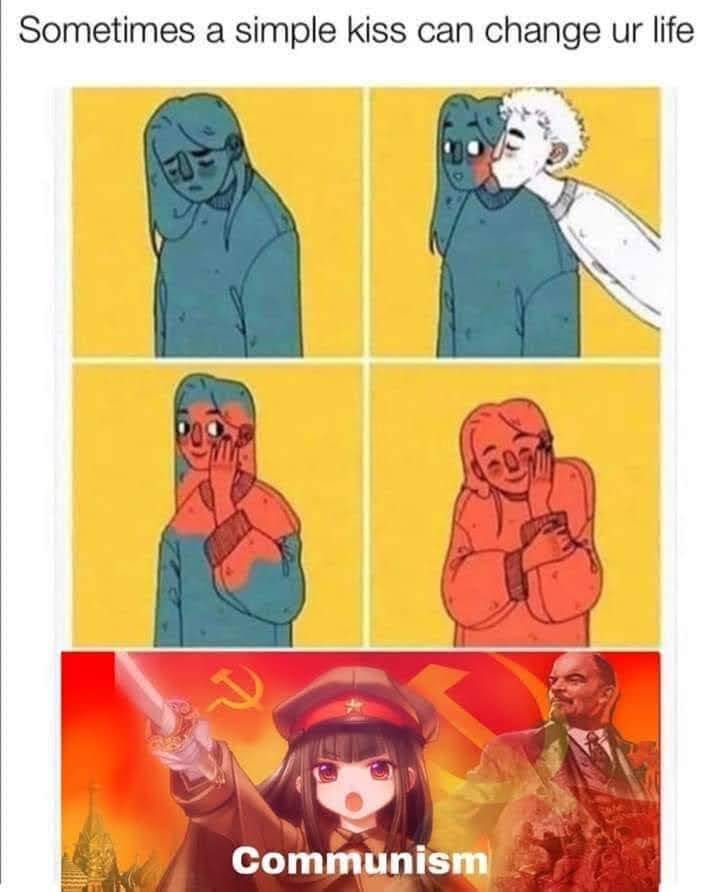
This meme begins with a classic romantic setup about how a single kiss can heal deep sadness, but it subverts this expectation at the bottom. The punchline reveals that the character was not just kissed for affection, but was instead "transformed" or "accepted" into the Soviet Union, identified by the Union Jack flag and Lenin, and explicitly labeled with the word "Communism." It is a visual metaphor for a sudden, forceful shift in political ideology rather than just a romantic relationship.
simple-description (llama3.2-vision_11b)
The meme is a humorous take on the classic "leftist" phrase "I'd rather die than be a capitalist" with a twist, replacing "die" with "kiss". The image shows a person who is about to kiss someone, but their face contorts in a comically exaggerated expression of disgust, implying that even a simple kiss is a betrayal of leftist values.
detailed-analysis (gemma3-27b-vision)
Okay, let's break down this meme through the lenses you've provided. It's… a lot. It's a deliberately absurd juxtaposition that relies heavily on internet meme culture and a specific understanding of the tropes it utilizes.
Visual Description
The meme is a four-panel image with a contrasting bottom panel.
- Top Four Panels: These depict a simple progression of a character’s emotional state. The character is drawn in a minimalist, somewhat crude style, with a teal/cyan color. The panels show the character slouched over, looking despondent. Then, a second character (with white hair) moves in and appears to kiss the first character on the cheek. The teal character then begins to blush and adopt a happier, more hopeful expression, culminating in a wide smile with closed eyes.
- Bottom Panel: This is where the meme's punchline lies. It’s a digitally-manipulated image of a character from the visual novel Doki Doki Literature Club (specifically, the character Monika) dressed in a Soviet-era military uniform, complete with a red star emblem, standing next to a photorealistic image of Vladimir Lenin. The image includes a backdrop hinting at Moscow's architecture, such as St. Basil’s Cathedral. Overlaid on the image is the word "Communism."
The juxtaposition is deliberately jarring – a cute, emotional narrative (implied in the top panels) suddenly colliding with a depiction of a political ideology.
Foucauldian Genealogical Discourse Analysis
Michel Foucault's genealogical method focuses on tracing the history of concepts and practices to reveal how power operates through them. In this meme, the concept of "romantic love" (or the idea that a simple kiss can change your life) is being linked to "communism."
- Power/Knowledge: The meme suggests that romantic desire and political ideology are not separate but intertwined. The "truth" about what fundamentally changes a person isn't simply individual emotion, but potentially a radical political transformation.
- Discursive Formation: The meme relies on established discourses around love, desire, and political conversion. It's poking fun at the idea that a powerful emotional experience could lead to a complete shift in worldview.
- Genealogical Tracing: One could trace the history of both romantic tropes in popular culture (the "love at first sight" narrative) and the often-emotional rhetoric used to promote political ideologies. The meme suggests they share underlying mechanisms of emotional appeal.
Critical Theory
Critical Theory, particularly in the Frankfurt School tradition, analyzes culture as a reflection of underlying power structures.
- Culture Industry: The meme can be seen as a product of the “culture industry,” appropriating and remixing elements of popular culture (anime, romantic tropes, historical figures) to create a statement. It's meta-commentary on the way ideologies are disseminated through culture.
- Ideology Critique: The meme playfully critiques the ways in which ideologies (like communism) can be presented as emotionally appealing or even transformative. It suggests that ideologies often tap into fundamental human desires for belonging, connection, and meaning.
- False Consciousness: By equating a simple kiss with a wholesale embrace of communism, the meme could be interpreted as satirizing the idea of individuals being easily swayed by ideological rhetoric without critical thought.
Marxist Conflict Theory
While seemingly absurd, the meme can be examined through a Marxist lens focusing on class struggle and ideological control.
- Ideology as a Tool: The image implies that both romance and communism offer narratives of transformation and belonging, essentially providing "false consciousness" to individuals to make them more readily accept their position. The implication isn't that communism is necessarily wrong, but that it, like romance, relies on a persuasive narrative.
- Rejection of Individualism: Communism at its core rejects individualism, emphasizing collective action and social change. The meme suggests that even the intensely personal experience of a kiss can be politicized and linked to a larger collective struggle.
- Critique of Capitalist Romance: One might interpret the meme as a satirical critique of the ways in which capitalist culture commodifies romance, presenting it as an individual pursuit disconnected from broader social issues. The meme subtly suggests that true transformation requires a collective political commitment.
Postmodernism
Postmodern thought emphasizes the deconstruction of grand narratives and the rejection of fixed meanings.
- Pastiche & Intertextuality: The meme is a prime example of pastiche and intertextuality, blending elements from different sources (anime, romantic tropes, political history) in a deliberately disjointed way. It refuses a coherent, singular meaning.
- Simulation & Hyperreality: The meme can be seen as operating within a hyperreal space, where representations (the meme itself) have become more real than the reality they represent. The absurdity is the point.
- Deconstruction of Meaning: The meme actively undermines any straightforward interpretation. It challenges the idea that a kiss necessarily leads to any particular outcome, and it questions the relationship between personal experience and political ideology.
Queer Feminist Intersectional Analysis
While the meme is not explicitly feminist or queer, some interpretations are possible.
- Subversion of Heteronormative Romance: The meme might be subtly subverting the traditional heteronormative narrative of romance. While the kiss appears to be between two individuals of unknown gender, the abrupt transition to communism could be seen as a commentary on the limitations of romantic relationships as a solution to broader social problems.
- Critique of Affective Labor: One could interpret the meme as a commentary on affective labor, where emotional connection is used as a tool to promote a particular ideology. The kiss is presented as a catalyst for political transformation, potentially exploiting the emotional labor of individuals for a political end.
- Intersectionality: The meme could be seen as hinting at the intersection of personal and political identities. The idea that a personal experience (a kiss) could lead to a radical shift in political consciousness highlights the ways in which our individual experiences are shaped by broader social and political forces.
In Conclusion:
This meme is surprisingly complex for its apparent absurdity. It operates on multiple levels, utilizing internet culture, political satire, and philosophical concepts to create a provocative and thought-provoking statement. It deliberately rejects easy answers and encourages viewers to question the relationships between love, desire, and political ideology. It's a meme that revels in its own internal contradictions, embracing the chaos of postmodern thought.
tesseract-ocr
Sometimes a simple kiss can change ur life ry y + Bg N ~~ 4 4 —} | ( “9 = AO» ox l~ ia \ ‘ J a? a i" | ae ie f unis yE ¥
simple-description (llama3.2-vision)
This meme is a humorous commentary on the idea that simple actions, like a simple kiss, can have a profound impact on someone's life. The text at the top reads, "Sometimes a simple kiss can change your life." The bottom part of the image is a satirical commentary on the idea that even a simple kiss can have an effect on someone's life, with a comical image of a girl from an anime or a video game, often used in memes, in a military or communist style, with a red background, and the word "Communism" written below her. The image is meant to be humorous and satirical, rather than serious.