First Seen
2023-05-10T21:03:35+00:00
simple-description (llama3.2-vision_11b)
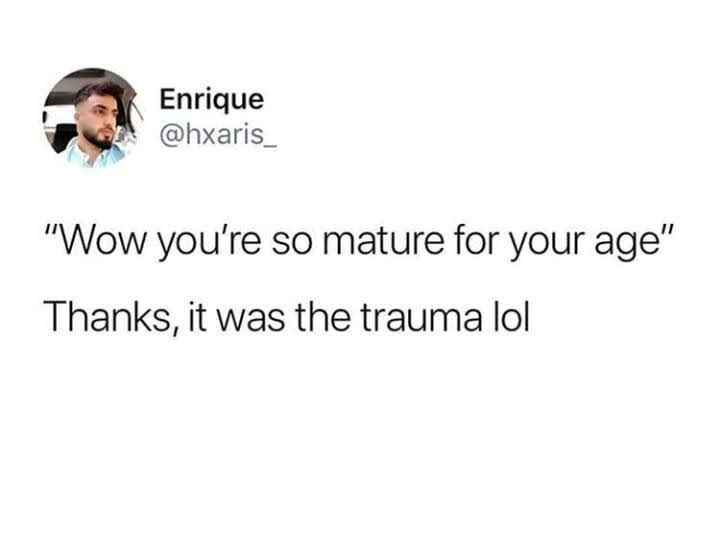
The meme is a humorous take on the phrase "you're so mature for your age" being said to someone who is actually experiencing trauma. The response "Thanks, it was the trauma" is a sarcastic and ironic way of acknowledging the praise, implying that the person's maturity is actually a result of their experience of trauma.
detailed-analysis (gemma3-27b-vision)
Okay, here's an analysis of the image, broken down into relevant theoretical sections. Since not all theories apply equally, I'll be selective in my approach.
Visual Description
The image is a screenshot of a Twitter/X post. It features a profile picture (a man with short, dark hair and a beard) and a username ("Enrique @hxaris_"). The content is a conversational exchange, formatted as a direct quote followed by a response. The quote reads: “Wow you’re so mature for your age.” The response is: “Thanks, it was the trauma lol.” The presentation is simple, with black text on a white background. The inclusion of "lol" suggests a casual, perhaps ironic or self-deprecating tone.
Foucauldian Genealogical Discourse Analysis
This short exchange is a fascinating point of entry for a Foucauldian analysis. The praise "Wow you're so mature for your age" isn't a neutral compliment. It creates a discourse around age and maturity. Foucault argued that knowledge and power are intertwined. This compliment, seemingly positive, operates within a system where being "mature" is considered desirable and "immaturity" is a fault.
The response, “Thanks, it was the trauma lol” radically disrupts this discourse. It points to the genealogy of that ‘maturity’ – that it's not a natural development but a production of traumatic experience. Trauma forces a premature confrontation with adult responsibilities, difficult emotions, and compromised innocence, resulting in behaviors and emotional states that are often labeled “mature.” The "lol" doesn't diminish the claim but highlights the absurdity of praising someone for coping with something horrible.
This disrupts the normalisation of "maturity" as a solely positive attribute. It reveals it to be a potential symptom of suffering. It illustrates how power operates through discourses – defining what is acceptable, desirable, and 'normal' and how those definitions are frequently built upon silences and the unacknowledged costs of societal structures.
Critical Theory
From a Critical Theory perspective (drawing from thinkers like Adorno, Horkheimer, and Marcuse), this exchange highlights the way seemingly benign social interactions can reinforce oppressive norms. The praise for "maturity" can be seen as a demand for conformity. Society often expects individuals, especially young ones, to act as if they have the emotional and cognitive capacity of adults.
The response subverts this expectation by exposing the hidden cost of that "maturity." It implicates the systemic forces – poverty, abuse, societal stressors – that contribute to trauma and, subsequently, premature adulthood. The "lol" functions as a cynical acknowledgment of this dynamic. The commenter isn't simply accepting the compliment; they are critiquing the social expectation that someone should be "mature" and revealing the damage done by the forces that require it. This is a subtle form of resistance to the status quo.
Postmodernism
From a Postmodern perspective, the exchange demonstrates the breakdown of grand narratives and the embrace of subjective experience. The compliment implies a universal standard of maturity. However, the response throws this standard into question. The "lol" signifies a rejection of a straightforward, sincere interpretation.
There's a playful deconstruction happening. The commenter isn't offering a definitive statement about trauma or maturity but offering a fragmented, ironic observation. It rejects the idea that there is a single, objective truth about development or that language can fully capture the complexity of experience. The focus shifts from a fixed definition of "maturity" to the individual's lived experience and its (often dark) origins. The exchange highlights the constructed nature of meaning and the instability of social categories.
Queer Feminist Intersectional Analysis
While not overtly stated, an intersectional lens can enrich the analysis. Trauma is disproportionately experienced by marginalized groups, including those identifying as LGBTQ+ and people of color. The response implicitly acknowledges this. The commenter's experience is likely shaped by systemic oppression, and their “maturity” is a survival tactic forged through navigating those systems.
The “lol” could be read as a way to cope with the absurdity and invalidation inherent in a society that praises resilience without addressing the root causes of suffering. The exchange subtly pushes against the expectation that marginalized individuals should "overcome" trauma and function "normally" without acknowledging the ongoing impact of systemic injustice. It’s a quiet assertion of the validity of their experience and a refusal to perform “maturity” on the terms dictated by a dominant, often oppressive, culture.
I hope this detailed analysis is helpful! Let me know if you’d like me to elaborate on any of these points.
simple-description (llama3.2-vision)
The meme is a tweet that uses a common phrase to express a sarcastic and relatable sentiment. The text reads: "Wow, you're so mature for your age" followed by "Thanks, it was the trauma I experienced as a child." The tweet is likely meant to be humorous and ironic, suggesting that the person's maturity is not actually due to their age, but rather the trauma they experienced as a child.
tesseract-ocr
oat Enrique ' x Page @hxaris_ “Wow you're So mature for your age” Thanks, it was the trauma lol