First Seen
2025-06-26T04:12:03.273280+00:00
simple-description (qwen3.5_2b-q8_0)
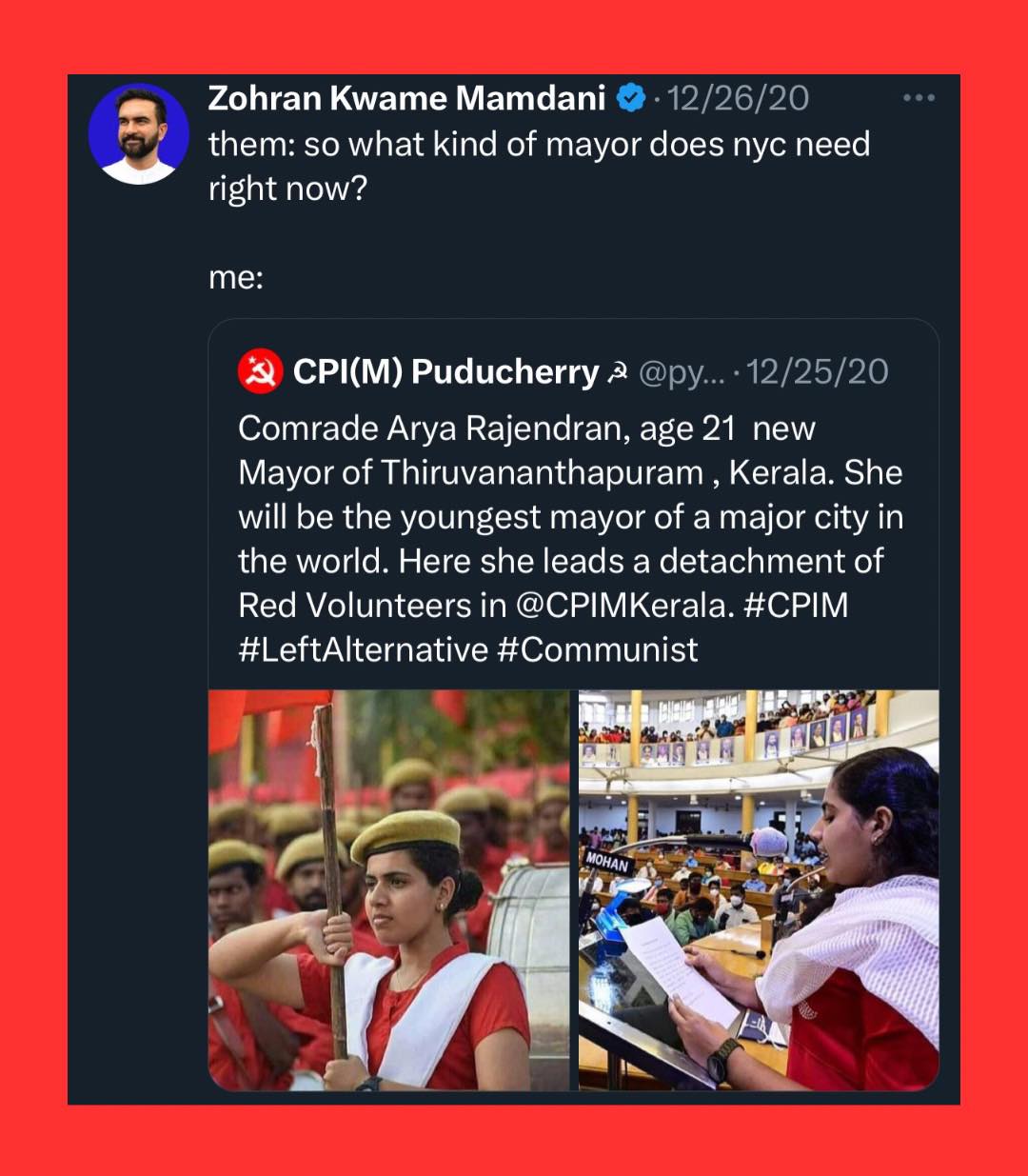
This political exchange mocks the notion that established leaders are required for governance, whereas leftist candidates prioritize revolutionary youth leadership over conventional positions of power. The reply reveals a candidate named Comrade Arya Rajendran, described in the post as "age 21 new Mayor of Thiruvananthapuram, Kerala," who is highlighted as leading a detachment of Red Volunteers. The visual elements include hashtags like #LeftAlternative and #Communist alongside photos of the young leader, visually framing her as a radical insurgent figure rather than a traditional mayoral candidate.
detailed-analysis (gemma3_27b-it-q8_0)
Okay, let's break down this meme from a leftist perspective, using the frameworks you've provided.
Visual Description
The meme consists of two parts: a tweet by Zohran Kwame Mamdani asking what kind of mayor New York City needs, and a response tweet from CPI(M) Puducherry, featuring a photo of Arya Rajendran, the newly elected (at the time) mayor of Thiruvananthapuram, Kerala, India. The photo shows Rajendran leading a group of uniformed "Red Volunteers." The volunteers are holding what appear to be flags and marching, suggesting a show of disciplined political force. The image is framed to emphasize Rajendran’s leadership and the collective action of the volunteers.
Marxist Conflict Theory
This meme is strongly rooted in Marxist conflict theory. Here's how:
- Class Struggle & Alternative Models: The meme presents Arya Rajendran – a young, communist mayor – as an implicit alternative to the perceived failings of capitalist governance in cities like New York. The question posed by Mamdani ("what kind of mayor does NYC need?") is framed to invite a response that contrasts with the typical, establishment-oriented political figures found in the US. Rajendran represents a political system (communist Kerala) operating under vastly different principles than the US, emphasizing collective ownership, social welfare, and reducing class disparities.
- Proletarian Revolution & Vanguardism: The "Red Volunteers" depicted in the image represent a visible manifestation of organized political action from below. The image evokes a sense of disciplined collective strength, which historically links to Marxist ideas about a "vanguard party" leading the working class in a revolutionary movement. While Kerala's communist party operates within a democratic framework, the visual of the volunteers still carries the symbolic weight of organized, determined popular power.
- Critique of Capitalist Urbanization: Implicitly, the meme critiques the effects of capitalist urbanization, which are often seen as exacerbating inequality, gentrification, and social alienation. The suggestion is that a communist mayor—focused on social welfare and equitable development—could offer a different path for cities.
Critical Theory
Critical Theory expands on Marxist principles to encompass broader power structures.
- Hegemony and Counter-Hegemony: The meme functions as a counter-hegemonic move. The dominant ideology in the US (and much of the West) is liberal capitalism. The meme challenges this hegemony by presenting a successful political model from outside the Western paradigm, suggesting alternative ways of organizing society and governance. The very act of posing Kerala’s mayor as a potential answer to NYC’s problems is a disruption to the normalized narratives of how cities should be run.
- The Role of the Intellectual: Mamdani’s question can be seen as an intervention by a public intellectual. He’s using his platform to introduce alternative political ideas and prompt discussion, challenging the status quo.
Foucauldian Genealogical Discourse Analysis
This analysis reveals how power operates in shaping the understanding of “good governance.”
- Discourse of "Effective Governance": The dominant discourse in the West often equates “effective governance” with free markets, privatization, and neoliberal policies. This meme disrupts that discourse by presenting a successful communist mayor as a viable leader.
- Genealogy of “Revolutionary Action”: The imagery of the “Red Volunteers” pulls from a genealogy of revolutionary movements, from the Paris Commune to the Russian Revolution. It re-articulates this historical imagery to demonstrate that alternative forms of political mobilization and collective action are possible.
- Power/Knowledge: The discourse around "youthful leadership" can often be co-opted by neoliberal politics (e.g., "young entrepreneurs"). However, the meme reclaims that concept and connects it to a radical political project.
Postmodernism (Less Directly Applicable, But Present)
While not central, there’s a subtle postmodern element:
- Deconstruction of "Universal" Models: The meme implicitly deconstructs the idea that there's one "right" way to run a city or a country. It challenges the notion that Western models of governance are universally applicable. The fact that a young, female communist mayor is thriving in India challenges Western conceptions of the “typical” political leader.
In conclusion, this meme is a powerfully concise statement of leftist political ideals. It uses the example of Arya Rajendran to offer a critique of capitalism, promote alternative models of governance, and challenge the dominant ideological narratives surrounding power and leadership. The use of visual imagery alongside the pointed question creates a provocative and thought-provoking message for those aligned with leftist principles.
simple-description (llama3.2-vision_11b)
This meme is a humorous take on the idea of a left-wing politician being elected as the mayor of a major city. The meme starts with a tweet from a user asking what kind of mayor New York City (NYC) needs, and the response is a joke about a 21-year-old communist activist being elected as the mayor of NYC. The joke is that the response is a serious proposal for a left-wing politician being elected as the mayor of NYC, with the tweet being a satirical commentary on the idea of a young left-wing activist being elected as the mayor of a major city.
detailed-analysis (gemma3-27b-vision)
Okay, here's a breakdown of the Twitter post, analyzed through the lenses you requested. I will skip sections that don't really apply.
Visual Description
The post contains a screenshot of a Twitter exchange. The top portion shows a user, Zohran Kwame Mamdani, asking "so what kind of mayor does nyc need right now?". Below that is a reply from the account CPI(M) Puducherry, showcasing a young woman in a red uniform leading a group of uniformed individuals. The image is a collage of 3 photos showing her in a marching formation and speaking at a podium. There are red flags and banners visible throughout. The composition suggests a display of organized political force and youthful leadership.
Marxist Conflict Theory
This post is deeply rooted in Marxist Conflict Theory.
- Class Struggle & Political Agency: The post explicitly positions this young woman, Arya Rajendran, as a "Comrade" and links to the Communist Party of India (Marxist) – CPI(M). This framing signifies a commitment to class-based politics and a rejection of liberal notions of neutral governance. The aim is not to present a broadly appealing figure, but a representative of a specific class interest – the proletariat or working class.
- Revolutionary Potential: Presenting a 21-year-old as the mayor of a major city is intended to convey the idea that a radical shift in power structures is not only possible but is actively happening. It presents youth as a force for change, challenging the established order.
- State as an Instrument of Class Power: The selection of Arya Rajendran as mayor is implicitly framed as a victory for the CPI(M) and its ideological goals. It suggests that the state, in this instance, is being utilized as a tool to advance the interests of the working class and challenge the dominance of other social classes.
- Hegemony and Counter-Hegemony: The post can be read as a counter-hegemonic act. By presenting a communist mayor, it challenges the dominant narrative surrounding political leadership, which is often associated with capitalism and neoliberalism.
Foucauldian Genealogical Discourse Analysis
Foucault’s genealogical approach examines how power operates through discourse, shaping our understanding of concepts and normalizing certain ways of thinking.
- Discourse of Youth & Leadership: The post constructs a discourse around young leadership. Traditionally, leadership positions are associated with experience and age. This post actively subverts that expectation, positioning youth as a source of strength and renewal. It creates a new discourse in which youth is seen as a positive trait for a leader.
- Normalization of Communism: The post strategically presents the CPI(M) and its ideology as a legitimate and effective force for political change. This normalization process is crucial for overcoming the negative stigma often associated with communism in many parts of the world.
- Power/Knowledge Nexus: The post links power (the position of mayor) with knowledge (the communist ideology and political awareness of the young leader). This demonstrates how knowledge is often used to legitimize and reinforce power structures.
- Discursive Formation of "Comrade": The use of "Comrade" isn’t simply a term of address. It actively constructs a specific relational dynamic – one of shared ideology, solidarity, and a commitment to collective action. It positions the mayor, and the party, outside the typical “political elite” framework.
Critical Theory
Critical Theory questions social structures and power imbalances.
- Challenge to Established Authority: The post implicitly challenges the status quo and conventional understandings of political leadership. The appointment of a young, communist mayor can be seen as a rejection of the existing power structures and a call for radical social change.
- Critique of Representation: The post highlights the importance of representation in politics. The selection of a young, female mayor from a historically marginalized group (communist background) can be seen as an attempt to address systemic inequalities and promote inclusivity.
- Deconstructing "Good Governance": The post implicitly challenges the dominant narrative of "good governance," which often focuses on economic growth and stability. By presenting a communist mayor, it suggests that alternative models of governance, based on socialist principles, are possible and desirable.
Let me know if you'd like me to elaborate on any of these points, or to explore other analytical frameworks.
simple-description (llama3.2-vision)
The meme is a screenshot of a tweet from a user named Zohran Mamdani, who is responding to a question about what kind of mayor New York City needs. The user is jokingly suggesting that the city needs a 21-year-old mayor from India named Comrade Arya Rajendran, who is a member of the Communist Party of India (Marxist) and has been elected as the mayor of Thiruvananthapuram, India. The tweet includes a photo of the young mayor.