First Seen
2023-05-10T21:03:35+00:00
simple-description (llama3.2-vision_11b)
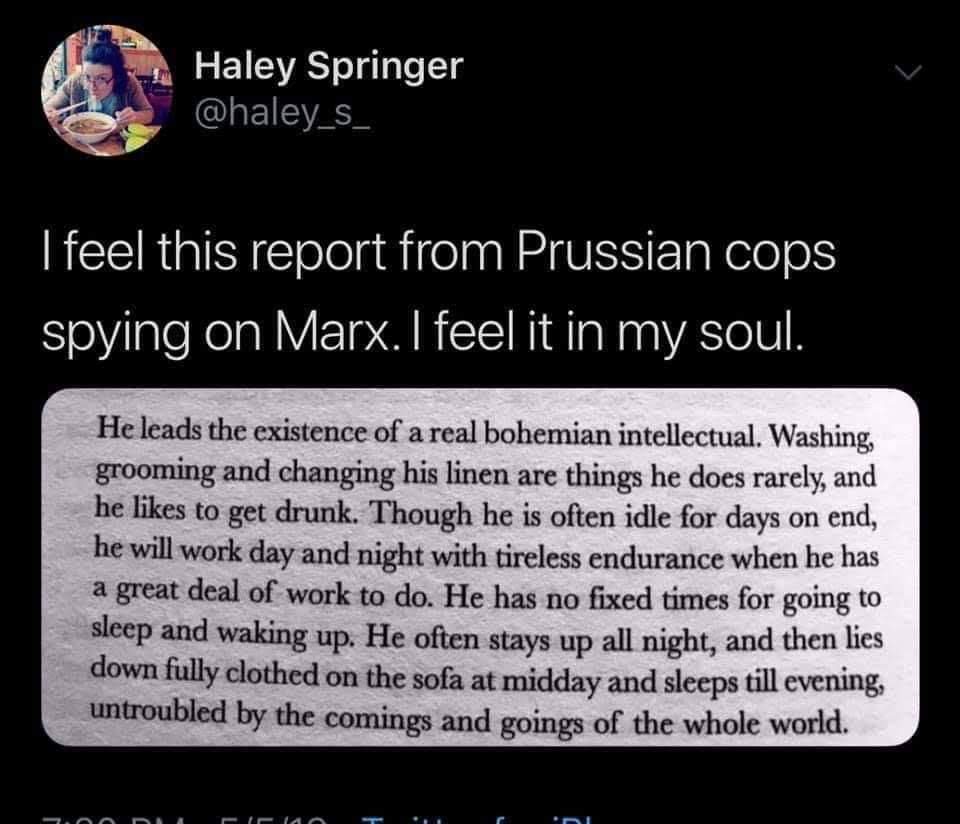
This meme is a satirical commentary on the left-wing perspective on the Prussian police's investigation of the The
detailed-analysis (gemma3-27b-vision)
Here's an analysis of the tweet and its contained text, broken down into sections as requested. Note that some categories are more applicable than others, and I’ll explain where a connection is tenuous.
Visual Description
The image is a screenshot of a Twitter post by Haley Springer (@haley_s_). The tweet states, “I feel this report from Prussian cops spying on Marx. I feel it in my soul.” Beneath the tweet is an image of text – likely a scanned or photographed document. The text appears to be a report, possibly from police surveillance. The font is old-style, suggesting a historical document. The framing is simple, focusing on the textual content. The user’s profile picture appears to be of a colorful, abstract image.
Foucauldian Genealogical Discourse Analysis
This snippet is rich for Foucauldian analysis. The very source of the text is paramount. It's not a self-presentation by Marx, but a description constructed by those in power—the Prussian police. This immediately signals a discourse of control.
- Power/Knowledge: The report isn't simply "reporting facts," it's producing a specific image of Marx. The act of observation (surveillance) creates the "truth" of who Marx is, according to the Prussian state. The details chosen—lack of grooming, erratic sleep schedule, constant work—aren’t neutral observations, but elements employed to frame him (possibly as dangerous, unreliable, or morally suspect).
- Discipline and Panopticism: This is a perfect example of surveillance as a disciplinary technique. The police don’t need to directly intervene; the knowledge they accumulate through observation allows them to categorize, judge, and potentially control him. The fact that Marx is aware he's being watched (or might be) is enough to influence his behaviour.
- Genealogy: Examining how this particular discourse emerged historically is vital. Why were these specific details of Marx's life considered important enough to record? How does it relate to broader strategies of state control over intellectuals and dissent? The report reveals how power operates through the construction of subjects, not simply through direct repression.
Critical Theory
This text directly relates to several aspects of Critical Theory, particularly concerning the construction of the “intellectual” and the role of surveillance in shaping public perceptions.
- Ideology: The report subtly conveys an ideology. By focusing on seemingly minor details (lack of grooming, irregular sleep), it paints a portrait of someone unconventional, perhaps even “degenerate” (through a 19th-century lens). This subtly delegitimizes him and his ideas.
- Domination & Control: The act of spying itself is a manifestation of power. It’s about knowing and therefore controlling. The state isn't interested in Marx’s intellectual work per se, but in managing a potential threat.
- The Public Sphere: The report represents a hidden layer of control over the “public sphere.” It reveals how power operates beneath the surface of public discourse, shaping perceptions and influencing narratives.
Marxist Conflict Theory
While the report isn't explicitly about class struggle, it is deeply intertwined with it.
- State as Instrument of Control: From a Marxist perspective, the Prussian police are an instrument of the ruling class, tasked with suppressing dissent and maintaining the status quo. Surveilling Marx is a way of protecting the interests of the dominant social order.
- Ideological Struggle: The report can be seen as a form of ideological warfare. By discrediting Marx (even through seemingly trivial details), the state aims to undermine his influence and protect its own ideology.
- The “Dangerous Intellectual”: The construction of Marx as unconventional and “bohemian” serves to categorize him as an outsider, a threat to the established norms of society. This categorization is a tactic used to justify repression and control.
Postmodernism
The postmodern aspects aren’t as pronounced, but still present:
- Deconstruction of “Truth”: The report offers a single, constructed “truth” about Marx. A postmodern analysis would question the authority of this report and highlight the fact that there are multiple possible interpretations of Marx’s life and work.
- Subjectivity & Perspective: The report is inherently subjective. It’s a particular perspective on Marx, filtered through the biases and assumptions of the Prussian police.
- Rejection of Grand Narratives: Postmodernism would challenge the idea that there is a single, universal "truth" about intellectuals or revolutionary movements. It would emphasize the fragmented, contingent, and unstable nature of knowledge.
Queer Feminist Intersectional Analysis
This is the most tenuous application, but still possible.
- Non-Conformity & Surveillance: Marx's "bohemian" lifestyle and disregard for conventional norms (lack of grooming, irregular schedule) can be seen as a form of non-conformity that invites scrutiny and control. Historically, marginalized groups (including LGBTQ+ individuals) have been subjected to similar forms of surveillance and control.
- Control of Bodies & Behaviour: The report focuses on Marx’s physical habits and behaviour, which aligns with feminist concerns about the policing of bodies and the regulation of social norms. The act of surveillance itself is about asserting control over individual bodies and behaviours.
- Intersectional Power Dynamics: The report reveals how power operates at the intersection of multiple social categories. Marx is targeted not only because of his political views, but also because of his perceived non-conformity.
In conclusion, this tweet and the contained report is a fascinating piece of historical documentation that offers rich material for a variety of theoretical analyses. The emphasis falls particularly strongly on Foucauldian, Critical Theory, and Marxist frameworks, as the text directly relates to themes of power, control, surveillance, and ideology.
simple-description (llama3.2-vision)
The meme is a tweet that expresses a sense of familiarity with a report from Prussian police officers who were investigating the activities of a person named Marx. The text of the report is presented in a box and is a humorous, satirical description of someone's daily routine. The text describes a person who is always working, but never actually accomplishing anything, and is always getting drunk and getting up to a few other things. The text is presented in a style that is meant to be humorous and satirical.
tesseract-ocr
SOWELL AS aes <a ae | feel this report from Prussian cops spying on Marx. | feel it in my soul. He leads the existence of a real bohemian intellectual. Washing, grooming and changing his linen are things he does rarely, and he likes to get drunk. Though he is often idle for days on end, he will work day and night with tireless endurance when he has a great deal of work-to do. He has no fixed times for going to sleep and waking up. He often stays up all night, and then lies down fully clothed on the sofa at midday and sleeps till evening, untroubled by the comings and goings of the whole world.